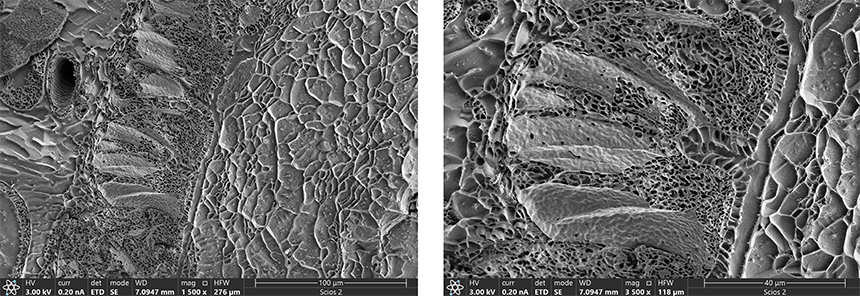
The Universitat de València (UV) and the company Syngenta have used high-resolution electron microscopy to characterise the effect of the Cry1Ca insecticidal protein from the bacterium Bacillus thuringiensis on the gut of larvae of the Egyptian cotton leafworm (Spodoptera littoralis), a pest that affects numerous crops.
The study, published in Journal of Invertebrate Pathology, shows that at low doses the intestinal damage is severe but reversible, whereas continuous exposure is lethal, and it introduces a new way of studying these toxins by observing the intact larva, without dissection.
Cry proteins from Bacillus thuringiensis (Bt) are one of the cornerstones of biological pest control and of the genetically modified crops designed to resist insects. They act on the midgut of the larvae: once ingested, they are activated and perforate the cells of the intestinal epithelium, ultimately killing the insect. However, many details of this process—and of the insect's ability to recover—had not been observed under conditions close to the natural ones.
To address this, the team combined cryogenic scanning electron microscopy (cryo-SEM) and transmission electron microscopy (TEM) on whole, undissected larvae, thereby preserving the tissue architecture and the real organisation of the gut. The observations show that sublethal doses inhibit growth without causing mortality and produce intense destruction of the epithelium which, however, regenerates appreciably within 48 hours. By contrast, continuous exposure to lethal doses causes irreversible tissue destruction. The study also directly visualises how the toxin breaks down the peritrophic matrix—the barrier that protects the gut—allowing the insect's own bacteria to invade normally sterile compartments, a phenomenon consistent with the septicaemia previously described in this species.
“Observing the intact larva, without dissecting it, has allowed us to see in unprecedented detail how the toxin breaks the gut barriers and how the insect's own bacteria end up invading tissues that are normally protected,” explains Joel González-Cabrera, researcher at the Department of Genetics and the BIOTECMED institute of the UV, director of the SCSIE and corresponding author of the study. “But we have also found that, after a brief exposure, the gut can regenerate—something that is key to understanding how these pests survive and may develop resistance.”
Beyond its biological results, the work proposes a methodological framework applicable to the study of other toxins that act on the insect digestive tract—such as Vip or Cyt proteins, or RNA interference-based technologies—which may contribute to the design of more effective and durable pest-control strategies.
The research is the result of collaboration between the Universitat de València and Syngenta—whose researcher Giovambattista Depietra is a co-author of the study—within a RISE (Research and Innovation Staff Exchange) action of the Marie Skłodowska-Curie Actions under the European Union's Horizon 2020 programme. These actions are designed precisely to foster cooperation and the exchange of research staff between academia and industry, and this article exemplifies the kind of knowledge that emerges from such public–private collaboration.
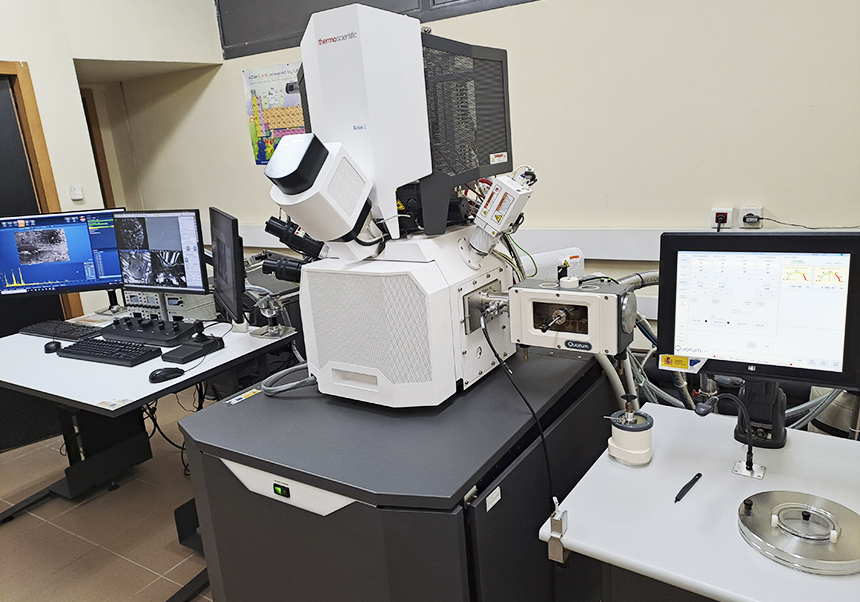
The study also illustrates the role of the Central Service for Experimental Research (SCSIE) of the Universitat de València as a provider of high-quality scientific and technical services. The ultrastructural characterisation was carried out at the SCSIE Microscopy Section using advanced cryo-electron microscopy equipment, and two of its specialists, María Teresa Mínguez and Enrique Navarro Raga, are co-authors of the work. The result shows how the UV's central services not only provide technical support but also play a decisive role in generating knowledge and transferring it to the scientific community and the business sector.
Reference: Depietra, G., González-Martínez, R. M., Mínguez, M. T., Navarro Raga, E., González-Cabrera, J. (2026). Assessing the impact of Cry insecticidal proteins from Bacillus thuringiensis on the midgut of Spodoptera littoralis (Boisduval). Journal of Invertebrate Pathology, 219, 108715. https://doi.org/10.1016/j.jip.2026.108715
Images: