Titol: Supernova Remnants as Probes of Massive Star Evolution and Core-Collapse Explosions
Lloc: Seminari del DAA. Edifici Investigació Jeroni Muñoz, planta quarta, a Burjassot.
Dia: divendres, 24 de maig de 2026. Hora: 12:00.
Resum:
Core-collapse supernova remnants (SNRs) offer a powerful diagnostic of massive-star evolution and explosion physics. Their complex morphologies and chemical inhomogeneities retain signatures of the supernova (SN) engine, including asymmetries, nucleosynthetic yields, and compact-object formation. In young remnants (<5000 years), the debris still preserves this early "memory", while the large-scale structure reflects interactions with the circumstellar medium (CSM) shaped by the progenitor's mass loss and, potentially, binary evolution. Studying SNRs is therefore essential not only for understanding SN physics and the mechanisms that trigger explosion, but also for probing the final fate of massive stars and the poorly understood processes governing late-stage mass loss.
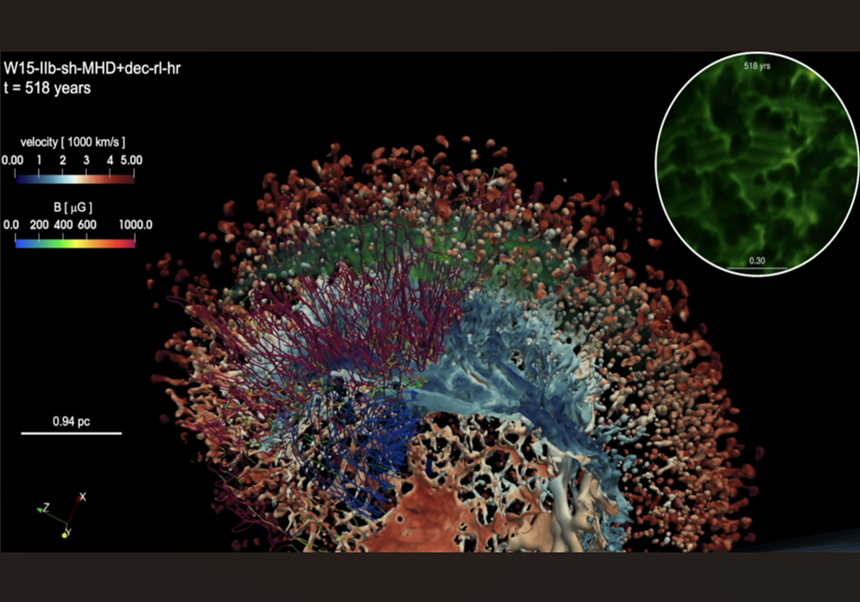
In this talk, I will review recent progress in modeling young to middle-aged core-collapse SNRs, based on simulations of neutrino-driven explosions evolved self-consistently from core collapse to remnant ages of several thousand years. I will highlight how these models, when confronted with multi-wavelength observations, can disentangle explosion physics from environmental effects. Particular emphasis will be placed on well-studied systems such as Cassiopeia A (now revealed in unprecedented detail by JWST) and SN 1987A, including the emerging evidence for its compact remnant and its evolving interaction with the surrounding debris.