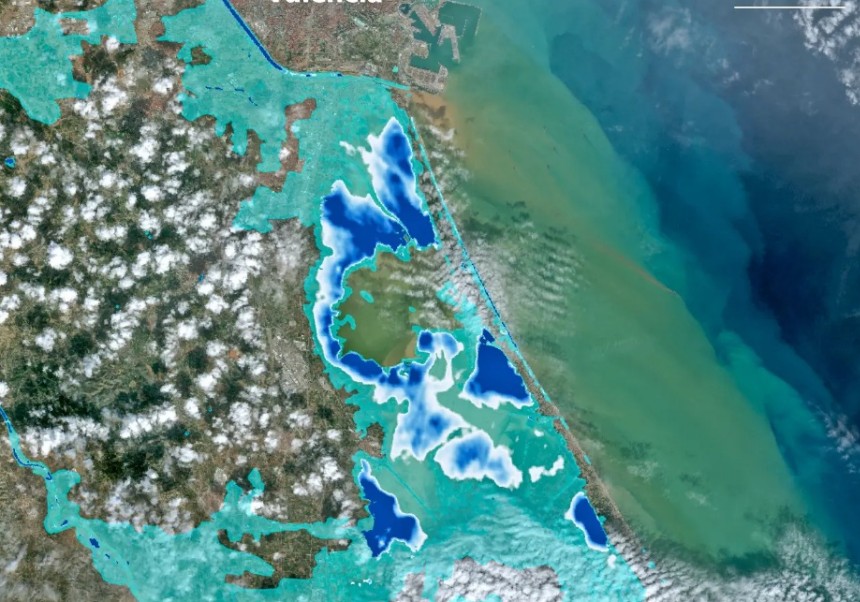
A study reveals how global warming increased both rainfall intensity and the total spatial extent of the storm of 29 October 2024
The work, published in Nature Communications, is the first to assess the role of climate change in the internal dynamics of this meteorological phenomenon
On 29 October 2024, unprecedented rainfall affected southeastern Spain. In some locations, the volume of precipitation exceeded the annual average within just a few hours. A new study led by the University of Valladolid (UVa) and the Spanish State Meteorological Agency (AEMET), in collaboration with researchers from the Spanish National Research Council (CSIC), an institution affiliated with the Ministry of Science, Innovation and Universities, quantifies for the first time the alterations in the internal structure of the storm induced by climate change. These changes intensified precipitation rates by 20%, expanded by 55% the area affected by rainfall exceeding 180 mm, and increased the total rainfall volume in the Júcar River basin by 19% compared to preindustrial conditions.
In October 2024, southeastern mainland Spain experienced intense rainfall associated with a cut-off low (DANA, for its Spanish acronym), fueled by the advection of very warm and humid air from the Mediterranean Sea. The rainfall particularly affected the province of Valencia, with extreme cases such as the municipality of Turís, where the meteorological station recorded precipitation exceeding the annual average (771 mm) in just 15 hours. In addition, accumulations surpassed the highest one-hour rainfall record ever observed in Spain, reaching 184 mm.
The new study published in Nature Communications, involving researchers from the Desertification Research Centre (CIDE, CSIC–UV–GVA) and the Pyrenean Institute of Ecology (IPE-CSIC), uses high-resolution simulations to determine the influence of climate change on the storm’s convective dynamics—the process by which precipitation forms following the rapid ascent of warm, moist air from the sea to the upper layers of the atmosphere.
The data show that Mediterranean sea surface temperatures exhibited an anomaly of 1.2 °C above normal, leading to enhanced atmospheric moisture content. As a result, precipitation intensity increased by 20% per degree of sea warming; in other words, under a climate without anthropogenic change, rainfall would have been up to one-fifth less intense. This increase even exceeds the Clausius–Clapeyron scaling, which describes how each degree Celsius of air temperature rise allows the atmosphere to hold approximately 7% more water vapor.
“Sea surface temperature acted as fuel, amplifying the convective available potential energy of the storm through stronger updrafts and changes in cloud microphysical activity,” explains Carlos Calvo, lead author of the study and current researcher at CIDE.
From global to local
The researchers analyzed the observations using a very high–spatial-resolution pseudo–global warming (PGW) approach, which allowed them to assess the contribution of climate change. “We studied different internal components of the storm using high-resolution (1 km) simulations applying this methodology,” Calvo clarifies.
This system operates analogously to a digital twin: after reconstructing the meteorological conditions that characterized the DANA, a forcing is applied to remove the accumulated global warming since the preindustrial era. This enables researchers to compare two scenarios—the October 2024 storm under present-day climate conditions and a reconstruction of the same event without the effects of climate change. “This methodology allows us to quantify how global warming has influenced an extreme meteorological event,” he adds.
The models used in the study overcome the limitations of traditional climate change attribution approaches, which are largely statistical and focus on surface impacts using predominantly observational data, thereby preventing analysis of how climate change affects the storm’s internal dynamics. Moreover, “thanks to the high resolution of the simulations, the methodology allows us to quantify the different components of a convective system and examine how climate change influences each of them,” highlights meteorologist and AEMET researcher Juan Jesús González Alemán.
The methodology employed demonstrates that nonlinear processes are involved in the impact of climate change on the atmospheric mechanisms responsible for the rapid ascent of warm, moist air in convective systems. “This is due to large increases in latent heat release and updraft strength triggered by small increases in evaporation and water vapor fluxes,” explains María Luisa Martín, professor and researcher at the University of Valladolid.
“What is most interesting about the study is that our experiments allow us to quantify the alterations occurring in the main physical processes involved in an extreme meteorological event of this nature, even at the scale of cloud microphysics. This approach had never before been applied to such an event; it is the first time for the Valencia DANA, and it allows us to state that the attribution of the magnitude of its torrential rainfall to climate change—both in intensity and affected area—is physically robust and coherent,” adds Amar Halifa, researcher at IPE and the CSIC Interdisciplinary Thematic Platform on Climate and Climate Services (PTI Clima).
More intense and complex storms
The Sixth Assessment Report of the Intergovernmental Panel on Climate Change (IPCC) indicates that global warming during the industrial period has reached approximately 1.3 °C. This increase enhances the atmosphere’s capacity to hold water vapor, leading to greater global precipitation.
The results of the new study reinforce IPCC conclusions by indicating that climate change may intensify the occurrence of flash floods in the western Mediterranean region. In the specific case of the DANA, it increased precipitation rates by 20% and expanded by 55% the area affected by rainfall.
In this context, extreme events in the western Mediterranean may be evolving toward scenarios of greater intensity as a result of global warming, with the formation of more virulent and complex storms. “These findings highlight the urgent need to implement effective adaptation strategies, including improved monitoring and forecasting of these phenomena, as well as revisiting urban planning to address increasing hydrometeorological risks in a rapidly warming world,” concludes César Azorín, principal investigator of the Climate, Atmosphere and Ocean Laboratory (Climatoc-Lab) at CIDE and co-author of the study.
The study led by UVa and AEMET, in collaboration with CSIC, also involved researchers from the Complutense University of Madrid (UCM), ETH Zurich (Andreas F. Prein), and the Institute of Atmospheric Sciences and Climate, ISAC-CNR (Mario Marcello Miglietta).
Calvo-Sancho, C., Díaz-Fernández, J., González-Alemán, J.J., Halifa-Marín, A., Miglietta, M.M., Azorin-Molina, C., Prein, A.F., Montoro-Mendoza, A., Bolgiani, P., Morata, A., Martín, M.L. (2026) Human-induced climate change amplification on storm dynamics in Valencia’s 2024 catastrophic flash flood. Nature communications. https://www.nature.com/articles/s41467-026-68929-9
CIDE Communication