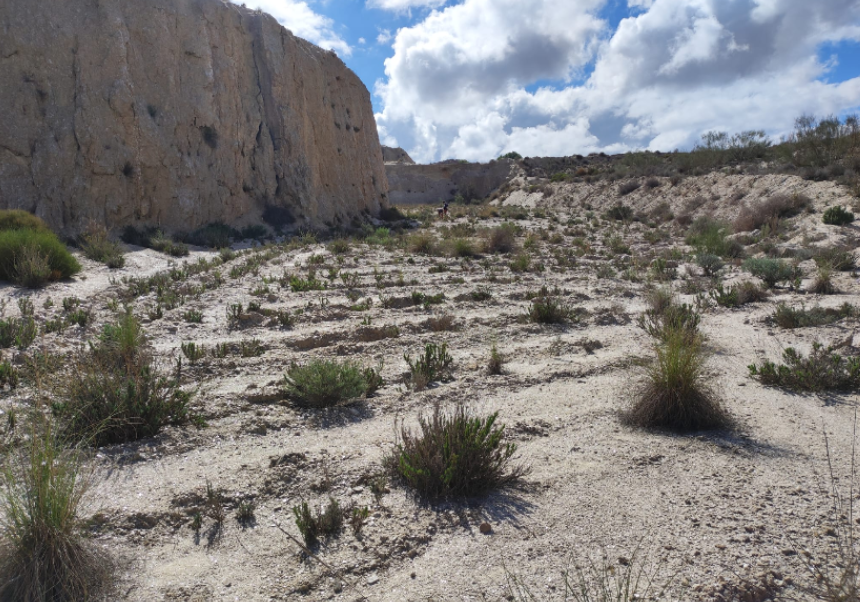
A study led by the Centre for Research on Desertification (CSIC-UV-GVA) analyses the ecological restoration of former gypsum mines in areas of Almería and Granada
The results reveal that restoring an ecosystem involves not only planting different plant species, but also rebuilding their relationships. After 13 years, half of these relationships had been restored
Restoring a damaged ecosystem is not just a matter of planting different species of plants, but of rebuilding the relationships between them. This is one of the conclusions of a study led by the Centre for Research on Desertification (CIDE), a joint centre of the Spanish National Research Council (CSIC), the University of Valencia (UV) and the Valencian Regional Government, published in the prestigious Journal of Applied Ecology. The researchers compared restored ecosystems in former gypsum mines in Almería and Granada with other natural environments to assess whether interactions between plants had been re-established after 13 years of intervention. The results show that half of the relationships had been re-established after this period, with no differences observed between the restoration methods used.
Traditionally, many ecosystem restoration projects focus on the selection of plant species and the improvement of physical soil conditions. However, ignoring interactions between species limits long-term success. Processes such as competition for resources or facilitation determine which species manage to establish themselves and persist. “For decades we have assessed restoration by looking at which species are present, but that only tells part of the story,” says Miguel Verdú, a CSIC researcher at CIDE who is leading the study.
Ecological restoration aims to recover degraded or destroyed ecosystems not only by planting species, but also by reactivating ecological processes and rebuilding functional networks. This study highlights that ecosystem recovery arises from complex networks of interactions between organisms. The study compared restored plant communities in former gypsum mines at Sorbas (Almería) and Escúzar (Granada) with nearby reference ecosystems to assess whether, after 13 years of restoration, key interactions between plants had been re-established. To this end, they carried out field sampling to quantify the frequency and the sign—positive (facilitation) or negative (competition)—of the interactions.
Facilitation, key to extreme environments
In arid and highly degraded environments, facilitation between plants is key: so-called ‘nurse plants’ create favourable microhabitats, increasing the survival probability of other species. Without facilitation, many fail to establish themselves in extreme conditions. “Interestingly, this same pattern of facilitation was also observed in the restored areas, where more positive than negative interactions were established. These results support the idea that facilitation plays a key role in ecological restoration, especially in disturbed environments such as the mining sites analysed,” the researchers highlight.
This study shows that facilitation occurs regardless of the type of restoration carried out, whether multiple species are sown or seedlings of host species are planted. Thus, they observed that, after 13 years, approximately half of the plant interactions observed in the natural area were restored with the same sign in the restored areas, both in the seed-based method (47%) and in the seedling-based method (57%). The interactions that were not restored were mostly positive in the natural area, but became neutral in the restored areas, losing their beneficial effect on the species.
“The shift from positive interactions to neutral ones may indicate that facilitation processes have not yet fully developed after 13 years of restoration,” the research team argues. Another hypothesis is that the decline in positive interactions in restored habitats could be due to a reduction in environmental stress (from soil preparation and initial irrigation), which reduces the need for plants to help one another.
More precise and effective restorations
The study emphasises that limiting the analysis to pairwise interactions oversimplifies ecological reality. Their approach, based on identifying interactions between more than two species, better captures the complexity underlying ecosystem recovery. “We observed a key difference when including higher-order interactions, those involving a third species,” recalls Verdú. The researchers also highlight the importance of incorporating a dynamic perspective. Analysing how interactions change over time and space allows for a better understanding of the mechanisms underpinning ecological stability and resilience.
This knowledge paves the way for more precise restoration strategies, capable of harnessing positive interactions between species, optimising plant combinations and increasing the effectiveness of interventions, particularly in arid ecosystems – veritable ‘natural laboratories’ for studying how they adapt to climate change. The ultimate goal is to prevent restoration projects from resulting in artificial and fragile systems. “Restoring an ecosystem is not just about reintroducing species, but about rebuilding the relationships that sustain them,” concludes Miguel Verdú. “Only in this way can we create systems that are truly resilient to global change.”
The study involves the National Institute for Agricultural and Food Research and Technology (CSIC); the Institute of Particle Physics (CSIC-UV); the Universities of Granada and Almería; and the Swiss Federal Institute for Forest, Snow and Landscape Research.
Johannes Hirn, Verónica Sanz, Juan Lorite, Fabián Martínez-Hernández, Antonio Jesús Mendoza-Fernández, Juan F. Mota, José Antonio Navarro-Cano, Francisco Javier Pérez-García, Jorge Prieto-Rubio, Ricardo Sánchez-Martín, Miguel Verdú. Evaluating the restoration of plant ecological interactions in gypsum mines with species co-occurrences analyses. J Appl Ecol. 2026;63:e70397. DOI: http://dx.doi.org/10.1111/1365-2664.70397
CIDE Communication