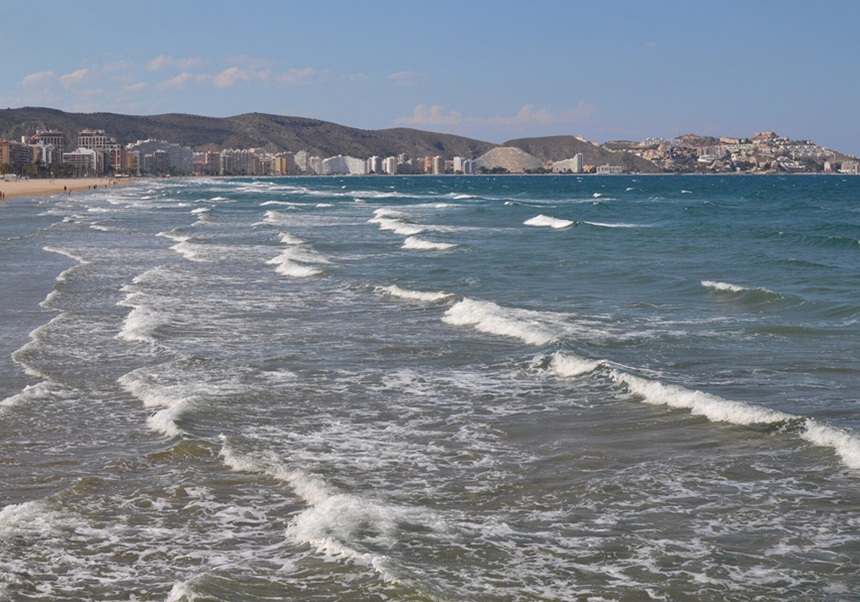
The opening event will address climate change, extreme weather and territorial resilience in the Mediterranean
The University of Valencia’s Master’s Degree in Techniques for Environmental and Territorial Management will hold its opening scientific event for the 2026-2027 academic year on 29 October 2026.
The central event will be the lecture ‘From climate knowledge to territorial resilience: science, extremes and decisions in a changing Mediterranean’, delivered by Dr Samira Khodayar Pardo, Head of the Meteorology and Climatology Area at the Mediterranean Centre for Environmental Studies (CEAM).
The event is initially planned for the morning at Cullera Town Hall Auditorium. The final venue, timetable and detailed programme remain subject to confirmation and may change, including the possibility of holding the event at the University of Valencia’s Faculty of Geography and History.
Information is subject to confirmation. Please check the official Master’s degree website regularly and follow @depgeouv on Instagram for the confirmed venue, timetable, registration process and any changes to the programme.
Science for anticipating climate extremes
The Mediterranean is one of the world’s principal climate-change hotspots. Rising temperatures, increasingly complex extreme weather and climate events, and the high exposure of communities, cities, ecosystems and economic activities require a reassessment of how territories are analysed, planned and managed.
Dr Samira Khodayar Pardo will discuss atmospheric and marine heatwaves, droughts, extreme rainfall, flooding and compound or cascading events. Particular attention will be paid to translating scientific research into effective capacity for anticipation, preparedness and territorial response.
The lecture will present CEAM research ranging from the evolution and physical mechanisms of Mediterranean extremes to observation, modelling and impact assessment. It will also cover observation networks, high-resolution urban modelling, Mediterranean monitoring, climate scenarios and compound risks.
The research combines observational data, field experiments, high-resolution modelling and advanced diagnostic techniques to examine interactions between land, vegetation, atmosphere and sea, improve understanding of extreme events and provide useful evidence for climate resilience and public policy.
From climate knowledge to decision-making
A central aim is to consider how climate-change diagnosis can develop into science focused on action and decision-making. Climate information has real value when it reduces vulnerability, anticipates impacts and supports responses tailored to each territory.
This approach is directly aligned with the Master’s degree, which combines environmental and territorial knowledge with analytical, planning and management techniques. Climate change affects spatial and urban planning, natural resources, hazards, ecosystems, infrastructure, economic activity, tourism and quality of life.
Cullera as a coastal territory and learning environment
If Cullera is confirmed as the venue, the event will place scientific discussion within a coastal municipality facing major environmental and territorial challenges.
Tourism pressure, beach and natural-area management, exposure to extreme events, urban sustainability and coastal adaptation make Cullera a particularly valuable setting in which to examine environmental change along the Mediterranean coast.
The session will include territorial context provided through the Chair of the City of Cullera and the Cullera Territorial Tourism Observatory, two initiatives strengthening institutional cooperation between Cullera Town Council and the University of Valencia.
The Cullera Territorial Tourism Observatory: evidence for territorial management
The Cullera Territorial Tourism Observatory, available at https://observatoricullera.uv.es/, is an open platform for collecting, organising and analysing local socioeconomic and territorial information. It operates within the Chair of the City of Cullera, promoted by Cullera Town Council and the University of Valencia with the participation of the Inter-University Institute for Local Development.
The Observatory turns regularly collected data into accessible indicators and bulletins. Information is organised into economic indicators covering productive sectors, employment, income and tourism; social indicators covering population, demographic structure and services; and environmental indicators concerning beaches, the Albufera Natural Park, Serra de les Raboses, the River Xúquer and pressures resulting from human activity.
Environmental indicators are also connected with the Sustainable Development Goals and the 2030 Agenda. The Observatory therefore provides structured evidence for territorial diagnosis, municipal planning, sustainability, tourism management and public decision-making.
Its work directly relates to the degree’s content, including indicator analysis, database management, cartography, local process analysis and knowledge transfer to public authorities. Each year, several Master’s students undertake external placements at the Observatory, applying territorial and environmental analysis to outputs that support local management.
An opening event aligned with the degree’s educational model
The event has been designed as a day of advanced learning, knowledge transfer and engagement with place. The lecture will be followed by a discussion with students and teaching staff on the scientific, social and territorial implications of climate extremes.
The session will strengthen the links between research and professional application, integrated analysis of environmental and territorial systems, current climate-change knowledge, direct engagement with leading researchers, institutional cooperation, learning through real problems and knowledge transfer into public policy.
Participation and free transport
If Cullera is confirmed, the Chair of the City of Cullera will fund return coach transport from Valencia. Travel will be free, with places allocated in this priority order: first, students on the Master’s Degree in Techniques for Environmental and Territorial Management; second, students on the Bachelor’s Degree in Geography and the Environment; and third, other people interested in the subject matter, subject to availability.
The registration process, number of places, departure point and time, and participation arrangements will be announced on the official Master’s website and on Instagram at @depgeouv.
Free transport is conditional on Cullera being confirmed as the venue and on seat availability.
Provisional programme
9.30 am: arrival and welcome. 10.00 am: institutional opening and presentation of the Master’s degree. 10.15 am: presentation of cooperation with the Chair of the City of Cullera and the Observatory, and territorial context. 10.30 am: opening lecture by Dr Samira Khodayar Pardo. 12 noon: discussion and open questions. 1.00 pm: scientific networking session for students, teaching staff, speaker and partner organisations. 2.30 pm: close and, if held in Cullera, return travel to Valencia.
The programme is provisional and may be amended before the event.
Institutional partnership and co-funding
The event is promoted by the Master’s Degree in Techniques for Environmental and Territorial Management and the Chair of the City of Cullera, with the participation of the Cullera Territorial Tourism Observatory and CEAM.
It is co-funded by the Vice-Dean’s Office for Culture and Student Participation at the University of Valencia’s Faculty of Geography and History. If Cullera is confirmed, the Chair of the City of Cullera will cover collective transport, the guest speaker’s participation and venue arrangements.
Provisional practical information
Event: opening scientific session for the 2026-2027 academic year
Title: ‘From climate knowledge to territorial resilience: science, extremes and decisions in a changing Mediterranean’
Speaker: Dr Samira Khodayar Pardo
Provisional date: 29 October 2026
Provisional time: 9.30 am to 2.30 pm
Planned venue: Cullera Town Hall Auditorium
Alternative venue: Faculty of Geography and History, University of Valencia
Format: in person
Registration: details to be published
Transport to Cullera: free of charge, subject to seat availability
Priority order: Master’s students, Bachelor’s students in Geography and the Environment, and other interested participants
The venue, programme and participation arrangements remain subject to confirmation. Updated information will be published on the official Master’s degree website and on Instagram: @depgeouv.