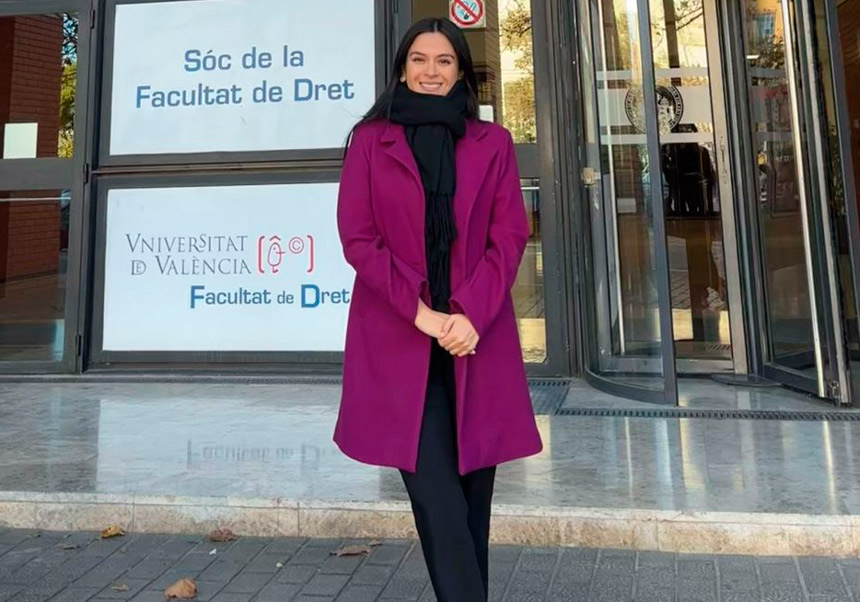

The student, Silvia Hoyos has realised her Final Project Degree about the Colombian consumer law and the withdrawal figure; a right in the Spanish law called ‘withdrawal’.
29 september 2017
Title: The vulnerability of the consumer to exercise the right of withdrawal in the purchase of air tickets through non-traditional or distance methods in Colombia against the right of withdrawal in Spain.
Author: Silvia Hoyos
The withdrawal right was recognised for the first time in the Colombian legal order in the 41 article of the 3466 of 1982 Decree, which empowered consumers to acquire goods and services through financing systems to exercise their power of withdrawal in respect of a validly concluded contract, a power that contemplated a time-limit for their exercise, as well as the observance of the legal requirements.
The aforementioned regulation has remained in force for more than twenty years. However, due to the technological evolution and its incidence in the distribution channels and commercialization of goods and services, methods of negotiation between consumers and market agents (producers and suppliers) were transformed by incorporating new forms of sales using non-traditional methods or distance (Internet, telephone channels, among others).
In this context, the Colombian legislator saw the need to regulate this type of conventions by doing it through a new and novel regime, the so-called "Consumer Statute", normative developed through an ordinary law 1480 of 2011 issued by the Congress of the Republic in exercise of its legislative powers conferred by article 150 of the 1991 Political Constitution.
- With the entry into force of the Consumer Statute the retracting right was reinvented, generating relevant changes in the matter.
- The scope of application was extended to other legal businesses.
- The term for the exercise went from 2 days to 5 business days, where Saturdays, Sundays and holidays are not taken into account
- Decree 3466 of 1982 enabled any of the parties to exercise retracting. For its part, the Statute granted such power only to consumers.
The rules in the Consumer Statute are governed by the ‘pro consumer’ principle which recognizes that the consumer is the weak part of the consumer relationship due to lack of knowledge of the objective elements of goods and services
In this legal context, we can observe that the standard rules in the Consumer Statute in its essence are protectionists and are under the ‘pro consumer’ principle which recognises that the consumer is the weaker party in the consume relation, due to the lack of knowledge respect to the goods and services. For this reason, ‘the Statute seeks to restore symmetry between the parties, giving users tools that allow them to guarantee their rights.’
The restoration of consumer rights is not only observed in the Colombian sphere, but also in Spanish, both the national and community legislator, have gradually improved and extended the guarantees granted to consumers, as evidenced by Directives issued after the Treatment of Maastricht on February 7, 1992. Under this same context, it is observed that by community provision and the adequate compliance in the Spanish legal system, the term for the exercise of the right of withdrawal, which increased from seven (7) days to fourteen (14) calendar days.
All in all, it is noted that consumer rights, both in the Colombian and Spanish legal systems, enjoy nuances different from any other type of regulation and constantly seek to optimize the conditions of consumers in the market and the symmetry in the relationship.
The Final Project Master Degree analyses why the Resolution 1375 of 2015 diminish the guarantees of Colombian consumers in their right of withdrawal comparing to the Colombian and Spanish legislations
And it is in this legal context that the prerogatives of consumers evolve. However, in the Colombian legal system this changed as of June 2015, when the director of the Special Administrative Unit of the Civil Aeronautics of Colombia (Aero civil) proffered the Resolution No. 1375 of 2015, which modified the established guidelines In this light and according to the criterion of that entity, had the power to reform the right retraction of passengers who purchased air tickets through the virtual platforms of the airlines, generating a lack of protection to the rights of consumers.
Consequently, the present Final Project Master Degree has the purpose of resolving the next questions: is it legally valid to apply the Resolution No. 1375 of 2015 issued by the Civil Aeronautics of Colombia in the cases of the right of withdrawal in the purchase of airline tickets through non-traditional or remote methods and what consequences derive from the application of the special regulation in contrast to the legal regulations?
In order to solve the legal approaches indicated above, the methodology used for the integral development of this TFM is that of an exegetic-critical nature, through which it is intended to analyse the regulations of the retracting right, make a comparison with each other and, in turn, the right of withdrawal enshrined in the Spanish legal system to finally establish why Resolution 1375 of 2015 undermined the guarantees of consumers and users in the exercise of the right of withdrawal.