On Thursday, 18th December 2025, a seminar entitled ‘Debates and controversies surrounding 18th-century chemical terminology: The case of oxygen and arxîcayo’ was held by Alberto Rodríguez Lifante, professor at the University of Alicante and former student of the Master's Degree in History of Science and Scientific Communication. The seminar was held in collaboration with the Catalan Society for the History of Science and Technology (SCHCT).
The seminar was based on the final master's thesis (TFM), which focused on analysing the debates surrounding the adaptation and accommodation of the new chemical nomenclature that emerged at the end of the 18th century. This TFM received the SHCTC 2025 award in its academic category and analysed the creation and debates linked to the term arxîcayo proposed by the surgeon Juan Manuel Guillermo de Aréjula as an alternative to oxygen. The thesis sought to investigate what insights the current debate in the history of science offers into a linguistic review of chemical terminology through the proposal of arxîcayo. It also aimed to study the circulation and reception of this term until the 19th century.
The research presented drew on primary and secondary sources. Among these sources were lexicographical works such as Español-Ingles by Henry Neuman and Lengua Castellana by Pedro Labernia, as well as translations of the 1787 French work Méthode de nomenclature chimique, Reflexiones sobre la nomenclatura química by Manuel de Aréjula from 1788, and the translation Nomenclatura química from 1788 by Pedro Gutiérrez Bueno. He also discussed studies on Aréjula and his work, the history and terminology of chemistry, the reception of Lavoisier in Europe, and 18th- and 19th-century medical dictionaries. He mentioned that the lexicographical works are included in TeLeMe and in the digital newspaper archives of the national libraries of Spain and France.
Rodríguez explained the variety of areas in which chemistry was practised in the 18th century, as it had applications in mining, the textile industry, the military and pharmaceuticals. Until 1787, substances were named after the place where they were discovered, the person who discovered them, or their colour, which caused various problems, so it was necessary to regulate the nomenclature to be shared by the scientific community.
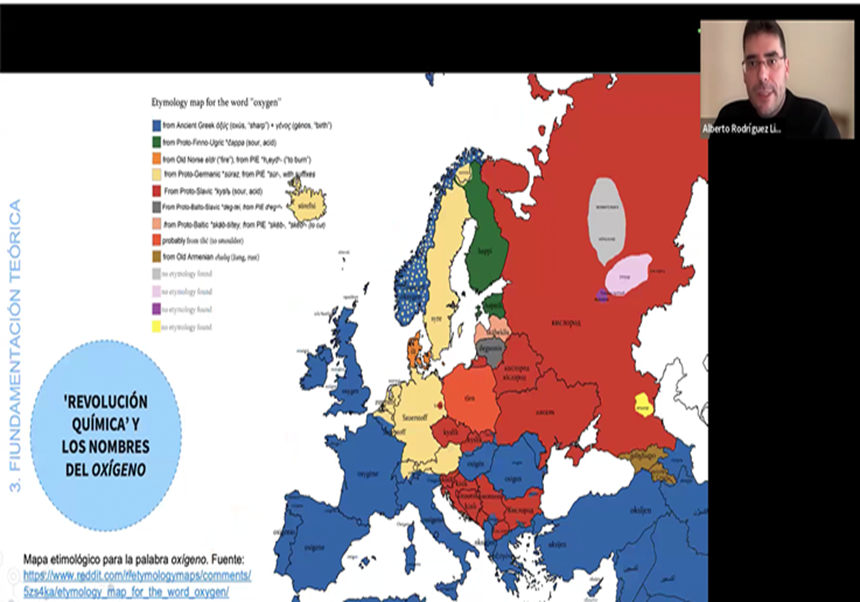
Etymologically, oxygen comes from ὀξύς, which means acid, and γξνής, which means generator or producer. This terminology was intended to reflect the idea that it was a constituent present in all acids. Languages adapted the nomenclature as a loanword, counter-loanword, or calque, and in the case of Italian, Spanish, and English, they adapted it to sound like their own language.
Professor Rodríguez mentioned the surgeon Aréjula, who was part of a group of people promoted by the Spanish crown to undertake scientific trips to France to learn about medicine, surgery, pharmacy, mining and metallurgy, and to return with this knowledge. He made two trips, one to Paris between 1787 and 1789 and another to Paris and London between 1789 and 1791. According to Aréjula, the term oxygen was not ideal phonetically and morphologically for Spanish, so he proposed arxîcayo. This proposal, as shown by Alberto Rodríguez, was unsuccessful for the following three reasons: 1) it was made on the basis of logical rather than experimental reasoning, 2) it was made by an unknown chemist from a country with no influence in the field of chemistry, and 3) it was made at a time when a battle was being waged against the defenders of old chemistry.
He pointed out that the term arxîcayo appears in various works: Elementos de orictognosia by Andrés Manuel del Río (1795 edition), Annales de Chimie (1797 and 1798 editions), A New Dictionary of Spanish and English Languages by Henry Neuman (1798, 1799, and 1817 editions), and Novísimo Diccionario de la Lengua Castellana con correspondencia catalana by Pedro Labernia (1866 edition). In Henry Neuman's work, the term was attributed to Spanish scientists.
Finally, the seminar concluded by showing that the Enlightenment period analysed was relevant for lexicography and the consolidation of new scientific terms in the Spanish language compared to other Romance languages. On the other hand, it concluded that the circulation of the term arxîcayo was brief, but longer than previously thought, as it appeared in both chemistry and lexicography works. However, its introduction was late, as the term oxygen was already widely used and had become established among authors, so it was ultimately unsuccessful.
Professor Alberto Rodríguez's seminar also included a section in which he contextualised his Master's Thesis within the framework of the Master's Degree in History of Science and Scientific Communication (UV-UMH-UA). He gave a presentation with the aim of serving as a guide for future students of the programme at the crucial moments of designing and writing their Master's Thesis. To this end, he analysed the important steps to be followed in its preparation. Without a doubt, this second part of the seminar provides a roadmap or guide for writing a master's thesis that is of great educational value for students in the master's programme.
Ivania Maturana, extracurricular internship student on the Inter-University Master's Degree in History and Communication of Science.