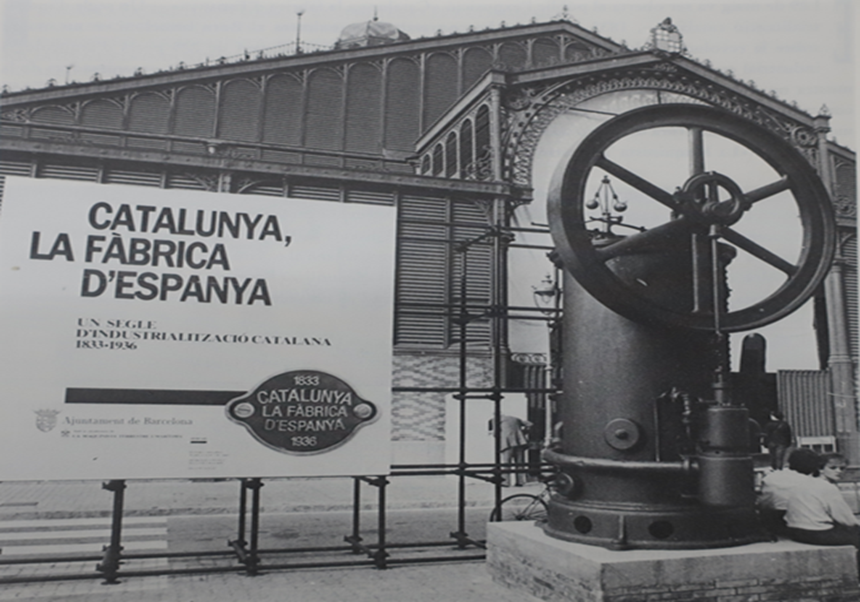
Seminar: Manufacturing Spain's Factory
Speaker: Jaume Sastre Juan
Wednesday, 4 February at 5:00 p.m.
Format: In person, Classroom 0 Palau Cerveró.
Summary
In May 1985, the exhibition ‘Catalonia, the Factory of Spain’ opened in Barcelona's old Borne market. Curated by economic historians Jordi Nadal and Jordi Maluquer de Motes and organised by Barcelona City Council, it was one of the first major exhibitions to shape the cultural policy of a city undergoing transformation in the run-up to the 1992 Olympic Games. It was also a key moment in the construction of ‘industrial heritage,’ putting into circulation a historiographical cliché that would become popular both inside and outside academia: Catalonia as the ‘factory of Spain.’ This paper explores the political uses of the industrial past based on its exhibition construction, understanding Barcelona's Borne market as a ‘civic laboratory.’ In his book Making Culture, Changing Society (2013), Bennett argues that museums can be understood as civic laboratories, that is, as levers that allow political action through a series of practices of collection, classification, study and exhibition of objects. By articulating certain expert knowledge (such as economic history) with certain artefacts (such as a steam engine or an old Catalan forge), it is possible to produce previously non-existent realities (such as “Catalonia, the factory of Spain”), which are then aspired to be socially disseminated, with both epistemological and political effects. A study of what these effects were in the case at hand can provide food for thought on the uses of the past in the present in relation to national identity, social conflict, and coloniality.
Biography
Jaume Sastre-Juan is a Serra Húnter professor at the Institute of History of Science and the Department of Philosophy at the Autonomous University of Barcelona. His research interests revolve around the political history of science communication, as well as the history and philosophy of technology. He has published articles and book chapters on the political history of ‘interactivity’ in science museums, the Rockefeller Foundation's interest in science communication in the 1930s, and the trivialisation of nuclear technologies through recreational exhibitions, among other topics. He has co-edited the books Science Popularisation as Cultural Diplomacy in Cold War UNESCO, 1946-1958 (Routledge, in press) and La cultura científica de la Transición: Museos, ciencia y política en la Barcelona preolímpica (Bellaterra Ediciones, in press). He is currently conducting research on the history of concrete and the cement industry.