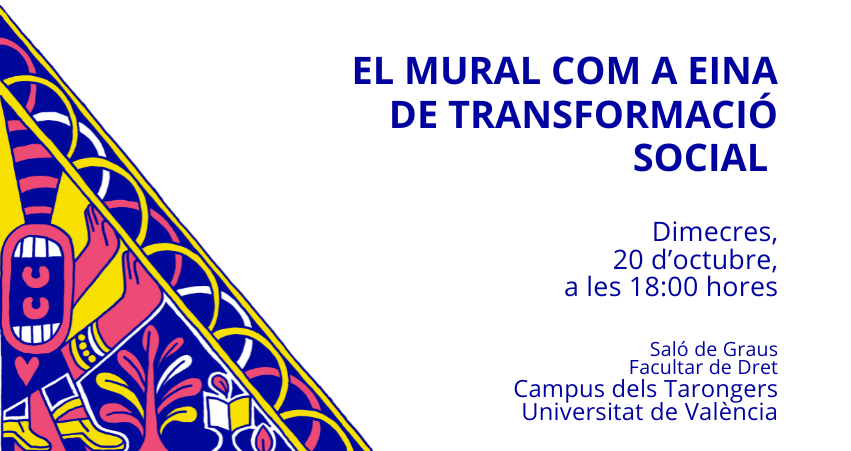
WebinarsLANAU: Converses ciència, evidència i raó. Facultat de Dret
“El mural como herramienta de transformación social” (“Murals as a tool for social transformation”)
Speakers:
Mónica Miros (Nosotras Estamos en la Calle Collective, Lima)
Carol Fernández (Amapolay Collective, Lima)
Fernando Castro (Amapolay Collective, Lima)
Javier Parra (muralist, Valencia)
Elías Taño (muralist, Valencia)
Hosted and moderated by:
Raúl Abeledo, Academic Director of the Observatorio Cultural UV
Abstract
How do murals influence in our daily lives? How do they contribute to our individual and collective wellbeing? Through what functions can the mural become a lever for social transformation? If the means is the message, to what does muralism contribute? This session will be completed with the creation of a mural at the Faculty of Psychology by two artists’ collectives from Lima (Peru) on tour throughout Europe: “Nosotras Estamos en la Calle” and “Amapolay”. Their work will address the value of diversity and the cultural right to identity from a gender perspective.
Artistic intervention: Mural at the Blasco Ibáñez Campus
As part of the activity, the collective Amapolay, formed by Carol Fernández and Fernando Castro, together with artist Mónica Miros from the collective Nosotras somos la calle, created a mural at the Blasco Ibáñez Campus. The three artists, of Peruvian origin, understand public space as a stage for struggle and expression, from which they foster social transformation, community empowerment, connection with local identity, and the affirmation of feminine strength as a driving force for change.
In their work, they blend contemporary aesthetics with the transmission of struggles and resistances rooted in popular culture and Indigenous peoples, as well as environmental advocacy. As can be seen, the artists employ short phrases, quick and striking messages, and bright, colorful images in their search for and encounter with identity, history, and territory.