Search result18 results
-
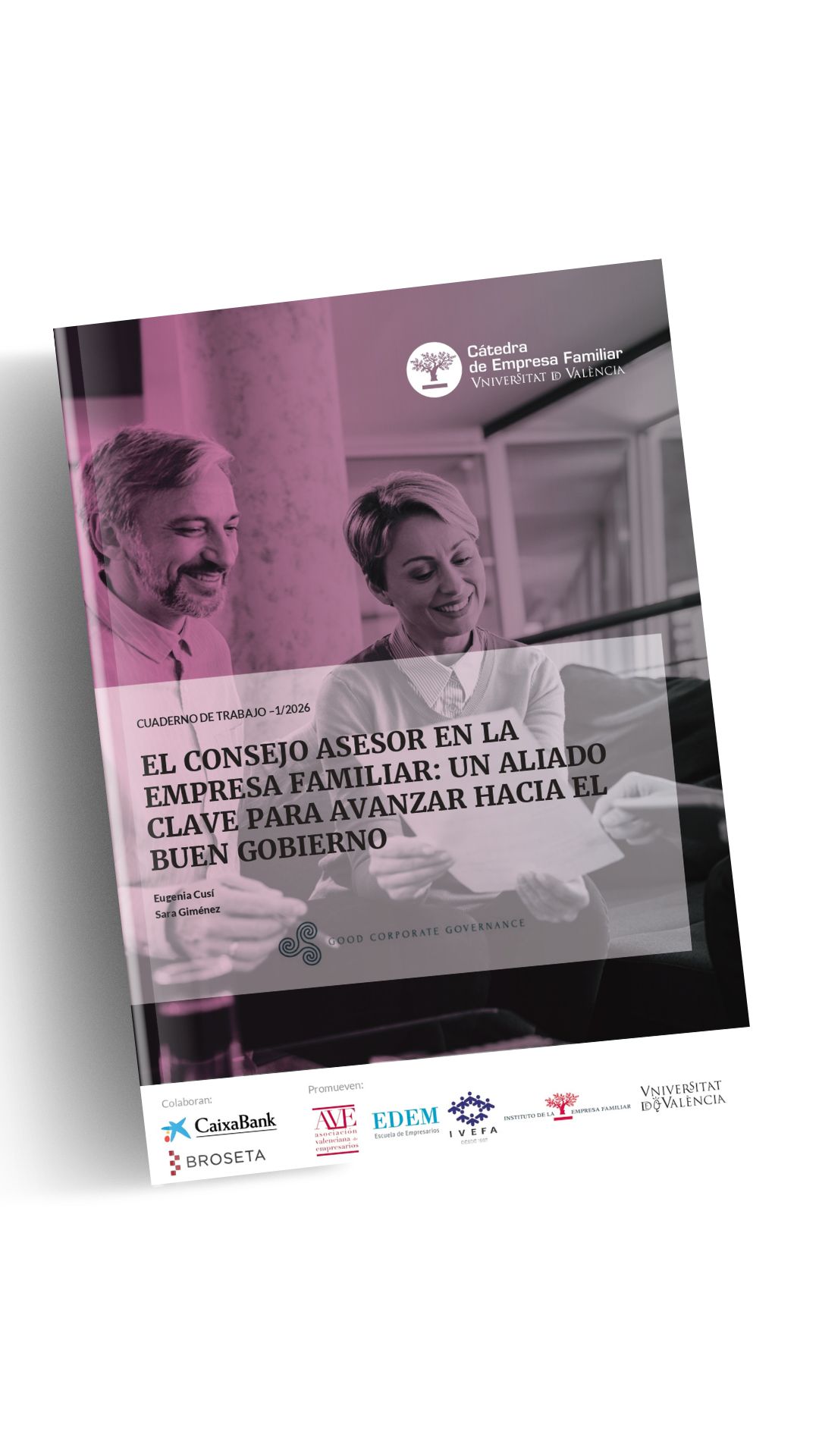
Working Paper 1/2026: “The advisory board in the family business: a key ally for advancing towards good governance”.
Eugenia Cusí (Independent Director/Corporate Governance) and Sara Giménez (Independent Director/Executive Coach) Good Corporate Governance
(2026). Recurs electrònicThe working paper analyses the role of the advisory board as a key tool for professionalising decision-making and advancing towards a model of good governance in family businesses. The publication highlights the importance of evolving from intuitive governance models towards more deliberate systems capable of improving the quality of strategic decisions, anticipating risks and preparing the future of the company. It also addresses aspects such as the differences between an advisory board and a board of directors, the criteria for designing an effective advisory board, and the evolution of governance in family businesses through different practical cases and application examples.
-
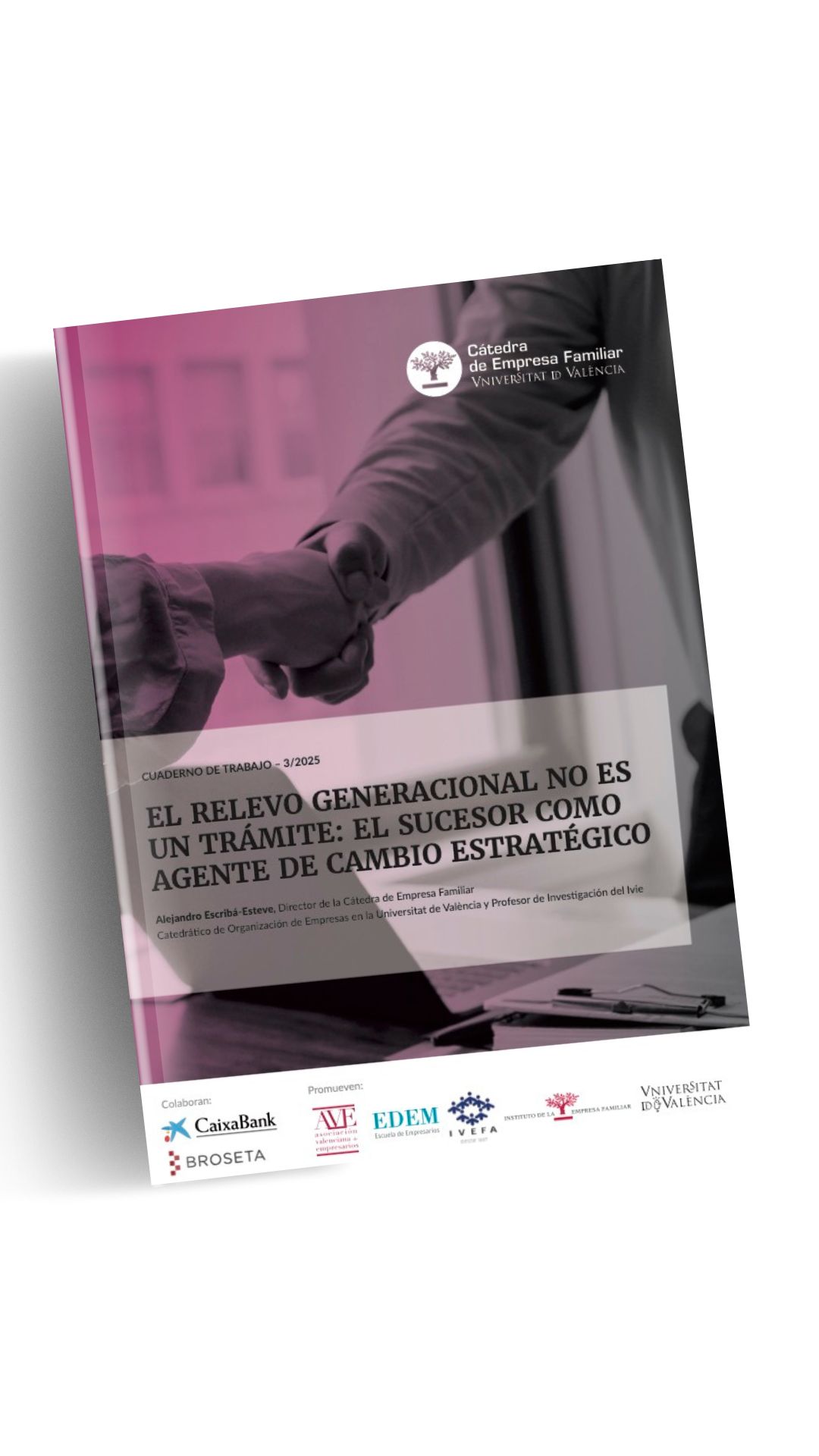
Working Paper 3/2025: ‘Generational succession is not a mere formality: the successor as an agent of strategic change’
Alejandro Escribá Esteve (Director of the Family Business Chair, Professor of Business Organisation at the University of Valencia and Research Professor at the Ivie)
(2025). Recurs electrònicSuccession in a family business is a profound strategic change, not a simple generational formality. The successor must act as an agent of change with their own vision that renews the business project. The process requires an honest diagnosis to determine whether the company needs incremental adjustment, evolution, strategic reorientation or profound transformation. Leadership is built by activating levers such as People, Processes, Structures, Culture, Strategy and Relationships, and is sustained by attitudes such as active humility, determination and trust (based on competence, integrity and benevolence). Resistance is inevitable (from the founder, family, managers or the successor...
Succession in a family business is a profound strategic change, not a simple generational formality. The successor must act as an agent of change with their own vision that renews the business project. The process requires an honest diagnosis to determine whether the company needs incremental adjustment, evolution, strategic reorientation or profound transformation. Leadership is built by activating levers such as People, Processes, Structures, Culture, Strategy and Relationships, and is sustained by attitudes such as active humility, determination and trust (based on competence, integrity and benevolence). Resistance is inevitable (from the founder, family, managers or the successor themselves), but it can be effectively managed using the PROMPT model (Persuasion, Resources and Organisation, Movement, Politics, Timing), allowing the successor to move forward with legitimacy and purpose.
Read more Hide -
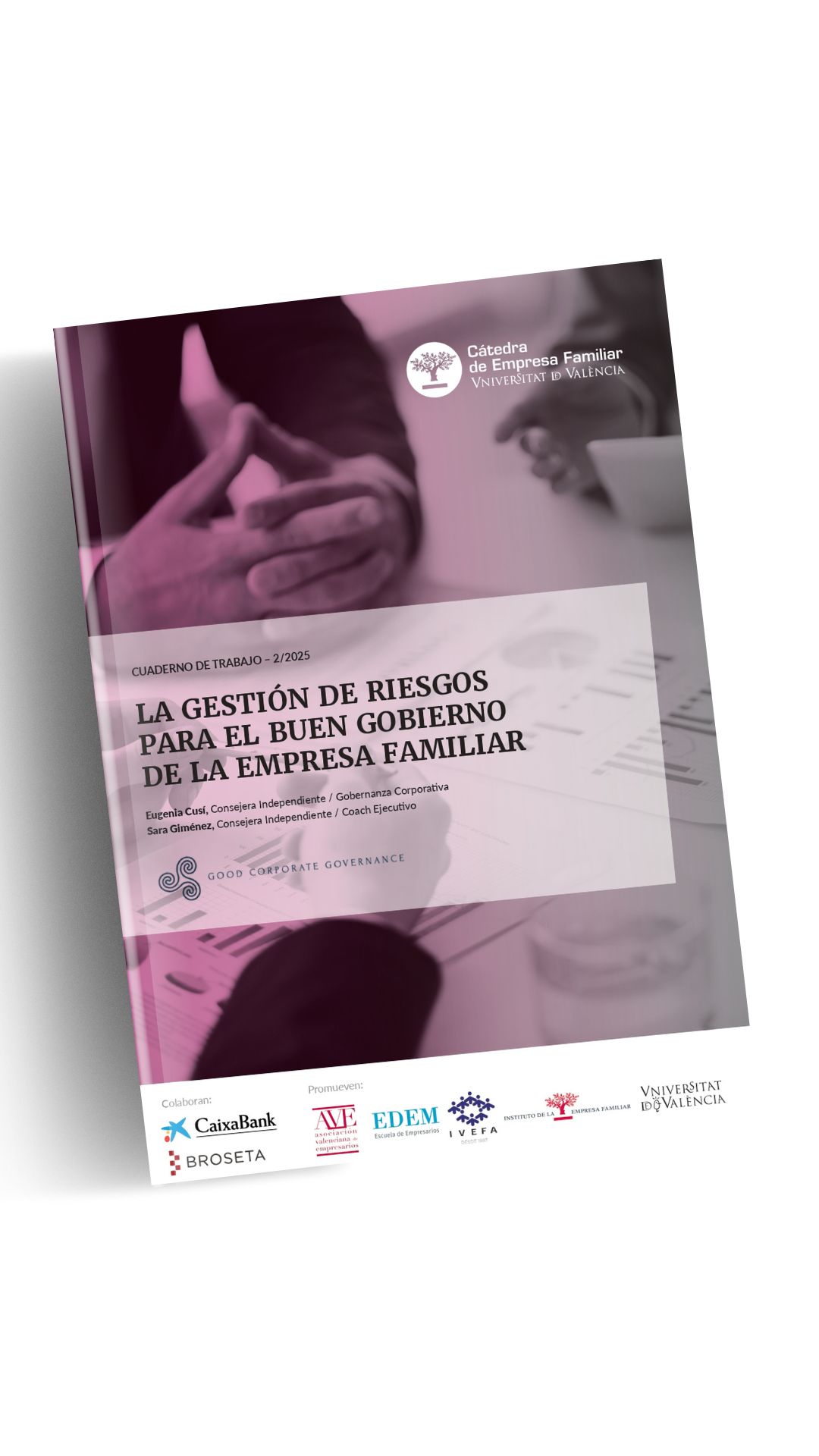
Working Paper 2/2025: ‘Risk management for good governance of family businesses’.
Eugenia Cusí (Independent Director/Corporate Governance) Sara Giménez (Independent Director/Executive Coach) Good Corporate Governance
(2025). Recurs electrònicIt addresses how strategic risk management can strengthen the sustainability, resilience and continuity of family businesses. The booklet provides practical tools for identifying, ranking and prioritising business risks. It details five broad categories of risk (governance, strategic, financial, operational and people-related), the steps to build an effective risk map, and discusses both internal risk management and possible outsourcing. In addition, the specific risks faced by family businesses, such as the lack of succession planning or family conflicts, are examined in depth. All of this from an ethical perspective that reinforces responsible decision-making and commitment to the family...
It addresses how strategic risk management can strengthen the sustainability, resilience and continuity of family businesses. The booklet provides practical tools for identifying, ranking and prioritising business risks. It details five broad categories of risk (governance, strategic, financial, operational and people-related), the steps to build an effective risk map, and discusses both internal risk management and possible outsourcing. In addition, the specific risks faced by family businesses, such as the lack of succession planning or family conflicts, are examined in depth. All of this from an ethical perspective that reinforces responsible decision-making and commitment to the family legacy.
Read more Hide -
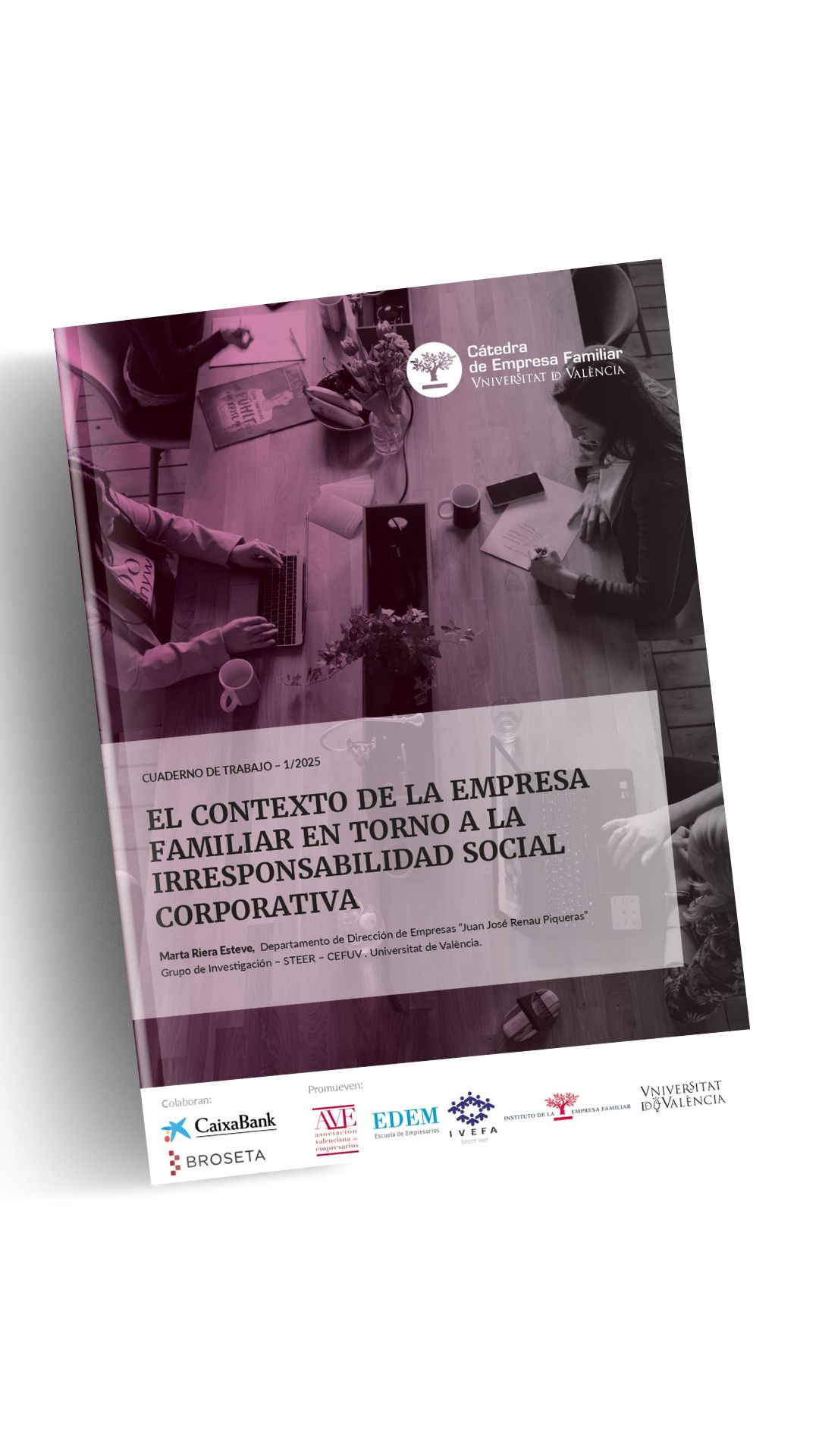
Working Paper 1/2025: “The Context of Family Businesses Regarding Corporate Social Irresponsibility”
Marta Riera Esteve (Department of Business Management: "Juan José Renau Piqueras"; Research Group STEER – CEFUV. Universitat de València).
(2025). Recurs electrònicThis study analyzes the phenomenon of Corporate Social Irresponsibility (CSI) in family businesses, exploring its causes, manifestations, and consequences. Unlike Corporate Social Responsibility (CSR), CSI involves practices that negatively impact the company, its employees, customers, and society as a whole.
-
Workbook 1/2024: "Keys to brand management in family businesses".
Emilio Llopis Sancho (PhD in Branding, Professor at EDEM Escuela de Empresarios and Partner of GLR Partners)
València , 2024. Recurs electrònicIn a highly competitive business environment, branding becomes a crucial strategic asset for family businesses. These companies, with their rich heritage and values passed down through the generations, find in family branding a powerful tool to communicate their unique identity and differentiate themselves from large corporations. This type of branding not only connects with customers looking for authenticity and quality, but also strengthens the emotional bond with the brand, which is vital for attracting and retaining talent, as well as creating a strong corporate culture. In addition, a well-managed brand can increase market value and ensure long-term economic sustainability.
-
Workbook 9/2022: Sustainable governance of the family business.
Begoña Pastor (Ángela Impact Economy)
Valencia , 2022. Recurs electrònicThrough this workbook we will analyze the main keys to sustainable governance that will allow family businesses to navigate their decision-making, taking into account the new sustainability variables, without losing competitiveness, profitability and strengthening their values. We will analyze the economic context and the role of sustainability in the coming years, the link between sustainability and the legacy of the family business, and how to introduce a sustainable perspective into strategy and decision-making.
-
Workbook 8/2022: The shareholder perspective in Family Firms: a proposal for good practices
Raúl Aznar (Aznar Patrimonio) Alejandro Escribá-Esteve (CEFUV)
(2022). Recurs electrònicThe main objective of this booklet is to offer guidelines that serve to value the shareholder's perspective, and establish effective control mechanisms in the family business without undermining the work of the managers, and intensifying communication between the property and the family business.
-
Workbook 7/2022: The employability of students in family firms. An assessment of student's competences and guidelines for improvement
Pilar González Navarro. Universitat de València Lucía I. Llinares Insa. Universitat de València Rania Hakmi. Universitat de València Alejandro Escribá Esteve, Univesitat de València
Valencia , 2022. Recurs electrònicFamily firms are the largest economic structure in Spain and the most important in terms of job creation. Their culture and values make them peculiar, as well as the labor relations established within them. This workbook analyzes the employability of university students in this context. The results obtained show that the students possess some of the employability skills for obtaining and maintaining employment, that may help them to be part of the social capital of the family business. These skills may also help them add value to the family business by integrating part of those resources called familiness that have been associated with business success. However, the results also show that...
Family firms are the largest economic structure in Spain and the most important in terms of job creation. Their culture and values make them peculiar, as well as the labor relations established within them. This workbook analyzes the employability of university students in this context. The results obtained show that the students possess some of the employability skills for obtaining and maintaining employment, that may help them to be part of the social capital of the family business. These skills may also help them add value to the family business by integrating part of those resources called familiness that have been associated with business success. However, the results also show that there is still a long way to go, and the areas for improvement are analyzed in which they should work to have more chances of success in their integration into the workforce of a family business.
Read more Hide -
CUADERNO DE TRABAJO – 6 / 2021 LOS ÓRGANOS E INSTRUMENTOS DE GOBIERNO DE LA FAMILIA
- Tomás Guillén. Grupo IFEDES - Alejandro Escribá-Esteve. Cátedra de Empresa Familiar de la UV
(2021). Recurs electrònic -
Cuaderno de Trabajo 5/2021: El Consejo de Familia, herramienta clave para la perdurabilidad de la Empresa Familiar
María Beltrán (Profesora del Curso de Empresa Familiar de CEFUV)
(2021). Recurs electrònic