

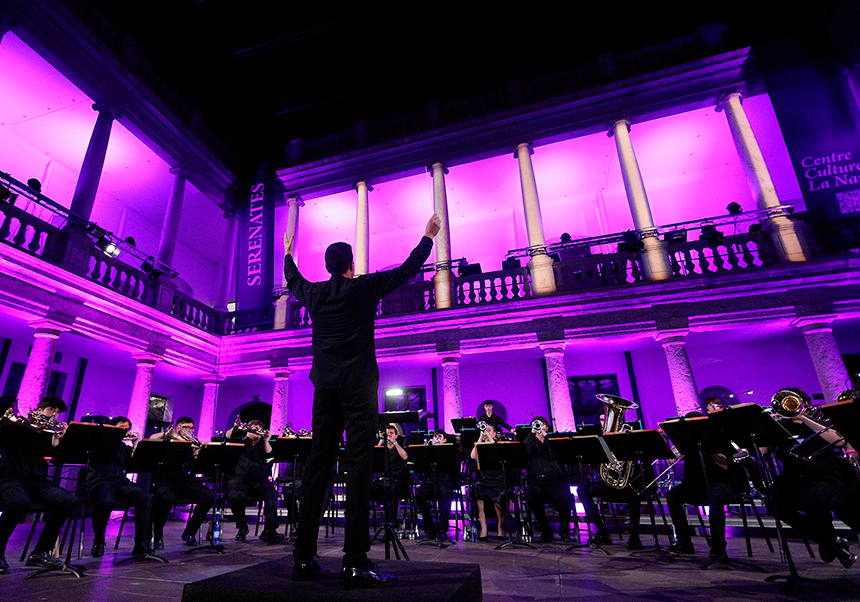
The Serenates festival ended on Thursday its 39th edition after gathering more than 4,000 spectators at the Cloister of the Cultural Center La Nau at the University of Valencia. Co-produced by the Institut Valencià de Cultura (IVC) (Valencian Institute of Culture), with the sponsorship of the Diputació de València (Valencian Council) and the Ajuntament de València (Valencia City Council)-Valencià Music City, and the collaboration of the Palau de la Música de València (Valencian Concert Hall), College of Art and Design of Valencia (EASD) and the General Foundation of the University of Valencia. The contest once again consolidated itself as one of the biggest cultural events of the Valencian summer. This edition registers an occupancy rate superior to the 90% and there were plenty of concerts that filled its entire line-up.
2026 edition has been especially significant for two reasons. For the first time, Serenates moved its date forward to 20 June to join the Fête de la Musique celebration, an initiative that takes place every 21 June filled with free concerts on the street and in public spaces around the world. Moreover, the festival achieved international presence thanks to the broadcasting of its opening concert for the European cultural channel ARTE, within the special programming europiano. The recital, starred by the Orquestra de València under the conducting of Alexander Liebreich and the Japanese pianist Mao Fujita as a soloist turned the entire cloister of La Nau in the only Spanish stage present in a broadcast that connected eleven European cities and got Serenates close to a million of spectators. This activity was possible thanks to València Music City, an initiative promoted by the Ajuntament de València (Valencia City Council) and the Palau de la Música de València (Valencian Concert Hall).
Throughout twelve concerts, Serenates once again reclaimed diversity as one of its main signs of identity. The line-up combined big symphonic ensembles, chamber music, contemporary creations, jazz, flamenco, songwriters, films in concert, inclusive dance, and interdisciplinary proposals, gathering artists of international presence, Valencian performers, and university formations on one stage.
Symphonic music opened and went all over the festival with the participation of the Orquestra de València, star of the opening concert, and the Orquestra Filharmònica de la Universitat de València, conducted by Hilari Garcia, which gave a show in which the musical performance interacted live with a lightning proposal. Contemporary creations also had a remarkable role in the premiere of Calix maudit, by the Valencian composer Joan Gómez-Alemany, and performed by the Orfeó Universitari de València.
Furthermore, the festival kept its bet on the dialogue among disciplines and artistic languages as a proposal for the film in concert of The Adventures of Prince Achmed or Barefoot from de company Entrelazados, which brought the audience closer to an inclusive dance performance. Afterwards there was the performance of the songwriter Christina Rosenvinge, who performed Los versos sáficos in a trio; the recital by the pianist Elena Font, the project Roneando, by the saxophonist Perico Sambeat alongside his Quinteto Flamenco; the concert by the Banda Simfònica Unió Musical l’Horta de Sant Marcel·lí in collaboration with the International Music Band Contest Ciutat de València; the celebration of the twentieth anniversary of the Women Choir a Cau de Orella; the concert of the singer and double bass player Tonina and the closing concert by Harmonia del Parnàs with Passió barroca, a proposal that combined historical music and dance.
One of the most remarkable traits of this edition was its determined commitment to equality. More than 62% of the participanting artists were women. This bet was present both in the attendance of performers such as Christina Rosenvinge, Elena Font or Tonina and the Women Choir a Cau de Orella, as well as, in performances of works by female composers from different decades, from Hildegarda de Bingen y Chiara Margarita Cozzolani to Joan Tower, Elisabeth Lutyens, Merche Femenía or Eva Ugalde.
Serenates has kept its commitment with Valencian creations, its support to young performers and artistic innovation, with premieres, interdisciplinary projects and collaborations with cultural institutions from the city, reaffirming a model that combines artistic excellence, public service and the diffusion of cultural heritage.
On the verge of its 4th edition, Serenates continues to consolidate a project that turns La Nau historical cloister into a meeting space for music, heritage and citizens




.jpg)
.jpg)
.jpg)
.jpg)
.jpg)
.jpg)
.jpg)
.jpg)
.jpg)
.jpg)
.jpg)
.jpg)
.jpg)
.jpg)
.jpg)
.jpg)
.jpg)
.jpg)
.jpg)
.jpg)
.jpg)
.jpg)
.jpg)
.jpg)
.jpg)
.jpg)
.jpg)
.jpg)
.jpg)
.jpg)
.jpg)
.jpg)
.jpg)
.jpg)
.jpg)