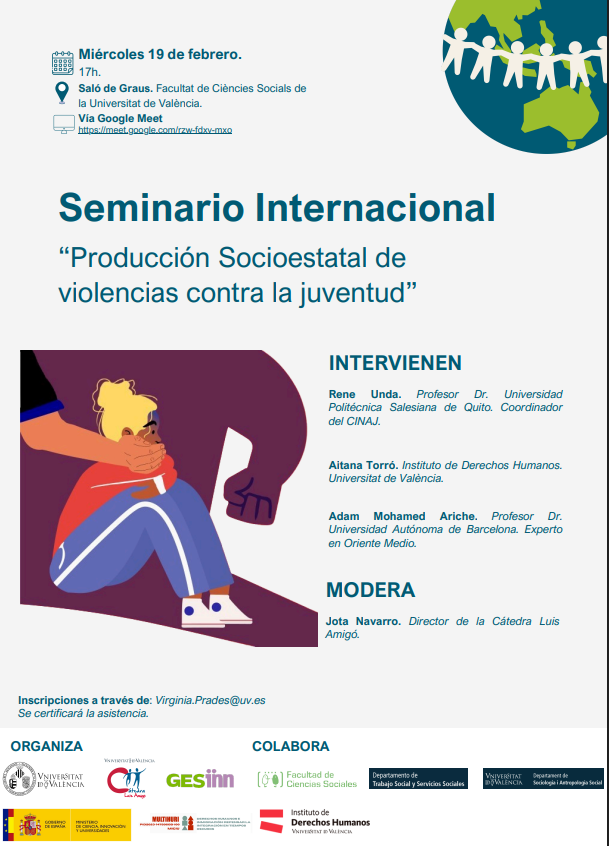
Wednesday, 19 February. 5:00 p.m. Graduate Hall. Faculty of Social Sciences, University of Valencia. Via Google Meet. Registration via: Virginia.Prades@uv.es. Attendance will be certified.
Speakers:
- Rene Unda. Professor, PhD. Salesian Polytechnic University of Quito. Coordinator of CINAJ.
- Aitana Torró. Institute of Human Rights. University of Valencia.
- Adam Mohamed Ariche. Professor, PhD. Autonomous University of Barcelona. Expert on the Middle East.
Moderator:
- Jota Navarro. Director of the Luis Amigó Chair.
 Seminar Objective:
The seminar aims to delve into these issues and to create a space for critical reflection, understanding that violence against youth is not only a local problem, but a matter involving the entire global system of human rights and public policies.
Contextualisation of the Topic:
The concept of “socio-state production of violence against youth”, highlighting how the State can act both as a direct agent (through repressive policies) and as an indirect agent (through omission or lack of protection) of violence against young people.
It is noted that these processes are not isolated, but rather respond to global, economic and political dynamics that affect youth in different contexts.
Diversity of Contexts:
Each speaker will address a different perspective: Latin America, Europe – Central America, and the Middle East. This allows us to see how structural violence is produced in different ways, but with common features such as lack of protection, criminalisation and social exclusion of young people.
The Role of the State and Social Responsibility:
The State, far from being a guarantor of rights, in many cases becomes a factor that produces or perpetuates violence, whether due to the absence of adequate public policies, the criminalisation of youth, or the use of repressive measures without guaranteeing fundamental rights.
Social Perspective on Violence:
- Violence as a Social and Cultural Product:
Violence against young people is a product of social structures that reproduce it.
- From victims to perpetrators.
The State, far from addressing the structural causes of violence, perpetuates them by generating public insecurity in order to justify its REPRESSION. (A planned ad hoc process to silence youth demands: Arab Springs)
- The Role of the State in the Production of Violence:
The State not only generates violence through direct repression, but also through omission: failing to provide access to fundamental rights (education, health, employment) contributes to structural violence.
Criminalising and stigmatising young people reinforces their exclusion and perpetuates a cycle of violence that becomes increasingly difficult to break.
Conclusions:
- Violence against youth is a social construction that responds first to dynamics of vulnerability, and later to exclusion and lack of protection.
- The repressive State perpetuates these forms of violence.
- The seminar seeks to reflect on how to break these cycles and build alternatives based on inclusion, opportunities and respect for rights.
- Poster (pdf)
- Via Google Meet
- Registration via: Virginia.Prades@uv.es.
- Attendance will be certified