

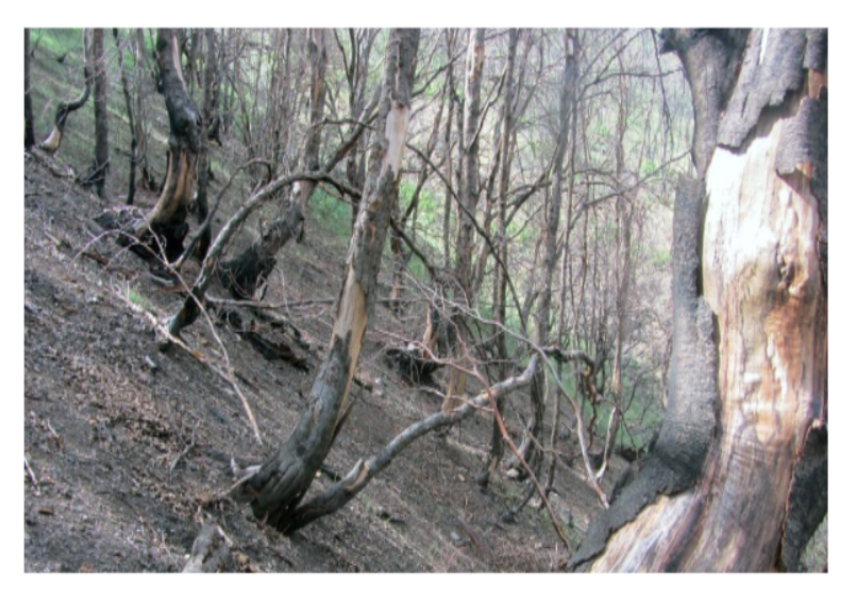
They describe for the first time the effects of a fire exacerbated by climate change on a beech forest in León
-
A study by the CSIC and the University of León analyzes the effects of a large wildfire during a summer heatwave in 2025 on this type of forest, which until now has been considered fire-resistant.
-
A third of the beech forest was drastically reduced, with mortality rates reaching 70%, and another third was severely weakened. Its slow regeneration raises concerns about a shift towards more flammable vegetation.
A study by the Desertification Research Center (CIDE), a joint center of the Spanish National Research Council (CSIC), the University of Valencia (UV), and the Valencian Regional Government, along with the University of León (ULE), analyzes for the first time the repercussions of a summer wildfire—specifically, the 2025 fire in Barniedo de la Reina (León)—on a beech forest, traditionally considered non-flammable. The analysis concludes that a third of the beech forest was seriously affected, with mortality rates exceeding 70%, while another third was severely weakened, thus promoting the growth of other, more flammable vegetation. The study warns that climate change favors the occurrence of these types of fires in these areas, weakening the capacity of beech forests to act as natural firebreaks.
Beech forests (Fagus sylvatica) have traditionally been considered non-flammable. They grow in cold, damp environments, and their dense canopy during the summer inhibits the growth of undergrowth (plants and shrubs that grow beneath the trees) as well as the spread of fire. Until now, when they burned, it was in small, low-intensity fires, generally in winter when the trees are leafless, so most of the beech trees survived.
Now, this pattern may have changed, according to a study led by CSIC scientist Juli G. Pausas at CIDE, along with ULE researchers Luz Valbuena and David Beltrán-Marcos, published in the journal Global Change Biology. Combining Sentinel-2 satellite images with fieldwork, they reconstructed the Barniedo de la Reina (León) fire, started by lightning on August 14, 2015, during an exceptional 15-day heat wave that triggered a record number of large wildfires in Spain and Portugal. The fire affected approximately 19,100 hectares at an altitude of between 1,120 and 2,315 meters, an area composed of a mosaic of scrubland, oak forests, and beech forests.
A mosaic of damage
According to the study's results, a third of the beech forest remained virtually unharmed (more than 99% of trees survived), while another third burned in an undergrowth fire that, despite its low intensity, proved lethal for most of the trees. The remaining third was in an intermediate state, with crowns that did not fully recover.
In the most affected plots, mortality depended on tree size: 74% of trees with a diameter greater than 10 centimeters died, and all trees smaller than that diameter died without exception. The remaining 26% managed to resprout from the trunk (epicormic resprouting), although very weakly: in June 2026, crown recovery in these trees was still below 15%. The authors caution that, given that episodes of delayed mortality after fire have been described in beech trees, the ultimate fate of these surviving trees remains uncertain.
No generational replacement in sight
The study also focuses on regeneration, and the diagnosis here is worrying. Beech seedlings were scarce and highly irregular: of the eight plots sampled after the fire, six had no seedlings, one had only four, and another had over 300. In contrast, seedlings of woody legumes (species with seeds that remain dormant in the soil and germinate after the fire) were nearly one hundred times more abundant.
“This difference is not accidental: unlike legumes, beech trees do not have a persistent seed bank in the soil or germination mechanisms associated with fire, and current climate trends make it unlikely that they can recolonize these areas from nearby unburned forests,” says Juli G. Pausas (CSIC). The most likely outcome, according to the authors, is a conversion of the beech forest into scrubland, a much more flammable ecosystem that, in turn, could increase the risk of new fires in the future.
A barrier that is weakening across Europe
The Barniedo fire is not, for researchers, an isolated incident. “It is a symptom of a fundamental change: global warming is allowing large wildfires to reach altitudes and ecosystems where, until now, summer fires were practically unknown, a trend already observed in other mountain ranges around the world and now reaching European temperate forests,” warns Luz Valbuena (University of León). It is a warning sign for European beech forests (and other temperate forests) in a scenario where fire is advancing to higher altitudes and further north.
Thus, models that predict the future of vegetation in the face of climate change tend to focus on the direct effects of climate, but do not take into account changes in fire regimes. The results of this study suggest that these changes, now driven more by climate change than by changes in land use, could have even more significant consequences. “Climate change not only favors the occurrence of fires, but also hinders the regeneration and subsequent expansion of beech trees, thus amplifying the impact of fire,” summarizes David Beltrán-Marcos (ULE).
“Global warming is weakening the capacity of beech forests to act as natural firebreaks, allowing fire to spread beyond ecosystems traditionally prone to burning and affecting fire-sensitive species,” concludes Juli G. Pausas (CSIC). “In the midst of the Anthropocene era, concepts like ‘non-flammable ecosystem’ or ‘pyrophobic’ are increasingly losing their meaning,” she laments.



