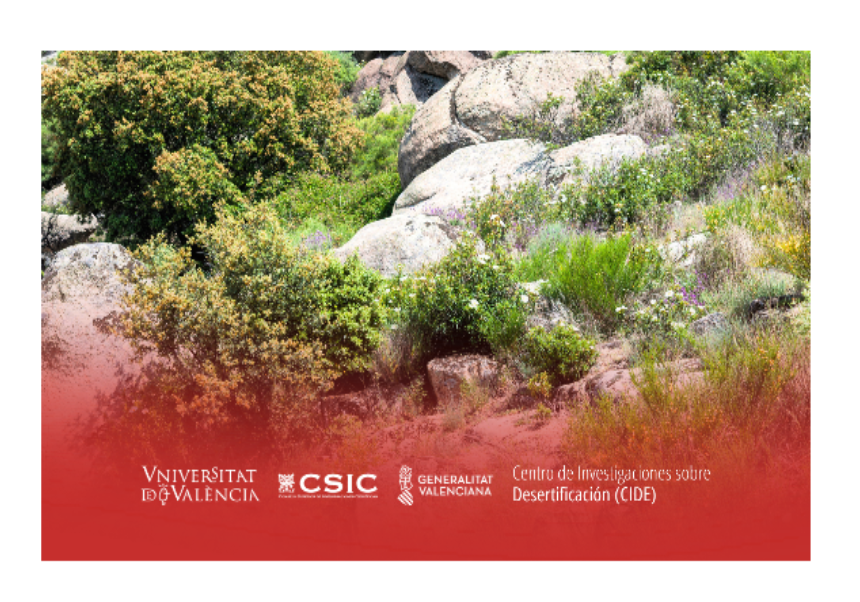
Beyond Boundaries: Integrating Multidimensional Drivers of Climatic Disequilibrium will study how climatic disequilibrium—the mismatch between the climatic conditions of an environment and the climatic optima of the species that inhabit it—influences the interactions between plants, soil microorganisms, and ecosystem processes. The ultimate goal is to understand the mechanisms that allow Mediterranean plant communities to maintain their functioning under changing climatic conditions and to use this knowledge to anticipate their evolution in future climate scenarios.
Beyond Boundaries builds on results from previous research by the group, which demonstrated that nurse plants can modify the environmental conditions beneath their canopy, creating microhabitats more favorable for the establishment of other species. This microclimate buffering effect allows certain plants to survive in places where climatic conditions would, in principle, be unfavorable for them.
However, this ability to facilitate the establishment of other species also depends on the state of the nurse plant itself and how far it is from its climatic optimum. Furthermore, these effects are not limited to plants, but extend to the soil, microbial communities, and, as a whole, the functioning of the ecosystem.
Based on these results, the project aims to go a step further: to identify the mechanisms that explain when climatic imbalance occurs, what factors modulate it, and how its effects propagate from plants to the rest of the ecosystem.
The project is based on a fundamental idea: climate is not the only factor that determines the response of species. Soil characteristics, the microclimate generated by vegetation, the ability of plants to modify their own traits (phenotypic plasticity), and interactions between organisms can buffer—or, conversely, intensify—the effects of climate variations. Understanding these processes is essential for predicting how Mediterranean ecosystems will evolve over the coming decades.
Six Interconnected Lines of Research
Over the next four years, the research team will develop six complementary lines of work to build a mechanistic framework for understanding and anticipating the response of Mediterranean ecosystems to future climate scenarios.
The research will address:
- How soil conditions, along with climate, determine where species can establish themselves;
- The extent to which phenotypic plasticity allows plants to adapt to environmental conditions far from their climatic optimum;
- How to apply this knowledge to improve ecological restoration strategies by selecting the most suitable species and microsites;
- The role of soil microorganisms in maintaining essential functions such as nutrient recycling and soil respiration;
- How interactions between species might change under different climate scenarios, identifying situations in which the protective effect of nurse plants could weaken;
- And how to disseminate these results to managers, restoration professionals, environmental managers, and the public through outreach and knowledge transfer activities.
Contributing to More Resilient Restoration
The project's results will enable the development of scientific tools and criteria for designing restoration and conservation strategies better adapted to future environmental conditions. In this regard, Beyond Boundaries envisions collaboration with companies, government agencies, and organizations dedicated to ecological restoration to validate and apply the developed models and indicators, facilitating the transfer of scientific knowledge to land management.
Beyond Boundaries is the result of a collaboration between: CIDE-CSIC, INIA-CSIC, Arid Zones Experimental Station-CSIC, Institute of Agricultural Sciences-CSIC, University of Jaén and the University of Zurich.
The Beyond Boundaries project is funded by the Prometeo Program for Research Groups of Excellence of the Valencian Government, a call for proposals aimed at promoting high-level research carried out by established groups in the Valencian Community. This funding supports projects with the capacity to generate cutting-edge knowledge and contribute to addressing particularly relevant scientific, social, and environmental challenges.
CIDE Communication
Contributor to this publication: Pablo Donato Pablos Rivera. This collaboration is supported by the MaX-CSIC Excellence Grant [DEEP-MaX-2024-2 CIDE]
Images: