

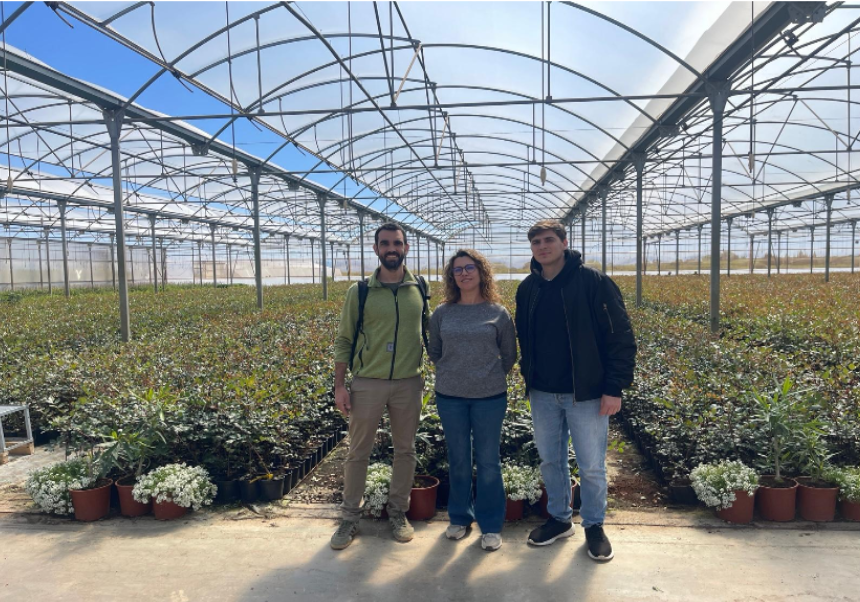
Viveros Hernandorena has launched, in partnership with the Centre for Research on Desertification (CIDE, CSIC–UV-GVA), a research project funded entirely by the company to study how deficit irrigation, water stress and salinity affect carob trees. The aim is to transfer rigorous knowledge to the sector and accelerate the modernisation of a crop of growing agronomic and economic interest.
This initiative forms part of the Carob Tree Project strategy, the programme through which Viveros Hernandorena has been working since 2011 to professionalise carob cultivation by improving plant material, modernising agronomic management and generating technical knowledge.
For over a decade, the company has focused its efforts on addressing the main challenges of the crop: first, by stabilising the production of grafted plants — currently with a 60–65% success rate — and subsequently by evaluating, on its 3 hectares of experimental plots, different plant varieties, planting dates, pruning, irrigation, nutrition and pest control.
“These trials have enabled us to move towards a more intensive and professional cultivation model, but they have also highlighted the need to refine water management to achieve fully profitable yields,” explains Fernando Hernandorena Ribas, the company’s manager.
Currently, experimental farms achieve yields of around 10 tonnes per hectare, but the aim is to reach 15 tonnes per hectare, an increase that requires a precise understanding of how the carob tree responds to water stress, drought and salinity.
“After more than a decade of progress in the production of grafted plants and in crop management, we are now taking a decisive step forward by promoting specific scientific research into the water requirements of the carob tree and its behaviour under stress conditions,” adds Fernando Hernandorena.
A research project led by CIDE
The project is led by Juan Miguel Ramírez Cuesta, a CSIC researcher at CIDE, and involves Diego Intrigliolo Molina, the current director of CIDE. Both are leading this study with the aim of defining water management strategies and varietal selection that will maximise production and water use efficiency. The University of Bari (Italy) is also collaborating on the research, with the participation of Professors Camposeo and Maldera, thereby broadening the geographical scope and international reach of the results to be obtained.
As Intrigliolo explains, the scientific interest is clear: “Although the carob tree is a drought-tolerant crop, when grown intensively it has specific water requirements, an aspect that has not yet been studied in depth.”
The long-term study is structured around three main lines of inquiry: determining the water requirements of carob in commercial cultivation using yield functions that allow the agronomic and economic optimum to be identified; evaluating the crop’s response to deficit irrigation to design strategies for sustainable intensification; and studying salinity tolerance in varieties and rootstocks, a key aspect in areas where the limitation is not only the quantity of water, but also its quality.
The initial results
The project began in March and combines an initial phase of trials under controlled conditions with a second phase of validation under commercial field growing conditions. In this initial phase, the CIDE team has established experimental plantations to assess the physiological response of different varieties and rootstocks to various irrigation regimes and salinity levels. “We are only at the beginning, but we can already clearly see that not all varieties and rootstocks behave in the same way when faced with water stress,” explains Intrigliolo. This information will enable farmers to be guided towards the most suitable plant material based on water availability in each area.
In parallel, CIDE and Viveros Hernandorena are preparing the next stage of the study, which will be carried out on the company’s mature plots, where the trees are now sufficiently developed to assess the crop’s response under real-world conditions.
Impact on the sector
All this knowledge will enable Viveros Hernandorena to offer technical recommendations based on scientific evidence, a step that represents a paradigm shift in the nursery sector. “As well as providing high-quality plants, we want to transfer knowledge to the farmer,” emphasises Fernando Hernandorena.
This research project, led and funded entirely by Viveros Hernandorena, reinforces the company’s commitment to generating and transferring technical knowledge that will help professionalise carob cultivation.
Through this line of work, Viveros Hernandorena is making progress towards its goal of establishing a modern, efficient and profitable cultivation model, positioning the carob tree as a solid and sustainable alternative for Mediterranean regions.
CIDE Communication



