

University education is divided in three cycles: Undergraduate degree, Master's degree and Doctorate. The doctorate is the highest university qualification that leads to the obtention of the doctoral degree. It has an official status and validity for the whole national territory, and it's recognised in the whole European Space of Higher Education.
A doctorate involves the fulfilment of an original research in one of the knowledge fields.This research will culminate in the writing of a doctoral thesis, which will be defended before a panel of doctoral experts in the chosen field. To this end, students will be supervised by PhD-qualified researchers who will guide them in the research process –definition of objectives, methodology, definició d'objectius, metodologia, interpretation of results, bibliographic sources, etc.
The Doctoral School of the UV presents one of the broadest ranges of doctorate programmes among Spanish universities, with 60 programmes covering the fields of knowledge of Basic Science and Engineering, Health Sciences, Social Sciences and Humanities, with a wide variety of research lines. The offered programmes can be consulted on this link.
A PhD is based on conducting original research that contributes new knowledge to an academic field.
When this research is also developed in collaboration with the socioeconomic environment, and aims to promote the transfer of knowledge between the university and society, the PhD candidate can obtain, in addition to the doctoral degree, the industrial mention. The combination of the doctoral degree and the industrial mention is known as an "Industrial Doctorate".
Therefore, the industrial doctorate combines the training and research inherent to a PhD with collaboration and knowledge transfer between the university and the socioeconomic environment.
Entities face unique challenges; a doctorate is original research. Consequently, an industrial doctorate is the execution of a unique research project to address the challenges faced by entities.
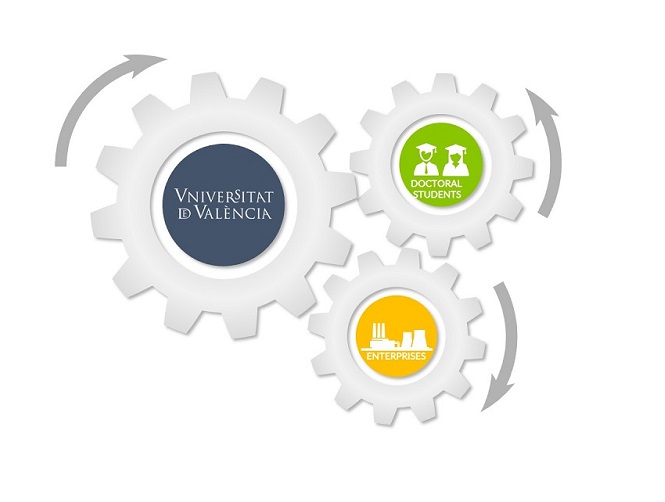
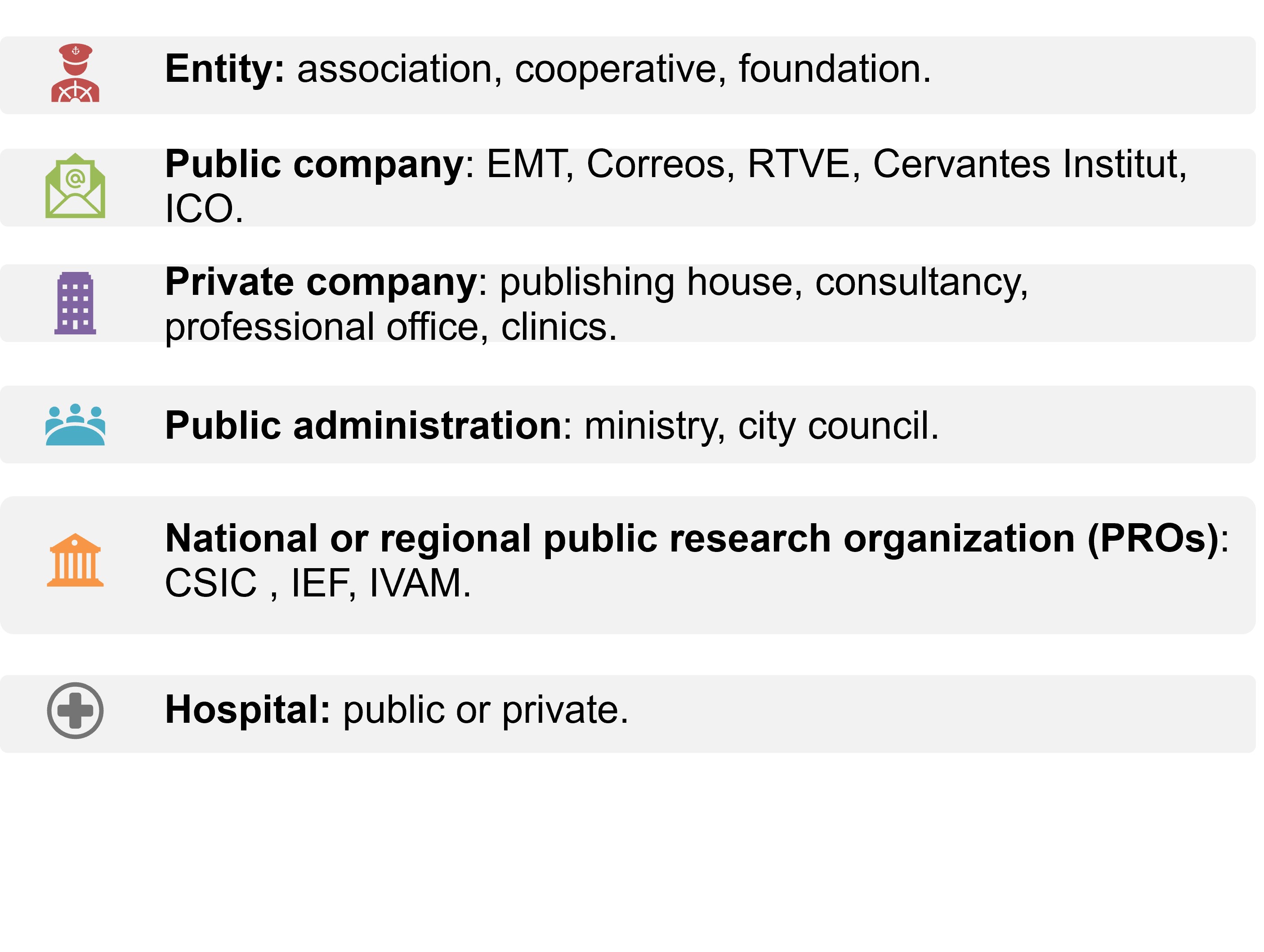
Generally, in any entity, public or private enterprise, public or private administration, research organisation or hospital.
Some practical examples are shown below:
The industrial distinction is regulated by Article 15 bis of Royal Decree 576/2023, which amends Royal Decree 99/2011, 28 January, regulating official doctorate programmes. In addition, the Universitat de València also includes this in its regulation on the submission, assesment and defence of doctoral theses.
In general terms, in order to obtain the Industrial distinction, the following requirements must be met:
-
The thesis must develop a research project of industrial, commercial, social, cultural and/or applied interest.
-
The thesis must be carried out in collaboration with entities, public or private enterprises, public administrations, research organisations or hospitals. Universities are partly excluded.
-
The collaborating entities must employ the predoctoral teacher at least for one year.
-
A valid agreement must be in force between the Universitat and the collaborating entities for the doctoral thesis development.
To know the requirements for admission to doctoral studies, consult the admission and enrolment requirements.
The access routes for doctorate students at the Universitat de València are the following:
Route 1: Carrying out professional activities in an entity, company, administration, while simultaneously pursuing doctoral studies.
Route 2: Beneficiary of pre-doctoral aids (FPI, FPU, ACIF, …) where the contracting entity is different from the Universitat (e.g.: Fisabio, Incliva).
Via 3: Beneficiary of aids that are specially earmarked for the class of the Industrial PhD
For the students:
Doctorate students participate in R&D&I aimed at solving real problems in society, strengthening their skills, and enriching their curriculum. This experience offers the opportunity to learn about, interact, and act as a bridge between the academic field and the productive and social fabric, promoting comprehensive training that combines the perspectives and knowledge from both environments.
All of this contributes to offering a more exhaustive professional training, providing the students with the necessary skills to face the challenges of the work environment and making it easier to reach positions of responsibility and relevance within the sector.
For the cooperating entity:
The participating entities can reinforce their competitiveness and their global positioning through the inclusion of staff with knowledge and skills of high added value for research and innovation. Additionally, they have the opportunity to get to the research groups and centres at the UV, as well as their specialised equipment and facilities.
This collaboration also contributes to participating in strategic and innovative projects, promoting collaborations in a national, European, and international level, creating new alliances and strategic bridges for the future. Apart from this, there is also the possibility to take advantage of tax incentives that are related to R&D&I activities.
For the Universitat de València:
Meanwhile, the Universitat promotes the mechanisms of knowledge transfer with productive and social environments, and it builds strong relationships with organisations from different sectors. At the same time, it makes available to society the infrastructures and knowledge acquired.
All the projects are developed under strict confidentiality clauses, guaranteeing a proper protection of the results.
The Industrial PhD receives institutional support from the Universitat de València and the Generalitat Valenciana.





