
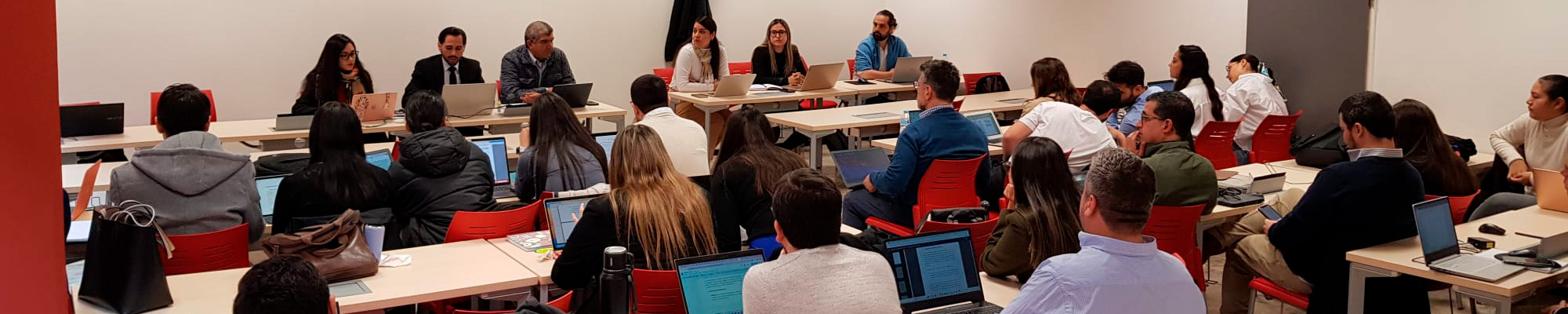

Felipe Aravena, student of the Master’s Degree in Law, Business and Justice, defends his Final Project on free tax legal assistance in Chile for low income taxpayers.
26 september 2017
Title: Right to defence and tax legal assistance in Chile
Author: Felipe Aravena Barrientos
Chile has an independent and specialised tax and customs justice. However, they didn’t consider the problems of a lacking institution capable of providing tax legal assistance to low income taxpayers, differing from other procedures, such has criminal, civil or labour. For these fields of law, specialised offices of the ombudsman were concurrently created.
Despite the right to defence is recognised in Chilean legal system, both constitutionally and in several international ratified treaties, there is actually no protection in this matter. Being a fundamental right, whose absence infringes the principles of the process, the State must guarantee the right to an effective defence.
Regarding the evolution of free legal assistance in Chile, they have go from a conception of an “honorific post” imposed to lawyers to its recognition as a fundamental right framed into the pertinent procedure, being direct consequence of the principle of equity under the law.
As for the content, legal assistance must be broadly considered, which includes previous advising and proper defence on trial in both administrative and judicial proceedings. Although the right to defence is expressly guaranteed in criminal cases, this must be extensible to any jurisdiction, ordinary or special, including tax matters.
The right to defence in Chilean legal system is recognised, but this protection does not extend to this matter. As a consequence, a fundamental right is being violated.
It is proposed the creation of a National Ombudsman for Taxpayers based on a staff system, considering the benefits of this model regarding specialisation and a broader geographiccoverage. It is an autonomous institution, combining public providers and private lawyers. These lawyers are selected by means of a tendering procedure, as it is the case of the Chilean Public Office of the Ombudsman for Criminal Justice, which provides more flexibility for the implementation and proper functioning of this institution.
Statistics prove that in Chile most part of business are small companies, being mostly unipersonal, which increases the risk of confusion in tax problems between the legal and natural person. It is also confirmed that most of these companies have low incomes, which can limit their access to Tax Justice - as they do not count on the support of a lawyer. All of this justifies the creation of the Public Office of the Ombudsman for Tax Justice.
He also mentions the use of alternative dispute resolution mechanisms in tax matters in Chile (ADR). These mechanisms have never been used until now in this area. In this sense, these mechanisms can be implemented and either considered out of the legal system or playing a role in the context of traditional forms of dispute resolution. In this last case, they should be incorporated to the procedures under tax administration and even in a previous stage during the audit process.
Apart from proposing the incorporation of mediation and conciliation as ADR alternatives, it is proposed the implementation of a sui generis mechanism denominated “previous tax evaluation”. It consists of the evaluation of the tax status of a taxpayer, but not by a public worker of the Tax Service, but for an independent and fair-minded person designated and paid by both parts on the basis of the supporting evidences and legal arguments. It would be a non-binding process for any of the parts involved, providing an impartial and early evaluation of the strengths related to the position of both parts - it also provides orientation regarding the probable result if the dispute ends in court.