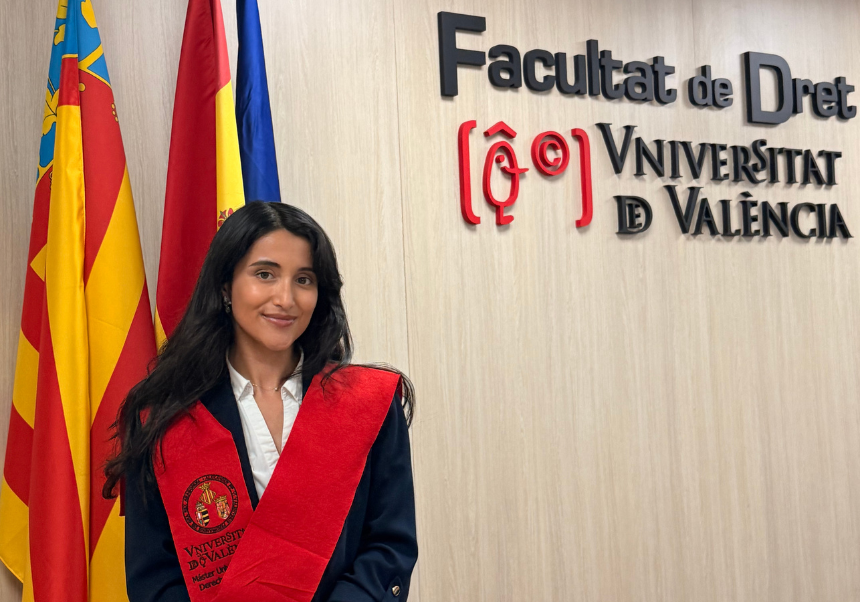
Last 23rd May, the student María José Sepúlveda Vilo defended her Final Master’s Project (TFM) in front of the evaluation committee of the Master’s Degree in Law, Business and Justice. She obtained an excellent, with a 9.5. Her defence was the final step of the demanding itinerary of the MUDEJ, and supposed a great source of satisfaction after months of research and constant work, besides the recognition of the honourable committee.
The project is called “Civil liability for damages caused by systems of Artificial Intelligence in the business activity – an approximation from the European Law”. It analyses one of the most urgent legal matters of nowadays, consisting in finding a response under the possible damage caused by AI in the business activity. The research is focused on the recruitment processes, insurance contracting, and lending. These are situations especially sensitive and representative in which AI currently intervenes.
Furthermore, the study has a particular relevance in a moment of normative transition, marked by the progressive application of the European regulations for Artificial Intelligence and for the withdrawal –in October 2025– of the proposal for a particular directive about civil liability in terms of AI, a circumstance that leaves the national tribunals without a harmonised framework to solve these assumptions.
The TFM was directed by Professor Dr Guillermo Palao Moreno, from the Department of International Private Law of the Faculty of Law. His support has been essential for the methodological guidance and the legal rigour of the project through all its development. The defence was carried out in front of an excellent committee composed by experts of different fields in relation with the project –Commercial Law, Private International and Artificial Intelligence. Led by Dr María Luisa Atienza Navarro, Dr Rosa Pla and Professor Dr Jesús Olavarria Iglesia, their assessment stood out because of the solid arguments and because of the timeliness and relevance of the topic, highlighting the exactitude in which the finale interpretative proposal was built.
As a main conclusion, the research supports that the current tort law –interpreted in the light of the obligations that the AI regulations and the GDPR impose– is already enough to answer the damages caused by AI systems in the business field, without the necessity of creating a specific regime of civil liability as a matter of urgency. This is a conclusion that does not come from an initial intuition, but from a progressive analysis that combines the dogmatic study of the classical categories of civil liability and a critical and updated reading of the European Union’s framework.
In this sense, the project offers specific interpretative criteria that can result useful both for legal practices and academic debates about the adaptation of Private Law to the challenges that artificial intelligence presents, in a subject that remains practically unexplored by the Spanish doctrine.
AWith her TFM’s defence, Sepúlveda Vilo closes a formative stage that combined the strength of traditional civil law with a critical and attentive look towards the challenges that new technologies create, being this an introduction to academic life, a path she plans to explore in the future.