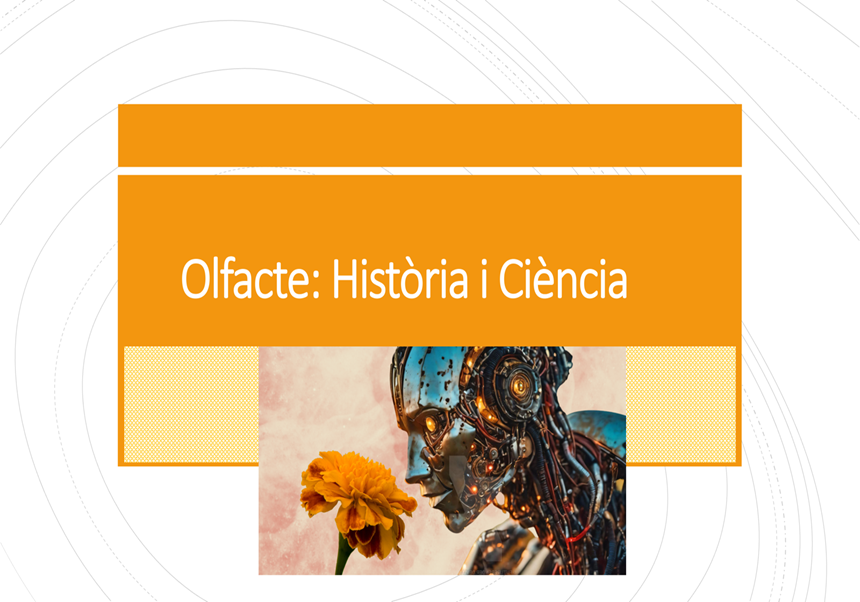
Anthony Synnott, one of the pioneers of studies on the senses, considered smell to be a "powerful sorcerer", particularly in terms of memory and emotions. Just a slight reverie transports us through years, activates unexpected and forgotten memories. There is no doubt that scents play an important role in our lives and in our social contacts. But we should not forget its role in cognitive processes either. Although smell has historically been undervalued—like taste and touch, relegated to "minor" senses in the Aristotelian hierarchy—its role in history and science is undeniable. The objective of the XII Morning of History and Science Teaching is to emphasize the importance of smell in history in general and in particular in the history of science. Tracing the "olfactory turn" of recent years across various disciplines can contribute to our knowledge of the past and to thinking about how to teach science today. The morning activities explore the landscapes and olfactory memories in different spaces and scenarios of science: they lead us to botanical gardens, alchemical laboratories, apothecarias, and other public spaces. Once again, the preceding hierarchies are called into question, inviting us to explore innovative and increasingly complex views of history.
Program:
February 20, 17:00, IILP-UV
Flavors and smells of chocolate (workshop), Marta Manzanares Mileo, UAM, Madrid
Is it possible to recreate the culinary past? Flavours, textures and smells hardly leave traces in documentary and visual sources, which poses a fundamental challenge for the history of food. This practical workshop proposes to reflect on culinary recreation as a method of historical research. Starting from the preparation and tasting of a seventeenth-century chocolate recipe, we will explore the sensory, social and performative dimension of its production, and reflect on the possibilities and limitations of this approach. The workshop invites us to think of the kitchen as a privileged space to be able to approach the historical experience through the body, the senses and practice, beyond the reading of recipes.
27 February, 17:00, IILP-UV
Smell: History and Science (José Ramón Bertomeu Sánchez, Jana Černá, IILP-UV)
Jana Černá, The Forgotten Sense: An Introduction to the Cultural History of Smell
The paper shows that smell, considered a minor sense in traditional classifications, is actually a fundamental key to memory, emotions and culture. Far from being just a biological function, smell and aromas have historically served to cure, classify, remember and even exclude and morally judge entire people and societies. From sacred perfumes and medical remedies to the stench associated with sin and poverty, smells have shaped social hierarchies, urban landscapes and cultural clashes between different worlds. Exploring the history of smell allows us to understand that what smells good or bad has never been universal, but deeply historical and cultural, and that what we breathe every day also shapes who we are and how we understand the world.
José Ramón Bertomeu Sánchez, The Smell of Blood: Evidence, Science and Justice
With this presentation we will review the changing character of Nazarenes and smells within the no less changing context of law and legal medicine of the nineteenth century. The various olfactory landscapes of courts and laboratories will allow us to reflect on the production of expert evidence through the sense of smell. They also allow us to investigate the changing epistemic values attributed to odors and their reliability within laboratories, public health, and criminal investigations. With the case of different surprising episodes, which could be a starting point for creating learning situations, we will review aspects of the history of the senses connected to old and new topics in the history of science, technology and medicine." More details:https://sabersenaccio.iec.cat/lolor-de-la-sang/
February 28, 9:00, IILP-UV
Smells, flavours and textures of a medicinal flora of the Mediterranean (José Pardo Tomás, IMF, Barcelona)
We will deal with three things. How half a thousand plants, certain parts of animals and some mineral products, from the Mediterranean and the Middle East were mobilized to deal with people's diseases. How this arsenal of medicinal remedies multiplied from the expansion of Islam, first, and then from the European colonial powers. And how the smells, tastes and textures of these products of nature were the basis for building rational knowledge about their healing properties.
28 February, 11:30, IILP-UV
Aromatic plants (workshop). Ginkgo Education, Botanical Garden
A sensory and informative tour is proposed around aromatic and medicinal plants. During the activity, there will be a guided tour of the botanical garden, where different species will be identified and their historical, scientific and cultural importance will be explained.
The workshop will address the role of aromas, their traditional uses in medicine, hygiene and rituals, as well as an introduction to the active ingredients and basic methods of aroma extraction. As a practical part, participants will make a bag of aromatic dried plants, combining different species and learning about their properties, to take away an applied experience that connects science, memory and sense of smell.
Speakers:
José Pardo-Tomás received his PhD in History of Science from the University of Valencia and since 2006 he has been a scientific researcher at the Milan and Fontanals Institution for Research in the Humanities (CSIC, Barcelona). It develops two main lines of research: knowledge and practices on natural history and medicine, with special emphasis on the relations between colonial and metropolitan areas during the sixteenth and seventeenth centuries; and the history of naturalistic and anatomical collections from the sixteenth century to the present day, their spaces (cabinets, gardens, theatres, museums...), actors and actresses and their communication networks (travel, correspondence, academies and societies, publications, teaching...). His latest book (co-edited with Elisa Andretta) is Dioscorides before the World. Usos plurales de un 'libro-laboratorio' en la Edad Moderna (Madrid, CSIC, 2025).
José Ramón Bertomeu is Professor of History of Science at the University of Valencia and a member of the López Piñero Interuniversity Institute. Initially trained in Chemistry, he obtained his PhD in History of Science with a thesis on Napoleonic scientific policies and scientific exchanges between Spain and France in the early nineteenth century. He has carried out research stays at institutions such as Yale, Harvard, the Max-Planck-Institut für Wissenschaftsgeschichte and the Science History Institute of Philadelphia. His research focuses on the social and cultural history of science, especially toxicology. His recent books include Toxics: Past and Present (Barcelona, Icaria, 2022) and, together with Carmel Ferragud, Entre venenos: Crímenes y castigos desde la Edad Media hasta la actualidad (Valencia, Bromera, 2023). He is editor of the history of science manual Saberes en acción: A new history of science, technology and medicine: https://sabersenaccio.iec.cat/.
Marta Manzanares Mileo is a Ramón y Cajal contract researcher at the Autonomous University of Madrid. She holds a PhD (laude, international mention) and a degree in History from the University of Barcelona, and a European Master's Degree in History and Culture of Food from the University of Barcelona, the GIV François Rabelais de Tours and the Università di Bologna. Between 2020 and 2022 she enjoyed a Marie Skłodowska-Curie Individual Fellowship at the University of Cambridge with the SWEET project. Her research focuses on the history of food in the Modern Age, in particular sugar, with a special focus on its social, cultural and gender dimensions.
Jana Černá holds a PhD in History of Science and a PhD in Philosophy from the University of West Bohemia. She has been a professor and researcher at this university, a researcher at Charles University in Prague and a Marie Curie Fellow at the CCHS (CSIC, Madrid) and UNAM (Mexico) with the HISPANEMA project (2019–2022), as well as a John Carter Brown Fellow (Brown University, 2023) with the project The Olfactory Memory of the Mexican Flora and European Sensibilities. She is currently an assistant doctor in the Dept. of History of Science and Documentation of the UV and a researcher at the IILP, UV. His research focuses on the natural history, materia medica and natural philosophy of the sixteenth and seventeenth centuries, especially in the Ibero-American sphere and its connections with Central Europe. He has co-edited, together with Juan Pimentel and Angélica Morales, the book La memoria de los sentidos: El Nuevo Mundo y los sentidos menores (CDMX, Siglo XXI Editores, 2024) and is currently preparing the monographic book The Invisible Empire: The Hidden Lives of American Natural Curiosities in Early Modern Central Europe.
Ginkgo Education is an educational organization specialized in environmental education and scientific training for all audiences. It offers workshops, courses and educational activities on nature, science and the environment, both face-to-face and online, adapted to different educational levels and ages. Since 1999 it has also worked in collaboration with the Didactics Office of the Botanical Garden of the University of Valencia, managing educational and informative activities, and developing training actions for schools, families and adults with a scientific and creative perspective.
Collaboratos: Servei de Llengües i Política Lingüistica de la Universitat de València.