

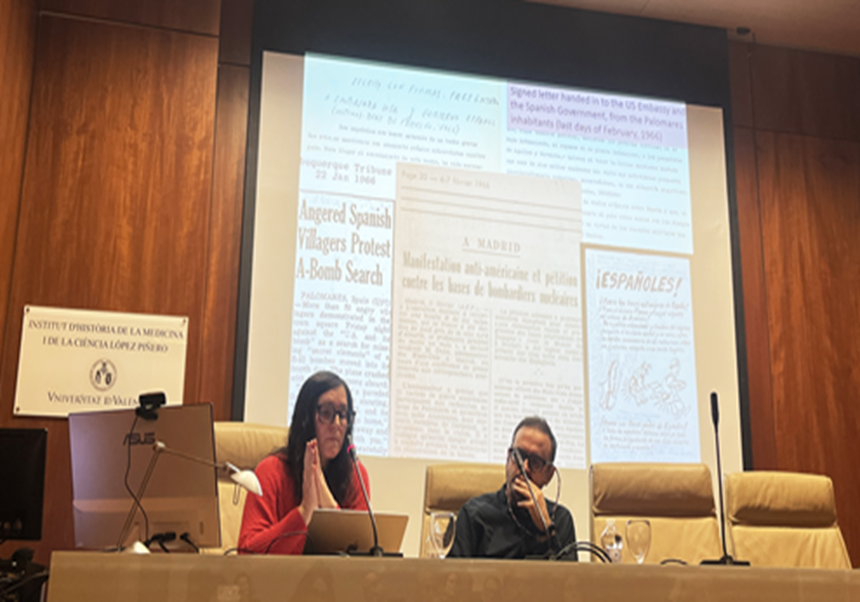
On Thursday, 20 November 2025, the seminar Diplomacy, Science and Technology: The Public Strategy of the Palomares Nuclear Disaster (1966) was presented by Clara Florensa, PhD in the history of science and Ramon y Cajal researcher at the Spanish National Research Council (CSIC-IMF, Barcelona). The seminar, organised by the Interdisciplinary Study Group on Francoism (Interfranc), was held at the López Piñero Interuniversity Institute's UV headquarters.
The seminar focused on the relationship between science and diplomacy through an analysis of the management of the diplomatic crisis caused by the Palomares nuclear accident in 1966. This accident occurred when two US Air Force aircraft collided during an aerial manoeuvre over Almería. One of the aircraft was carrying four nuclear bombs, three of which fell to the ground while one fell into the sea and remained lost for three months. The radioactive material from the bombs that fell to the ground spread over a vast area of land that was inhabited and cultivated. Florensa explained that the accident led to an international political crisis, so the United States used all the resources at its disposal to minimise the damage in order to calm Spanish public opinion and prevent its reputation from being seriously damaged.
Clara Florensa explained that the archives of Anger Biddlen Duke, US ambassador to Spain at the time of the accident, show the authorities' concern about its impact on tourism, despite the supposed safety guarantees from Spain and the US Atomic Energy Commission. The accident also affected the 1953 agreements between the United States and Spain, which allowed the installation of US military bases on Spanish territory, as after the nuclear accident both governments avoided questioning the presence of the military bases. On the other hand, Dr Florensa argued that what had happened presented a problem for Spain, as the Spanish community feared the radiological risk to health and the environment, and this anti-nuclear sentiment, combined with anti-American sentiment, posed a threat to the nuclear agreements between the two countries. To calm this reaction, science, scientific instruments and technology were of utmost importance in the diplomatic strategy that was carried out.
According to Clara Florensa, in the history of public diplomacy, some scholars have pointed out that visual and performative diplomatic actions attempt to capture the imagination of the media and the public, yet academic interest in visual scientific diplomacy has been scarce. Studies on the history of scientific diplomacy focus mainly on relations between social elites. An example of scientific diplomacy would be the history of nuclear diplomacy, as it requires the establishment of processes involving international negotiations, such as radiation protection standards, which require the collaboration of scientists and diplomats.
The researcher explained that the solution to the public crisis triggered by the Palomares nuclear accident was based on what could be called public and visual diplomacy of a scientific and technological nature. A few days after the accident, there was media pressure, especially internationally, regarding the consequences of the accident, which could lead to speculation due to the policy of not commenting on the matter and the various unresolved issues. One of the bombs was still lost at sea, the consequences of the contamination in the Mediterranean waters were unknown, as was the state of the crops and fields where the other bombs had scattered plutonium. The consensus among the authorities was that positive action powerful enough to curb the damaging news was required. That is why one of the best-known diplomatic actions of this campaign against media speculation was carried out, namely the famous swim by the US Ambassador to Spain and the Minister of Information and Tourism on a beach a few kilometres from Palomares on 8 March 1966. This act of scientific diplomacy was carefully orchestrated, as those involved had to follow a specific script, appearing cheerful and carefree, as if they were on holiday.
On the other hand, Florensa analysed the process of circulating technological images as a strategic communication plan to manage the public crisis. Controversial elements that caused fear and potential danger, such as protective clothing or radiation detectors, had to be eliminated. That is why images of the search for the bomb, such as those of the deep-sea submersibles Deep Jeep, Alvin and Aluminaut, were the protagonists of this campaign. After the images were authorised, the Spanish press displayed the naval devices in large-format reports with detailed explanations. In addition, the researcher explained how the premiere of the James Bond film Thunderball, which dealt with the loss of bombs at sea, was used as a comparison and a press campaign. Finally, the image of the nuclear bomb recovered from the sea on 7 April 1966, almost three months after the accident, brought this public campaign strategy to an end and was considered the final act of the Palomares accident.
This entire campaign, together with media coverage, spread a propaganda image of the United States as a saviour and a technologically superior power due to its ability to conduct deep-sea searches and surveillance, even though military technical reports revealed that the submarines used were ineffective and had serious technical limitations. At the same time, the media campaign diverted attention from nuclear contamination on land, such as in crops, and the radiological risks to people, ignoring the bombs that fell on land, broke and contaminated it with plutonium. To calm public opinion, a key technological element was the whole-body counter, which was a very advanced device for its time, but ineffective in detecting plutonium in humans. The whole-body counter was sent as a diplomatic gift to Spain by the US government as part of the Otero-Hall agreement.
The researcher explained how the whole-body counter acted and played the role of a diplomat, improving the image of the United States, especially in the Spanish public sphere, strengthening relations between the United States and Spain, and contributing to scientific and commercial exchange. The inhabitants of Palomares experienced the contradictions between what was happening on their land and what was being reported in the media, trying to comment on what was happening to them through letters to the press and demonstrations during the dictatorship. Thus, the arrival of the whole-body counter was announced as the device that would finally prove that the population of Palomares was not contaminated by radioactivity. The press described it as a highly sophisticated device, but omitted to mention that specific committee reports had concluded that this technology was not useful for monitoring the general public. Clara Florensa explained that to this day, the inhabitants of Palomares are measured by the whole-body counter and that all this established scientific hierarchies between Spain and the United States, placing US scientists as the leading experts on this issue.
To conclude the seminar, Clara Florensa invited participants to reflect on the politics of scientific instruments and technology and how they have the capacity to perform diplomatic tasks. The whole-body counter was a diplomatic gift in compensation for the radioactive contamination that still exists in the area. Scientific and technological images and imagery played a leading role in the public and media management of the crisis generated by the Palomares accident. All this crisis management served to reinforce unequal political and scientific relations and project an optimistic narrative that concealed the presence of radioactive contamination, demonstrating the power of visual and scientific diplomacy in the public management of disasters such as Palomares.
Ivania Maturana, extracurricular internship student in the Interuniversity Master's Degree in History and Communication of Science.



