Date: 29 January 2026, 05:00 p.m.
Format: online Zoom Access code: 452319
Speaker: Wiara Rosa Alcântara (UNIFESP). Moderator: Eduardo Galak (University of La Plata)
Abstract
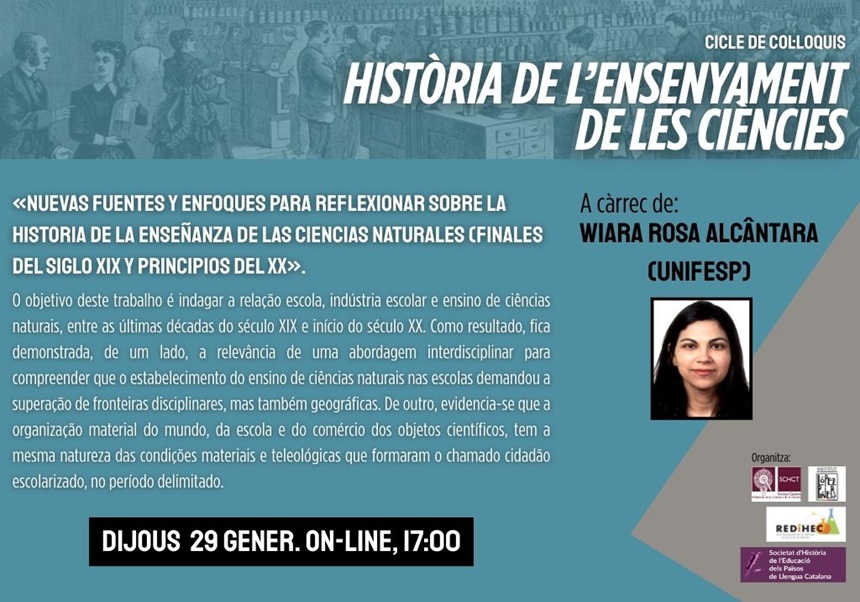
The aim of this study is to investigate the relationship between schools, the education sector and the teaching of natural sciences between the last decades of the 19th century and the early 20th century. To this end, two types of documents produced in the field of commercial law and foreign trade will be analysed. First, the ‘Statistical Maps of Trade and Navigation of the Port of Rio de Janeiro’ will be examined. These contain data on foreign trade and the export and import of goods from 1841 to 1891. Organised and published by the Port of Rio de Janeiro Customs Office, with the authorisation of the Minister of Finance, the Maps are a valuable source for the study of foreign trade related to school and scientific goods. They contain information on direct exports to other countries; direct imports from other countries; duty-free imports under laws, orders and contracts; sailing and steaming in and out; re-exports, among other data. These documents show not only the material conditions of transoceanic trade, but also the material conditions for the acquisition of objects for the teaching of natural sciences in the period in question. Secondly, bills of lading are other documents issued in the maritime modality, as a requirement for customs clearance. Customs clearance is a fiscal procedure carried out in the context of foreign trade. This method examines the accuracy of the data declared by the importer/exporter on the imported/exported goods. The bill of lading is a document, a contractual instrument for the transport of cargo by sea, signed between the sender and the carrier. Through this document, the competent authorities and legally interested parties can verify the accuracy of the data provided by the importer/exporter in relation to the imported/exported goods. From the data provided, the investigator can identify the company that sold and shipped the goods, the institution that purchased them, the date, value, and weight of the purchase of the scientific objects. The methodology consists of an analysis of both the form and content of the documents, comparing them with other sources that provide information on the request and acquisition of scientific objects for educational institutions. As a result, it demonstrates, on the one hand, the relevance of an interdisciplinary approach to understanding that the consolidation of natural science teaching in schools required overcoming disciplinary, but also geographical, boundaries. On the other hand, it is evident that the organisation of the material world, schools and the trade in scientific objects share the same nature as the material and teleological conditions that shaped the so-called educated citizen during the period in question.