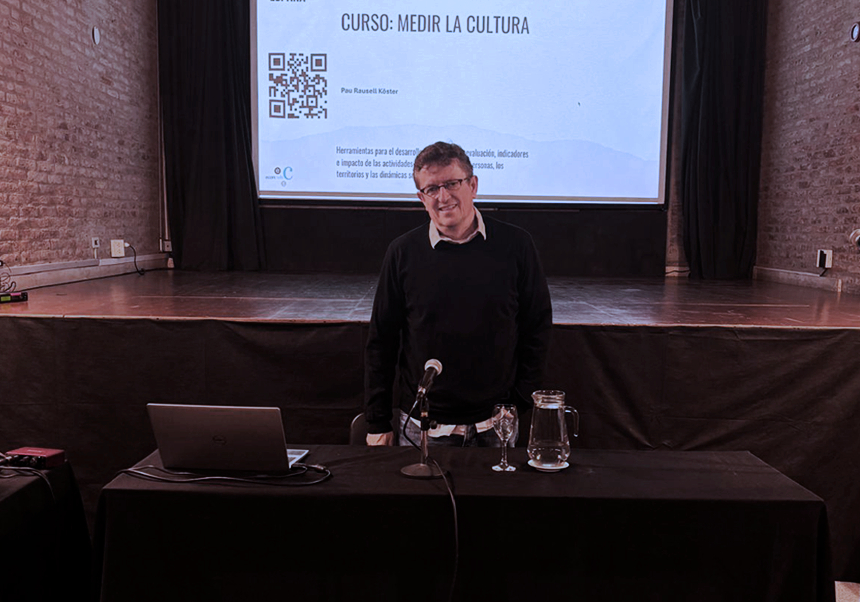
The coordinator of ECONCULT is participating from 22 to 24 July in a training programme at the Centro Cultural Parque de España in Rosario, focused on measuring cultural impact and developing indicators for public policies.
Pau Rausell takes part in a workshop course on cultural indicators and public policy evaluation in Argentina
The coordinator of ECONCULT is participating from 22 to 24 July in a training programme at the Centro Cultural Parque de España in Rosario, focused on measuring cultural impact and developing indicators for public policies.
Pau Rausell-Köster, coordinator of ECONCULT and professor in the Department of Applied Economics at the University of Valencia, is taking part in Rosario, Argentina, in the workshop course “Cultural Indicators: Cultural Impact and the Development of Indicators for Cultural Public Policies”, organised by the Centro Cultural Parque de España within the framework of the ACERCA Programme for training and development in the cultural sector, promoted by Spanish Cooperation.
The theoretical and practical training programme is being held in person from 22 to 24 July 2026 and aims to explore methodologies for developing cultural indicators, with particular attention to local and regional contexts and to the complexity involved in measuring the cultural sectors. The programme considers indicators to be essential tools for evaluating cultural public policies, strengthening strategic planning and contributing to the consolidation of cultural democracy.
Cultural indicators, impact and public policies
The course addresses the methodologies available for measuring culture, the construction of indicators and the evaluation of the social, economic and cultural effects of public policies.
The programme combines theoretical and practical content, with particular attention to local and regional contexts.
During the first session, Pau Rausell delivered the module “Cultural Economics: The Social Science that Facilitates Measurement”, which focused on the different methodologies available for analysing culture, including cultural statistics, satellite accounts, impact studies, indicator systems and the use of big data. The module also addressed a political and methodological question: what do we decide to measure, and why?
Rausell’s second contribution, entitled “The Transformative Impact of Culture: The Convergent Model”, addressed the need to define more precisely the different effects attributed to culture. The session distinguished between the intrinsic objectives of cultural action—such as the fulfilment of cultural rights, individual resonance and the value of cultural experience—and its instrumental uses in areas such as economic development, social cohesion, innovation, well-being and sustainability.
The course concludes with a third module, jointly delivered by Pau Rausell and Natalia Calcagno, focusing on the transition from theoretical models to practical measurement. This session analyses the tensions and decisions involved in constructing indicators to measure cultural impact and presents two reference models developed in Spain and Argentina, including the experience of ECONCULT.
The programme also includes several sessions led by Natalia Calcagno on the evaluation of cultural policies and projects, as well as a final panel devoted to contemporary cultural research practices and methodologies. Representatives of cultural observatories and networks from Chile, Mexico and Argentina are participating in this session, with the aim of sharing local and regional experiences and promoting collaborative networks in the field of cultural research.
Pau Rausell’s participation in this initiative strengthens ECONCULT’s international profile and its contribution to the development of tools capable of generating evidence, evaluating the effects of culture and improving the design of cultural policies.