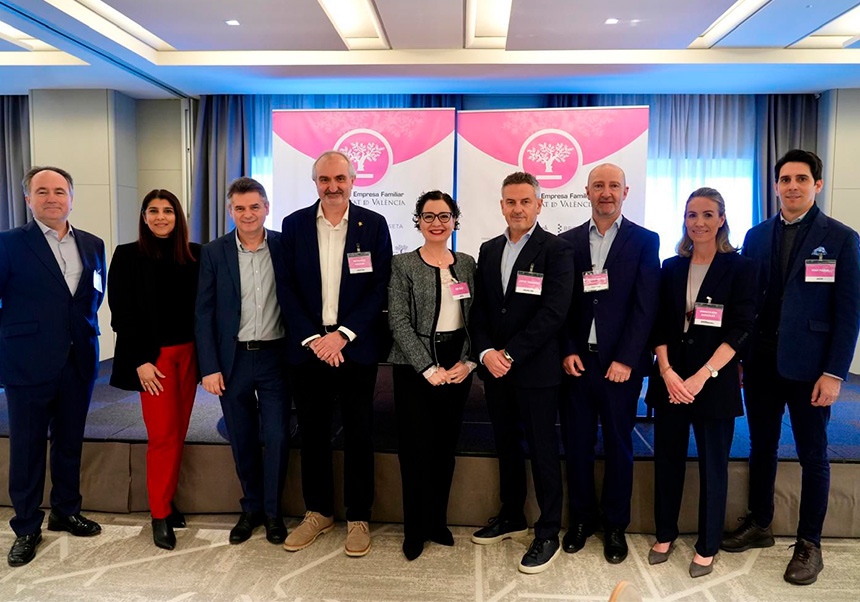
Valencia, March 10, 2026. The Chair of Family Business of the University of Valencia (CEFUV), promoted by the Valencian Association of Entrepreneurs (AVE), EDEM Business School, the Valencian Institute for the Study of Family Business (IVEFA), the Family Business Institute (IEF), and the University of Valencia (UV), and supported by CaixaBank and Broseta, organized today a new breakfast discussion aimed at demystifying the fear surrounding the professionalization of family structures, a pending challenge in many organizations.
Under the title “Afraid of Family Governance? Advantages and Challenges of Establishing a Family Council,” the meeting featured the experience of Bernardo Gregori, President of the Family Council of Grefusa, and Jorge Tarazona Soriano, President of the Board of Directors of Grupo Tarazona Soriano Diversificación (Grupo TSD). The discussion was moderated by Inmaculada González, founding partner of Systemicall, and highlighted the importance of governance in ensuring continuity, cohesion, and professionalization in family-led organizations.
The power of dialogue and constant communication
The central theme of the event was the need to foster communication in order to reach solid agreements. The speakers agreed that the institutionalization of the business family is not a bureaucratic procedure, but rather a space for dialogue and the exchange of ideas related to both the family and the business. In this regard, Bernardo Gregori emphasized that “a Family Council does not begin with a regulation; it begins with conversations.”
Grefusa, a Valencian family business with more than 95 years of history and a leader in snacks, nuts, and baked products, explained how its third generation marked a decisive moment to organize its governance structure. Bernardo Gregori pointed out that when the company reached that stage, the family understood that it needed to establish a model that would allow it to anticipate challenges before they emerged, thus strengthening the foundations for the future. During this process, the family worked to identify and reinforce values such as perseverance, continuous innovation, and the importance of reputation, which have been transmitted from generation to generation.
Bernardo Gregori reinforced this idea with clear advice for other families: “The Family Council does not guarantee the success of a family business, but its absence increases the risk of failure.” He also highlighted the direct impact of transparent communication: “Having a Family Council has helped us achieve greater cohesion and a stronger sense of belonging and pride. Conversations that did not exist before now take place and help prevent conflicts.”
In line with this perspective, Jorge Tarazona agreed that the success of this process lies in the search for common agreement and expert support: “We started with an external advisor; it was a very comprehensive exercise for the family. Everything was approved unanimously. We prefer to reach a consensus.” Therefore, his recommendation is not to embark on this journey alone, but to rely on specialists.
Finally, Inmaculada González concluded the discussion by outlining a roadmap for taking the first step. According to González, it is essential to begin “training” in governance, since “many families start this path on their own, especially first-generation companies, but if the business family has that concern, it is good to begin learning. One way to start is by incorporating external advisors or independent members first into the governance of the company and later into the governance of the family. These are different stages and different perspectives.”
Education and the role of the next generation
The breakfast also addressed the preparation of generational succession as a continuous learning process and highlighted the importance of educating the next generations. In this regard, Grupo Tarazona Soriano Diversificación (TSD) served as an example of evolution. Comprising five companies in key sectors —such as agronutrition, natural ingredients, and strategic consulting— the group explained how its transition from the first to the second generation has taken place.
Jorge Tarazona acknowledged that for many years TSD’s focus was exclusively on growth and reinvestment, without opening spaces for dialogue about the long-term future: “Our transition happened very naturally. But it is true that for many years we only focused on working, reinvesting, and growing, and we had never talked about how the company would evolve or what the future would look like. We trained a lot and gradually we have been evolving.”
This commitment to education played a key role in the company’s transformation, particularly during the collaborative work with an external advisor, through which they established a decision-making style based on unanimous consensus and a forward-looking perspective. Tarazona also delivered an optimistic message about the role of young people in this new context: “Family business is now studied at universities, and the new generations are very well prepared. This is very positive for the continuity of family businesses. It is very important to be well trained in order to later become part of the boards of directors of family businesses.”
Anticipation: building governance in times of calm
Another major topic discussed was the ideal moment to structure governance. From her experience at Systemicall, Inmaculada González warned about the importance of “being more afraid of improvisation than of governance.”
The entrepreneurs supported this view by warning about the risks of acting too late. “If you wait until a problem arises to organize yourself, you are already too late. Family governance must be built in times of calm,” explained Bernardo Gregori, acknowledging the process experienced at Grefusa: “We became aware of the importance of governance in the third generation, and you often do not dedicate time to these issues. We realized that the third generation was growing and that we had to start putting things in order.”
For his part, Tarazona recommended anticipating transitions: “A good moment is before the next generation has entered the company. Without precedents, it is easier.”
The Family Council: a driver of unity, values, and strategy
Throughout the breakfast, it was emphasized that long-term success requires formal tools. As Inmaculada González pointed out, “More than 90% of companies in Spain are family businesses and they generate more than 70% of private employment. The longest-lasting family businesses usually have governance structures and good governance practices in place,” adding that “talking about continuity, the future, and how business and family coexist is the starting point for talking about family governance.”
Jorge Tarazona was emphatic about the importance of this structure within Grupo TSD: “It is of vital importance that family businesses have well-structured governing bodies, both family and professional, with clearly defined responsibilities.” According to Tarazona, “The Family Council and the Family Assembly are very valuable instruments for establishing values and aligning the family strategy with the business strategy,” confirming that in their case “the Family Council has provided us with values, unity, alignment, and strategy.”
At Grefusa, the Family Council has also been key in balancing forces and protecting the business project: “There is one rule: whenever we make a decision, we all take ownership of it and carry it out. In the Family Council we are all equal. There is no hierarchy. The goal is to stay aligned and preserve the company,” explained Gregori.
To conclude, Alejandro Escribá, Director of the Chair, offered a clear takeaway: governance is not only a management tool but also a strategic element that ensures continuity, cohesion, and stability in family businesses. Education, dialogue, professional guidance, and anticipation are key factors for preparing future generations and preserving the legacy, while promoting a renewed and sustainable vision of the business project.
Images:

.jpeg)
.jpeg)
.jpeg)
.jpeg)