

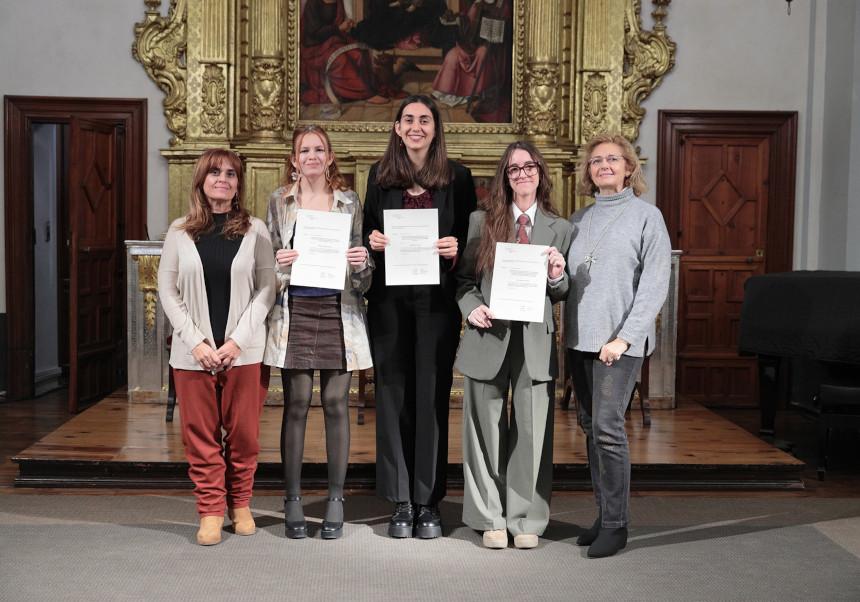
The Universitat de València, through the Cultural Heritage Area, has celebrated the 4th edition of the awards for the best Master’s Degree Final Project (TFM) on cultural, natural, scientific and technological heritage. These prizes are for the best projects carried out by university’s students on its various heritage collections (historic-artistic, of natural history, botanic, ICT, scientific-medical, astronomical observatory or education, among others).
The call, with 3500 euros (a first prize of 1500 euros and two other prizes of 1000 euros each) intends to promote interest for cultural, natural, scientific and technological heritage of the Universitat and its dissemination in the university context and society in general.
The palaeontologist Josefina Ochoa has won the first prize with her work Análisis sistemático de nuevos restos de Hipparion (Perissodactyla, Equidae) procedentes de un yacimiento del área de Concud (Teruel).
Her research focuses on characterizing a recent addition of equid fossil remains to the collection of the The Natural History Museum of the Universitat de València (MUVHN), donated in 2022 by a private collector. The study carries out quantitative and phylogenetic analyses comparing these remains with Hipparion species documented on the Iberian Peninsula, with the aim of identifying the most closely related species or determining their classification with genus.
One of the 1000 euros prize has been given to Desirée Vacas for her work Efectos de las epizootias por morbillivirus sobre la abundancia y estructura poblacional del delfín listado, Stenella coeruleoalba, en el Mediterráneo occidental.
The biologist specialised in Biodiversity, Conservation and Evolution analyses how epizootic registered in 1990 and 2007 affected the population of this Mediterranean species, drawing on the extensive database of the Stranding Network of the Marine Zoology Unit at the University of Valencia, officially established in 1990, although with activity since 1980. The study examines whether the arrival of dolphins with different morphometric characteristics occurred during these high-mortality episodes; additionally, it evaluates how these events may have affected the population in the long term, particularly regarding abundance, size, and age structure.
Laura Monroy, historian specialised in the construction of ‘otherness’ and in historical-artistic heritage, has been awarded with another prize for her work Construyendo al otro: mudéjares, judíos y conversos de la Corona de Aragón en albores de la modernidad. Puesta en valor del patrimonio multicultural valenciano a través de un proyecto expositivo.
Her proposal presents an educational exhibition project aimed at democratising culture and fostering critical thinking through educational resources accessible to all audiences. Likewise, the project seeks to highlight a multicultural narrative through heritage pieces belonging to the Universitat de València, contributing to their revaluation and dissemination among citizenship.
The evaluation committee was composed by Marcos Durà, delegate of the principal for Students; Marisa Vázquez de Ágredos, principal of Cultural Heritage UV; Anna García, delegate of the principal of The Natural History Museum; Jaime Güemes, principal of the Botanical Garden; and as secretary, Ana María Chillarón, management technician in La Nau Cultural Centre.
The call highlights the importance that the Heritage of the Universitat de València has in the educational development of students enrolled in different official Master’s Degree programmes, to find in the university’s preserved heritage collections, the cultural and scientific interest necessary for their TFM that will be the end of a period. It is a legacy with an immense historical value, which contributes to our memory and identity as an institution, the study of which has been enriched through outstanding researches such as those recognised in this fourth edition.
Links:



