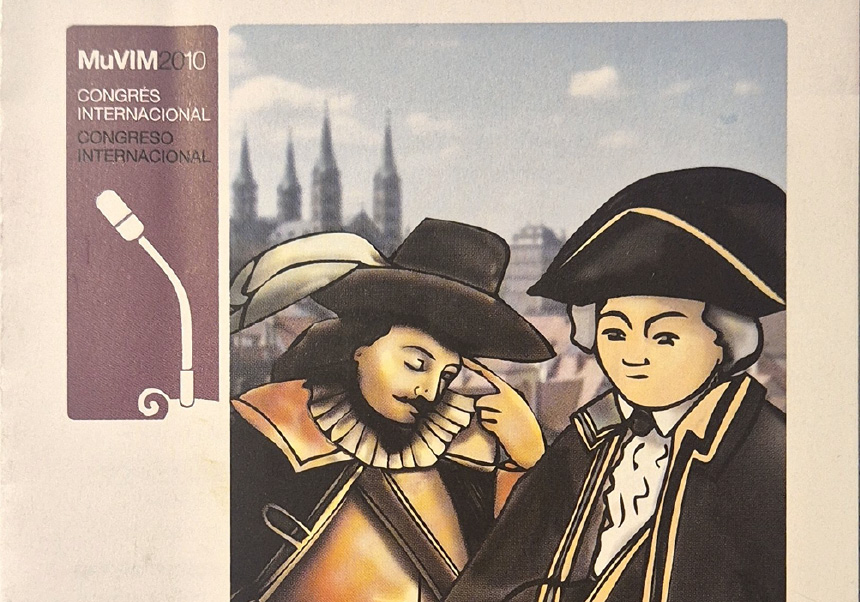
From 26 to 28 April 2010, the RIALE research group of the Universitat de València organises the International Congress «Estereotipos interculturales germano-españoles» (‘German-Spanish intercultural stereotypes), a scientific meeting, which gathers national and international specialists to analyse the images, perspectives, and cultural representations, resulted from the relationship between Spain and German-speaking countries. Te congress is held in cooperation with Museu Valencià de la Il·lustració i de la Modernitat (MuVIM).
The initiative is part of the research trajectory of the group, aimed at the study of Hispanic-German literary and cultural relationships. The main goal of the meeting is to foster the academic discussion on the construction of stereotypes, clichés, topics, and common places of a social, religious, and linguistic nature that have historically marked exchanges between both cultures.
During the different sessions, the participants tackle issues related to heterostereotypes and the images of the other, the selfstereotypes present at German literature, the literary origin of several cultural topics, and the theoretical aspects linked to the definition and delimitation of the different forms of stereotyped representation.
The congress pays special attention to travel literature, one of the main research lines developed by RIALE, since they constitute a privileged space for the analysis of mutual images built between Spain and the German-speaking field. Travel stories allow to study both intercultural knowledge processes and the creation and spreading of collective imaginaries, which have conditioned the mutual perception between both cultural spaces.
Scientific organisation is undertaken by researchers Berta Raposo, Ingrid García Wistädt, María José Gómez Perales, Isabel Gutiérrez Koester, Reinhold Münster, Ferran Robles, and Eckhard Weber, who promote through this meeting a space for reflection on cultural relations between Spain and the German-speaking world.
With this congress, RIALE establishes its role as a benchmark for the study of Hispanic-German interculturality, and reinforces a line of research that will keep being developed the years forward through projects, publications, and new scientific initiatives dedicated to travel literature and cultural transfer between Europe and Spain.