- Universitat de València (55%)
- Universitat Jaume I (45%)
- Abargues Lopez, Rafael
- PDI-Prof. Permanent Laboral Ppl
- Saura Aviles, Alejandro
- PI-Invest No Doctor Uv A1
- Julio Sixto Giménez
Nowadays, there is a growing need to generate the green energy from renewable sources. One of the sources is generation H2 from water hydrolysis. So far, the manufacture of new metal oxides in a metal-organic matrix capable of producing hydrogen has not been described or suggested, nor the production of the improved hydrogen compared to methane reformed, which also has the disadvantage of leaving a significant carbon footprint.
It is desirable to provide green energy to fight with the climate change by generating the H2 capable of producing the hydrogen with lower reaction activation energy and at the same time leaving no carbon footprint. The H2 has use, for example, as a fuel for electricity generation in a fuel cell, one very promising solution for being a completely clean and recyclable energy, since its combustion generates H2O as a product of the reaction, which avoids carbon footprint.
Therefore, there is a need to provide an improved electrocatalytic electrode or electrocatalyst for hydrogen production, low-cost and that can be fabricated using techniques that are scalable at the industrial level and whose techniques are also low-cost.
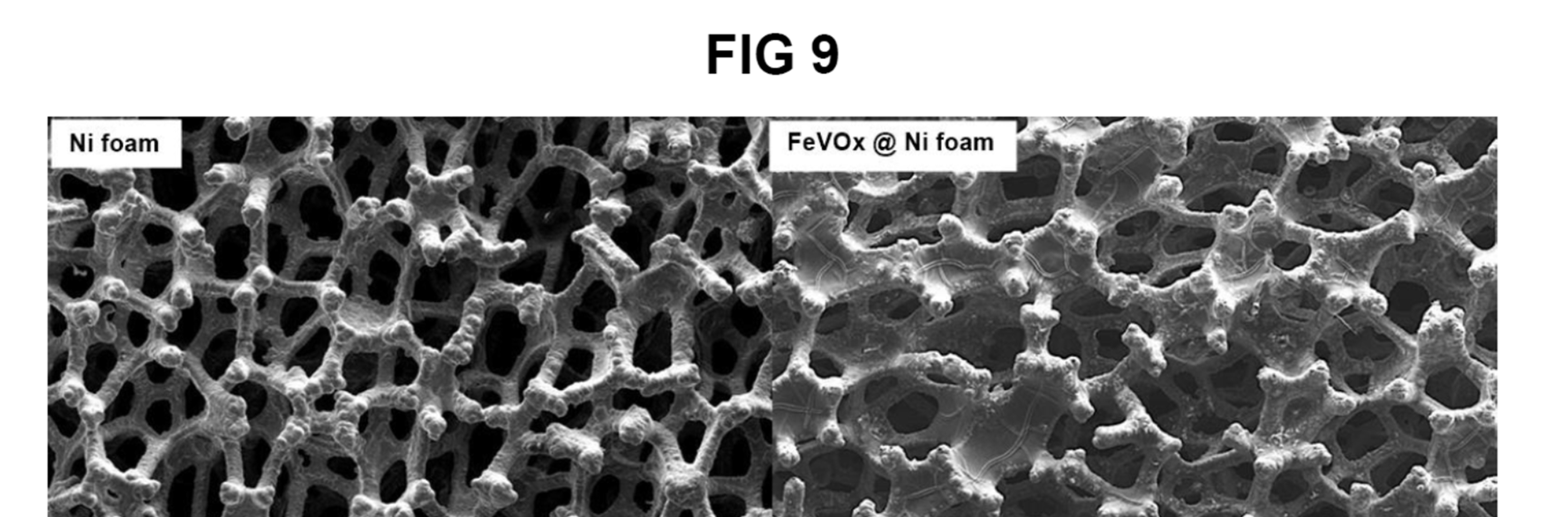
Personal investigator of the Universitat of Valéncia and the Universitat Jaume I have developed an invention which refers to a method of chemical synthesis and deposition of layers of mixed oxide of Fe (III) and non-stoichiometric vanadium (IV and V) (FeVOx). These discoveries are the base for the development of catalysts which may be applied in photoelectrocatalysis for the generation of H2 and O2 from water hydrolysis (water splitting) as well as in photocatalysis for the synthesis of metallic nanoparticles with biocidal activity and oxygen reactive species catcher. The manufacturing method use is easily scalable and compatible with some catalyst that can be applied in photoelectrocatalization for the generation of H2 and O2 from continuous roll-to-roll, printing cnic water hydrolysis.
The main application of this material is its use as an electrocatalizer of mixed iron (III) oxide and non-stoichiometric vanadium (IV and V) (FeVOx) in ultrafine film form. This material has shown very promising results for the oxidation of water to O2 (necessary process for the production of H2) as well as for multifunctional coatings with biocidal activity and capture of EROs for food preservation.
The main advantage of the invention is the reduction in the cost of the technology for water hydrolysis, by reducing the cost of the material used (FeVOx) as well as the ease of manufacture/deposition of the catalyst.
Moreover, the invention shows photocatalytic properties in the synthesis of nanoparticles on its surface, inside polymers for the manufacture of multifunctional coatings for plastic packaging with a biocidal activity and for the capture of reactive oxygen species that possess properties REDOX that cause the break of food and contaminants in the water and air. The invention presents photocatalytic properties for the synthesis of metal nanoparticles because it can generate polymers internally by curing with ultraviolet light.
- Patent applied
Blasco Ibáñez Campus
C/ Amadeu de Savoia, 4
46010 València (València)