

Conferencias al DAA. Charla a cargo del profesor José María Torelles , del Institut de Ciències de l'Espai, CSIC/IEEC, Barcelona. Lugar: Seminario del Departament d'Astronomia i Astrofísica, 4ª planta del Edificio de Investigación, en Burjassot. Dia: martes 8 de enero 2019. Hora: 12:00.
RESUMEN:
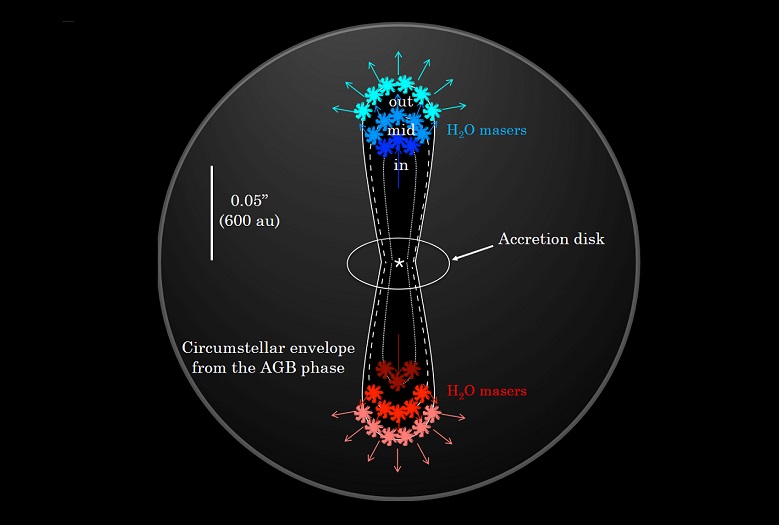
Water fountains (WF) are evolved stars showing early stages of collimated mass-loss during transition from the asymptotic giant branch, providing valuable insight into the formation of asymmetric planetary nebulae. In this talk, we introduce the results of our multi-epoch VLBI observations published in Orosz et al. (2019; MNRAS, 482, L45), which determine the spatial and three-dimensional kinematic structure of H2O masers associated with the fastest water fountain IRAS 18113-2503. The masers trace three pairs of high-velocity (~150-300 km/s) bipolar bow shocks on a scale of ~0.18 arcsec (~2000 au). The expansion velocities of the bow shocks exhibit an exponential decrease as a function of distance from the central star, which can be explained by an episodic, jet driven outflow decelerating due to drag forces in a circumstellar envelope. We estimate an initial ejection velocity of ~840 km/s, and a period for the ejections of 10-20 yr, with the youngest being ~12 yr old. We hypothesize that IRAS 18113-2503 hosts a binary central star with a separation of ~10 au, revealing novel clues about the launching mechanisms of high-velocity collimated outflows in WFs. We also note that these short-lived, episodic ejections observed in the WF mimic what we also observe in some protostars.



