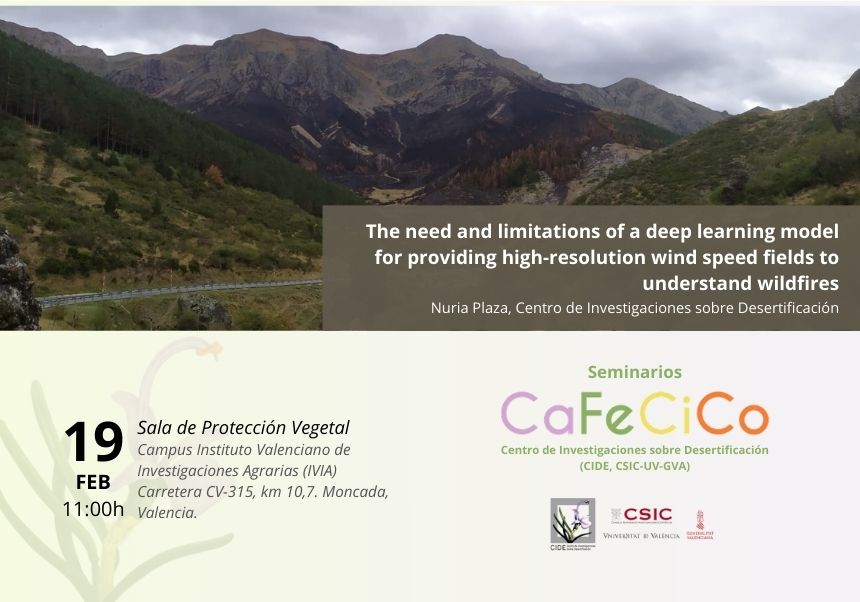
Over recent decades, near-surface wind speed has generally declined worldwide, a phenomenon known as stilling, but its impact on wildfire regimes remains unknown. Part of the problem arises from the existing global climate datasets used to understand wildfire–climate relationships: besides providing coarse spatial resolution of climate variables, they poorly reproduce the stilling phenomenon. In this study, we evaluate the ability of higher-resolution models to capture this temporal trend and propose a station-based reconstruction using a U-Net partial convolutional model trained on 3 km daily wind speed data from the New European Wind Atlas.
The results show improved performance compared to NEWA when validated against unseen observations, as well as a clear long-term decrease (although slightly overestimated) in wind speed across the region. Furthermore, we use this high-resolution wind speed grid to examine how wildfire-related wind conditions have changed since 1983 in Spain, addressing current limitations and identifying future research directions for studying wind-related wildfire regimes.
Presented by: Nuria Plaza Martín, Researcher at The Climate, Atmosphere, and Ocean (CLIMATOC-LAB) (CIDE)
The seminar will be conducted in English
Date: Thursday, 19 February, at 11:00 a.m.
Location: Plant Protection Room of the Valencian Institute of Agricultural Research (IVIA).
Carretera CV-315, km 10.7 - Moncada, Valencia.
CIDE Communication
Carretera CV-315, km 10,7 - Moncada, València.
Comunicació CIDE