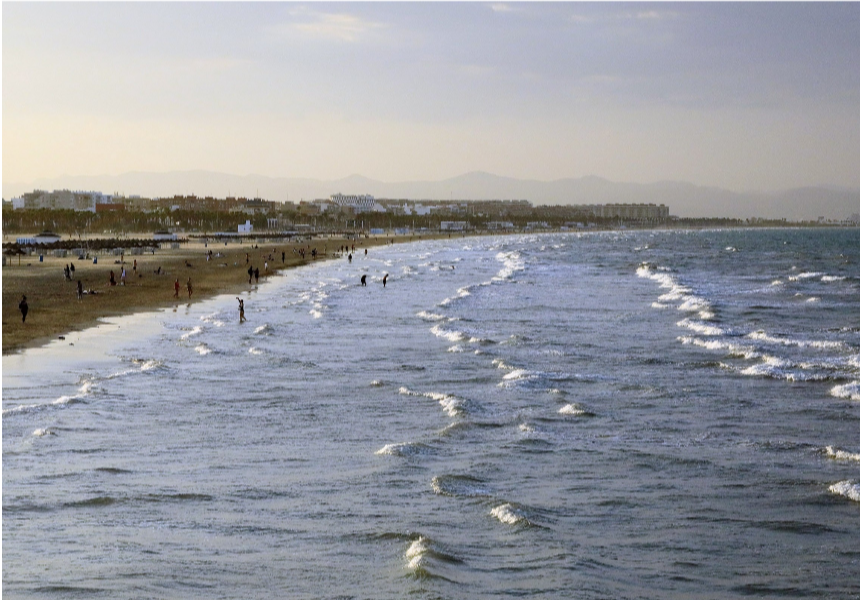
Global warming and heat waves are weakening sea breezes in the Mediterranean.
-
The Desertification Research Center (CSIC-UV-GVA) reveals that sea breezes are now 17% weaker in Spain, a phenomenon that intensifies during summer heat waves.
-
This slowdown means the breeze loses some of its ability to moderate temperatures in coastal cities, impacting health, air quality, and storm formation, among other things.
The Mediterranean's sea breeze is slowing down, reducing its ability to moderate temperatures in cities like Barcelona, Valencia, and Ibiza. This is the conclusion of a study led by the Desertification Research Center (CIDE), a joint center of the Spanish National Research Council (CSIC), the University of Valencia (UV), and the Valencian Regional Government, which analyzes 41 years of data from weather stations distributed along the western Mediterranean coast. Contrary to what might be expected given the rising temperatures in the region, the data show that the speed of the sea breeze has steadily decreased since the 1980s, a weakening that intensifies during summer heat waves. The study is published in Scientific Reports.
Sea breezes are the winds that arise during the day when the land heats up faster than the sea. As the warm air rises over the land, the cooler air from the sea moves towards the coast, creating a flow that cools the coastal areas. Currently, the Mediterranean basin is warming between 20 and 40% faster than the rest of the world, intensifying the thermal contrast (the driving force behind the breeze). “We would expect this greater contrast to generate stronger breezes. However, we observe that sea breezes are becoming weaker, although more frequent during times of the year when they are less common, such as winter,” explains Shalenys Bedoya-Valestt, first author of the study and predoctoral researcher at CIDE.
Balearic Islands and the Mediterranean Peninsular Coast
This study analyzed, for the first time, data collected between 1981 and 2021 from 39 meteorological stations located in Spain, France, Italy, and North Africa. Ninety percent of the stations show a reduction in sea breeze speed. Specifically, since 1981, sea breezes in the western Mediterranean have weakened by 0.095 meters per second per decade, “which translates to almost an 11% decrease since 1981 on average across the entire region. If we consider only the summer months, this change intensifies to 12.7%,” reveals the researcher from the Climatoc-Lab at CIDE, dedicated to the study of meteorology and winds.
By region, the Balearic Islands (17.6%) and the Mediterranean coasts of Spain (17%) and France (12.6%) showed the greatest weakening of the sea breeze. The Spanish cities that experienced the most pronounced weakening were Barcelona, Tortosa, Menorca, Almería, Castellón de la Plana, Málaga, Ibiza, and Palma de Mallorca, where the breeze decreased between 17% and 25% at specific stations. This slowdown is attributed to several cascading atmospheric mechanisms, such as the persistence of anticyclonic ridges over the Mediterranean (a high-pressure area extending from an anticyclone that causes atmospheric stability and dry weather), the influx of continental tropical air from the Sahara, and heat waves.
Sea Breezes and Heat Waves
One of the most significant findings is the relationship between heat waves and the weakening of sea breezes. During summer heat waves, breezes are up to 10% weaker on islands such as Corsica, Sardinia, and Sicily. In the Balearic Islands, heat waves weaken breezes by approximately 8%, while on the Spanish Mediterranean coast, the average reduction is 4.8%. This figure does not simply reflect the overall trend but rather the specific impact of heat waves on summer breezes. The study links these changes to the accelerated warming of the Mediterranean, one of the climate change hotspots.
Since 1981, the region has recorded a 1.3°C increase in surface air temperature and a 1°C increase in sea surface temperature, with a significant rise in solar radiation. Thus, when temperature anomalies reach between 1 and 1.5°C above historical levels, the intensity of the sea breeze drops between 4% and 8%, especially in spring and summer, the research reveals. “It’s paradoxical: warming causes more heat waves, and these, in turn, further weaken the coastal winds that help alleviate them,” the researcher points out.
“Our hypothesis is that global warming is changing the way air masses move, causing warm air of tropical continental origin to become ‘trapped’ over the Mediterranean and leading to more frequent and intense heat waves. This hot, dry air acts like a ‘lid’ over the region: it stabilizes the atmosphere and slows down the air movements that drive the breeze, weakening it,” argues Shalenys Bedoya-Valestt.
Impact on the Mediterranean Population
“Precisely because we are now experiencing more intense, frequent, and earlier heat waves, understanding how sea breezes are changing allows us to grasp the potential impacts on the coastal population of the western Mediterranean and lay the necessary groundwork for climate adaptation,” says César Azorín, a CSIC researcher who leads the Climatoc-Lab at CIDE. Weaker sea breezes, especially during heat waves, reduce their ventilation capacity, impacting heat stress and human health, among other consequences.
Furthermore, weaker breezes can cause pollution to recirculate or become trapped in coastal and inland areas for days, so the information provided in the study would help in planning more precise anti-pollution protocols. On the other hand, breezes also transport moisture inland, allowing for the formation of severe storms in summer. “If the breeze weakens, the hydrological cycle could be disrupted,” Azorín explains. “These results help us understand why the pattern of these storms is changing and how this affects soil dryness in the region,” he asserts.
This work is part of the results of Shalenys Bedoya-Valestt's doctoral thesis, carried out at the CIDE Climatoc-Lab under the supervision of César Azorín and Luis Gimeno. The Pyrenean Institute of Ecology (CSIC) and the Environmental Physics Laboratory (EPhysLab) of the University of Vigo; the University and Polytechnic University of Turin (Italy); the University of Gothenburg (Sweden); and Tsinghua University (China) also collaborated on the study. This research is being conducted within the framework of the CSIC's Interdisciplinary Thematic Platform (PTI) Climate.
Bedoya-Valestt, S., Azorin-Molina, C., Plaza-Martin, N.P. et al. Weaker and more frequent Mediterranean sea breezes in a warming climate. Sci Rep (2026). DOI: https://doi.org/10.1038/s41598-026-47025-4
CIDE Comunication