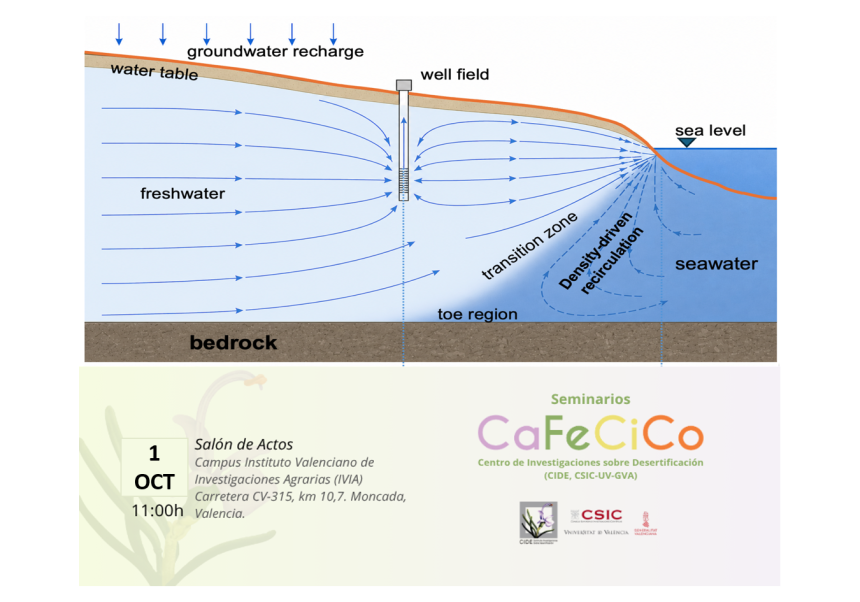
Modelling Coastal Groundwater Systems under Change: From Prediction to Resilient Water-Resources Management
Coastal aquifers are subject to multiple interacting natural and anthropogenic pressures, including intensive abstraction, seawater intrusion, changing recharge conditions and sea-level rise. These pressures are particularly important in Mediterranean environments, where limited and highly variable water availability, recurrent drought and substantial dependence on groundwater create significant challenges for sustainable water-resources management. Predicting groundwater-system responses is further complicated by subsurface heterogeneity, incomplete observations and uncertainty in future environmental and socioeconomic conditions.
This seminar explores how advances in groundwater modelling can help address these challenges, moving from the representation of physical processes towards uncertainty-aware prediction and water-resources management. Examples from coastal aquifers, land subsidence and contaminant hydrology will illustrate the development and application of process-based numerical models, data assimilation and uncertainty quantification, together with surrogate, reduced-order and multi-fidelity approaches for computationally demanding groundwater problems.
A particular focus will be placed on the integration of these modelling approaches within simulation–optimisation frameworks for water-resources management. Management decisions typically involve multiple, and often competing, objectives, such as meeting water demands, limiting environmental impacts and management costs, and maintaining or enhancing system resilience. At the same time, feasible strategies must satisfy constraints on groundwater levels, abstraction, water availability and, in coastal systems, seawater intrusion. Their performance must also be evaluated under uncertainty in aquifer properties and geological structure, as well as in external forcing and stress conditions such as groundwater recharge, drought, sea-level rise and future water demand. The large number of model evaluations required by this combination of optimisation and uncertainty analysis makes computational efficiency a fundamental challenge, motivating the development of computationally efficient “surrogate” modelling approaches.
Rather than identifying a single optimal solution, this approach generates Pareto sets of alternative management strategies representing different trade-offs among competing objectives, including system resilience. Evaluating the performance of these alternatives across uncertain system properties and future conditions then provides a basis for assessing their robustness and identifying strategies that remain effective across a range of plausible futures. Such frameworks can ultimately provide water authorities and public administrations with quantitative decision support for selecting sustainable groundwater-management strategies while explicitly recognising the uncertainties inherent in long-term water-resources planning.
Presented by:
Domenico Baú, PhD School of Mechanical, Aerospace and Civil Engineering University of Sheffield, CV below
E-mail: d.bau@sheffield.ac.uk
Web : http://www.shef.ac.uk/civil/staff/academic/dbau
The seminar will be held in English
Date: Thursday, 1 october at 11.00 am
Venue: Auditorium of the Valencian Institute of Agricultural Research (IVIA).
Carretera CV-315, km 10.7 – Moncada, Valencia.
CV Summary – BIO
Domenico Baù is a groundwater hydrologist and environmental modeller with more than 25 years of research experience in groundwater flow and transport, water-resources management and computational modelling. He is currently Honorary Associate Professor at the University of Sheffield, UK, where he was Associate Professor in Groundwater Engineering from 2014 to 2026. Previously, he was Assistant Professor of Groundwater Hydrology at Colorado State University, USA, and held research positions at Michigan Technological University, USA, and the University of Padova, Italy.
His research lies at the interface between groundwater hydrology, environmental modelling and computational science. A major strand of his work concerns the development of simulation-optimisation approaches for water-resources management, including the explicit treatment of uncertainty and multiple management objectives, together with data assimilation and inverse modelling for the characterisation of heterogeneous groundwater systems. His research also encompasses theoretical, numerical and computational aspects of subsurface flow and transport modelling; the development of model emulators, surrogate and reduced-order models for computationally demanding environmental problems; and uncertainty quantification, risk analysis and decision-support methods.
These approaches have been applied to groundwater supply and conjunctive water use, agricultural groundwater systems, groundwater recharge and surface-water - groundwater interactions, coastal aquifers and seawater intrusion, contaminant transport and remediation, and land subsidence. His research has been supported by a broad range of public and private organisations, including UKRI-EPSRC, the US National Science Foundation, the US Department of Energy, the US Department of Agriculture and the Colorado Agricultural Experiment Station, the Colorado Department of Natural Resources and, more recently, Shell Global Solutions and Sellafield Ltd.
Alongside academic research, he has worked with water and environmental agencies and other end users, including the Colorado Water Conservation Board and the UK Environment Agency, on groundwater modelling, decision-support and professional training. A consistent aim of his work is to connect methodological advances with practical environmental problems and to develop modelling tools that can support real-world water-management decisions. His current interests increasingly focus on climate-resilient groundwater management, robust decision-making and sustainable water-resource development under environmental and socioeconomic change, particularly in Mediterranean and coastal systems.
CIDE Communication