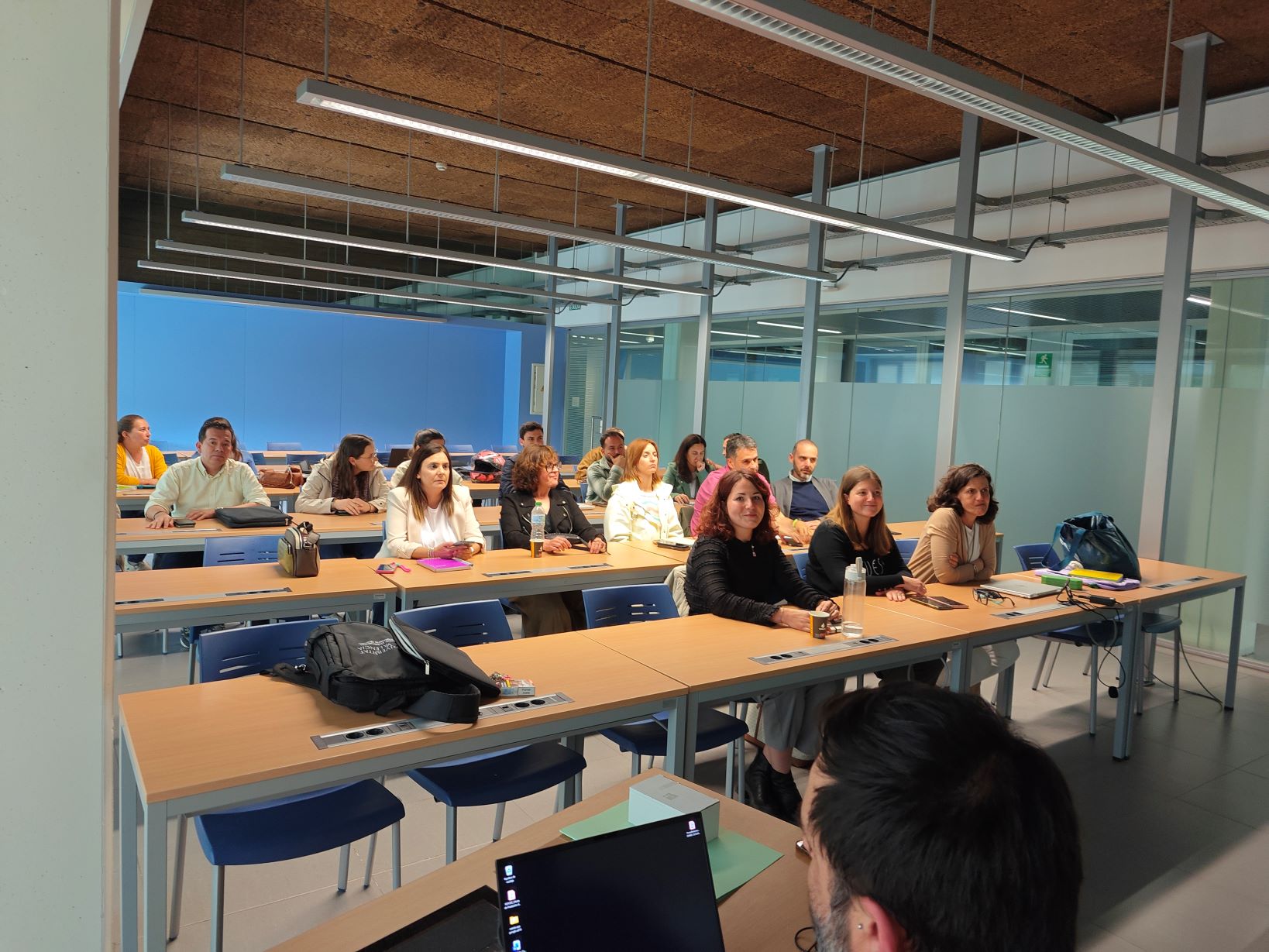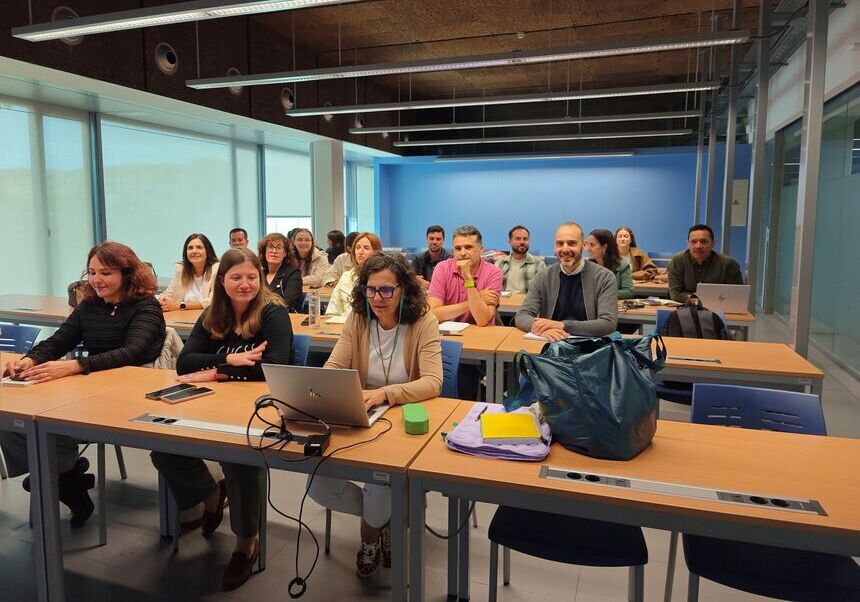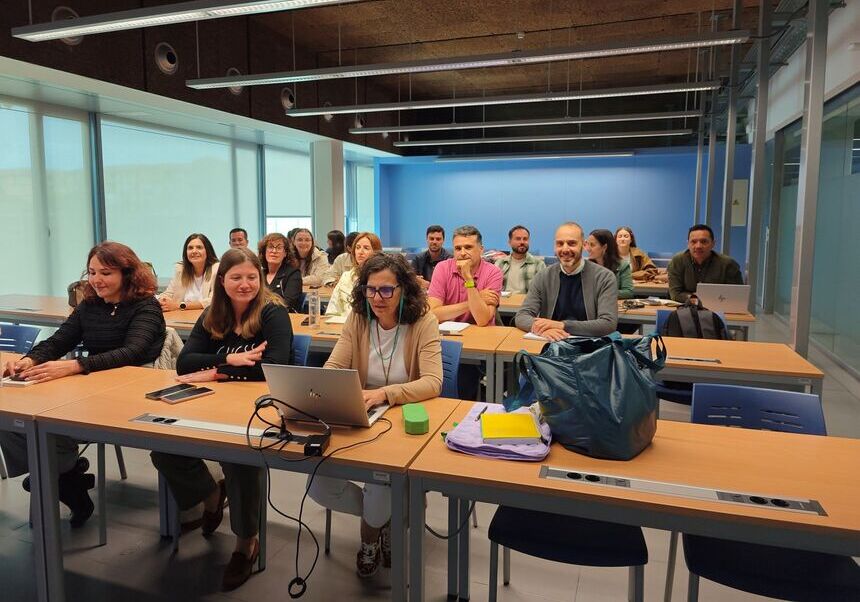
On 8 May 2026, the Engineering School (ETSE) from the Universitat de València hosted an internal educational event organised by the Green Horizon Chair: Water-Bioenergy Nexus, focused on the presentation of different simulation, modelling and control tools developed by the CALAGUA research group.
The activity featured nearly 20 attendees from different companies of the group Nealis, in a session aimed at reinforcing knowledge transfer, promoting the sector’s digitisation and approaching scientific-based technological developments to professional and industrial environments.
The event started with the presentation of the BioCalibra team, given by Josep Ribes, head of the Green Horizon Chair, focused on modelling and calibration strategies of biological processes applied to the treatment of sewage. The tool allows to adjust complex mathematical models such as ASM to real operational data of EDAR (wastewater treatment) making it easier to create an advanced simulation of biological processes and to optimise operational conditions. During the session, it was shown how this type of digital tools enable to reduce the time of calibration, to improve the models’ predictive ability and to support decision-making in real operating environments and facility design, thus reinforcing digitisation and the use of digital twins within water and bioenergy sector.
After that, Ángel Robles, professor and researcher of the CALAGUA-UV group, presented the DESASS simulator, a tool developed for the analysis and advanced simulation of purification processes. The software enables to study different plant layouts and to evaluate different operational scenarios from a hydraulic, biological and energetic point of view, making it easier to optimise processes and to analyse technological alternatives before its real implementation. The tool is aimed at both research applications and technical support for engineering and advanced operation of facilities, creating a support platform for the improvement of efficiency and sustainability in treatment systems.
Lastly, professor M. Victoria Ruano, professor and researcher at CALAGUA-UV, showed the features of the programme LoDif BioControl, aimed at the intelligent follow and control of biological processes in treatment systems. This computing platform includes some advanced controlling algorithms based on fuzzy logic developed by the CALAGUA group, enabling to optimise both aeration and biological nutrient removal in EDAR. Its main advantages include the possibility to work with low-cost sensors, its inclusion with SCADA systems through the OPC protocol and its ability to significantly reduce energetic consume associated to aeration.
The software has been already implemented in several plants in different locations in Spain, reaching up to 40% decreases of energetic consume in some cases, which turns it into a specially interesting platform for keeping forward a more effective and digitised management of sanitation facilities.
The event allowed to share technical experiences, to answer questions on practices and to create a space for interaction between research staff and professionals of the field, reinforcing one of the main goals of the Green Horizon Chair: promoting cooperation between university and business through specialised training activities, technological transfer and applied innovation.
The organisation evaluates very positively the participation and involvement of the attending companies, as well as the interest shown in the tools developed by the CALAGUA group and its potential application in real operation and control contexts.