


A research team including personnel of the Departament of Biologia Celul·lar i Biologia Funcional of the Universitat de València (UV), the Unitat Predepartamental de Medicina of Universitat Jaume I of Castelló (UJI) and Queen Mary University of London (QMUL), has showed that the mutation of the gene
Mecp2 alters the function of the hypothalamus-pituitary-gonadal axis, that controls the levels of sexual hormones, and delays pubertal development in a mouse model of Rett syndrome.
Rett syndrome is a rare neurodevelopmental disorder, mostly lethal for males, affecting almost exclusively to girls and women. This syndrome causes severe symptoms, like epilepsy, intellectual and motor disability or respiratory difficulties. In addition to these symptoms, this disease affects to the neuroendocrine system, but this has received less attention.
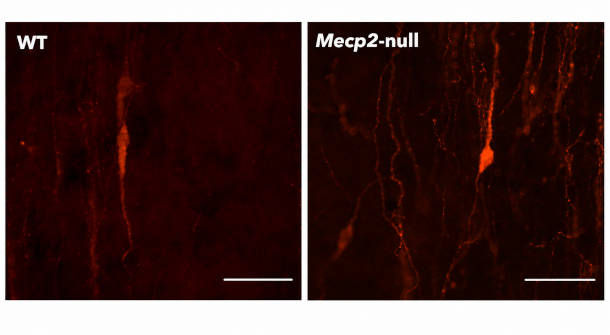
Now, an international team led by Carmen Agustín Pavón, associate professor of the Faculty of Biological Sciences, has discovered that in mutant mice for the gene Mecp2, main cause of the Rett syndrome, there is an excess of hypothalamic GnRH neurons, cells responsible of puberty onset and regulation of levels of sexual steroids. However, the pubertal development of mutant mice finds is delayed regarding their healthy conspecifics of the same age, associated to low weight, and levels of sexual hormones in mutant mice are lower than in healthy individuals, suggesting a dysregulation of the hypothalamus-pituitary-gonadal axis.
“We knew that in some patients with Rett syndrome puberty follows an atypical course, with a precocious onset but a delayed first menstruation”, comments Ana Martín-Sánchez, of the Universitat Jaume I of Castelló and first author of the study. “The fact that the control system of sexual hormones is altered not only impacts on puberty and menstrual cycles, but these hormones are key for the organisation and the maintenance of neural circuits that control social behaviour, also affected in these mice, cognition and the health of muscle-skeletal system, among other functions”.
“Understanding in detail the mechanisms by which the lack of MeCP2 leads to neuroendocrine alterations could open new avenues to assay hormonal substitution therapies, already in use for other conditions, for patients with Rett, what could lead to an improvement of their quality of life”, concludes Carmen Agustín Pavón.
In addition to the team of UV and UJI, the study was made in collaboration with Sasha R. Howard, paediatric endocrinologist of the Hospital Barts Health NHS Trust and QMUL. The project has been funded by a subvention for consolidated groups of research of the Conselleria of Education, Culture and Universities of the Generalitat Valenciana (CIAICO/2023/027) and by the Fund for the Investigation for Rett Syndrome (FinRett) promoted by the Spanish and Catalan Associations of syndrome of Rett.
Article reference: Martín-Sánchez, A.; Jiménez-Díaz, D.; Esteve-Pérez, R.; Vasile-Tudorache, A.; Read, JE.; Howard, SR.; Agustín-Pavón, C. “Pubertal development and hypothalamic-pituitary-gonadal axis are altered in male mice lacking Mecp2”. J Neuroendocrinol. 2026 Jul;38(7):e70221. https://doi.org/10.1111/jne.70221



