On Thursday, January 29, 2026, the seminar Novas fontes e enfoque para pensar a história do ensino de ciências naturais was presented by the doctor of education Wiara Rosa Alcántara, professor at the Federal University of Sao Paulo. The seminar was held as part of the colloquiums dedicated to history education in science, promoted by the Catalan Society of Science and Technology History in collaboration with the Ibero-American Network for Research in History, Education and Scientific Communication.
The teacher developed a theoretical and methodological reflection on the incorporation of natural sciences as school content. He addressed the new sources and new approaches to think about the history of the teaching of natural sciences and the relationships between his research and the archaeological theory of networks, developed by Carl Knappett, which considers that the networks or relationships between teaching and learning are composed of a collection of nodes and links that can be human or not. In his works, Knappett shows that this material connection of the world favors interaction and calls for the meshwork network. Networks are not fixed but can mutate.
Professor Alcántara explained that material culture is an indispensable element of our actions and our connections with the world and that these interactions occur at different scales, microscale, mesoscale and macroscale. Based on this, one can think about what would be the key points of the mediation of material culture. According to Knappet, this mediation at the different scales would be a) the duality between form and content, b) the mediation between theories, c) the connection between the local and the virtual, and d) the role of the built environment.
The professor developed the point on duality between form and content, which is a theoretical element that helps to understand the selection of sources she has chosen for her research. This element is capable of mediating the micro, meso and macro scales, that is, the local, regional and global, since this material culture is at the same time form and content. For example, when you think of the macro form, you can say that it will be a scientific artifact that encapsulates a social form or a typology that represents structure and abstract categories. On the other hand, the micro scale will represent an object that is the result of a specific moment of production, charging the contingencies of individual agency and the local context. As an example, Wiara Alcántara pointed out that one typology would be Bronze Age pottery, representing the macroscale, while each individual vase shows variations that reflect the microscale of human practice.
Dr. Alcántara also covered the element, thinking about materiality for the teaching of natural sciences and the connection between the local and the virtual or the local and the global. In this case, material culture serves as a continuum that sustains networks of different speeds and scopes. These virtual or macro-scale networks tend to be faster and more fragile or to be anchored in face-to-face relationships, representing the micro scale, and to be slow and mediated by a shared material culture. This aspect allows us to develop many reflections on this materiality for the teaching of science and its particular use in the classroom.
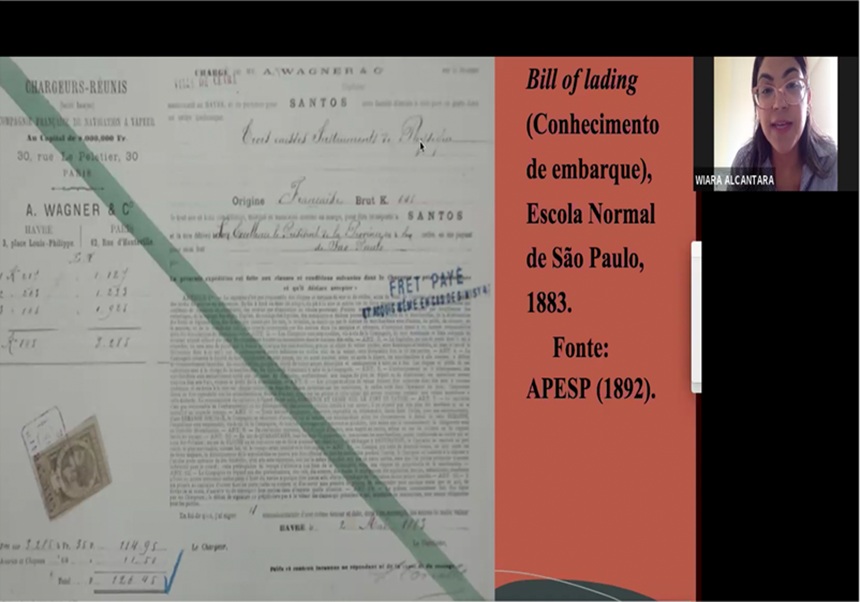
The professor covered two types of documentary sources that were central to her research: customs clearances and statistical maps of trade and navigation. Thanks to these documents, it is possible to track the circulation of scientific objects intended for teaching and also to identify actors, routes, economic values, fiscal policies and also commercial strategies that are involved. Customs clearances record detailed information on the import of scientific instruments, such as physics instruments, from Europe to Brazil, including data on ports, ship companies, and recipients.
Wiara Rosa Alcántara stressed that the statistical maps of trade and navigation made it possible to make visible dynamics that were not well known, such as the processes of re-export of scientific instruments. In addition, some regions acted as nodes of redistribution to the other territories. The analysis of the tax classification of goods allows us to show how certain policies favored the importance of scientific objects and also encouraged and circulated and used in education. This study of the sources allows us to access the concrete materiality that was had in the teaching of natural sciences. For all these reasons, the history of the objects, the trajectory they traveled and the networks that were made while they circulated allow us to understand the historical configuration of educational systems and a condition of democratization of science.
Video Link passcode: H*h2dnB^
Ivania Maturana, extracurricular internship student of the Interuniversity Master's Degree in History and Communication of Science