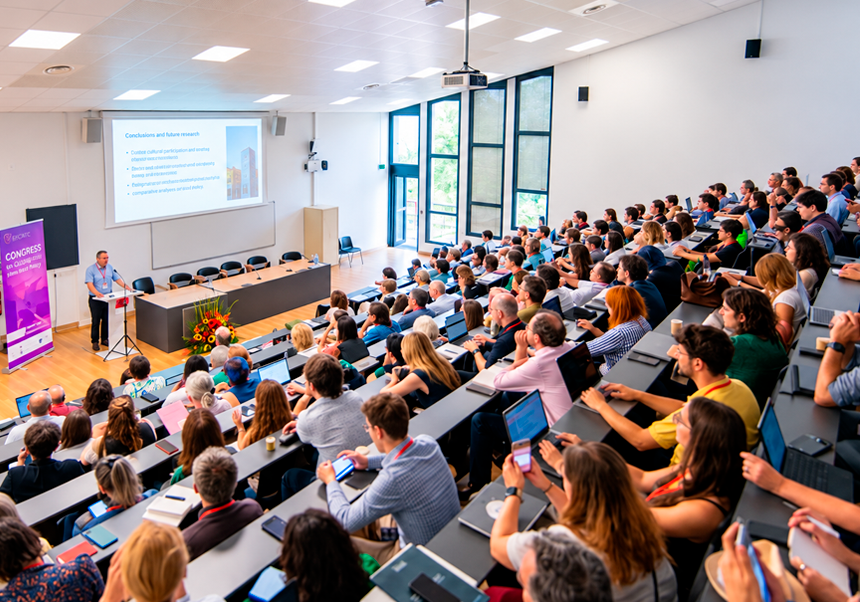
Chuan Li, Mónica Edwards-Schachter and Joaquin Diaz Boils present at ENCATC 2026 findings on the adoption of immersive technologies in cultural consumption
Dr. Chuan Li, a member of the ECONCULT research unit, presented at the ENCATC 2026 congress, held from 23 to 25 September 2026, the preliminary results of a study on the factors that explain why visitors accept and adopt cultural experiences based on immersive technologies.
The presentation, titled «La adopción de tecnología inmersiva en el consumo cultural. Integrar las perspectivas tecnológica y psicológica», addresses an emerging question in the field of cultural and creative industries: what factors explain why visitors accept and adopt cultural experiences based on immersive technologies?
Technology, creativity and new forms of cultural consumption
Immersive technologies, such as virtual reality (VR) and augmented reality (AR), are transforming the way in which artistic and cultural experiences are created, presented and consumed. In particular, immersive exhibitions have become an increasingly widespread format in museums, cultural spaces, heritage institutions and tourist destinations.
Unlike traditional exhibitions, which are mainly centred on the contemplation and appreciation of cultural objects, immersive experiences combine technology, narrative, visual design, sound and interaction to generate new forms of visitor participation.
In this context, the research argues that the acceptance of these experiences does not depend solely on technological characteristics. The study proposes analysing jointly the role of technology and creativity in shaping visitors' perceptions and experiences.
The model analyses how these factors, in particular the quality of the computer system and the quality of the creative content, influence different dimensions of users' perceptions —such as performance expectations, ease of use, hedonic motivation, social influence and facilitating conditions— and, ultimately, the acceptance of immersive cultural experiences.
Preliminary results: technology needs content
The results show that the quality of the technological system is an important factor in generating quality in the content and shaping visitors' perceptions. In turn, the quality of the content plays a relevant role in transforming technological capabilities into a meaningful cultural experience.
One of the particularly relevant findings is that ease of use does not show a statistically significant relationship with the acceptance of the experience. This result raises the possibility that, as immersive technologies become widespread and users gain greater familiarity with them, ease of use may cease to be a differentiating element and come to be considered a basic feature of the experience.
The study also identifies three mechanisms through which technology can contribute to the acceptance of immersive experiences: a mechanism driven mainly by technology, another dependent on the quality of the creative content, and a third of a hybrid nature, in which technology and content interact to shape the visitor's experience.
Implications for the cultural and creative industries
The results have important implications for the management of museums, cultural centres and heritage spaces:
- Technological development should advance in a coordinated way with the development of creative content; the adoption of more advanced technologies does not in itself guarantee greater visitor participation or acceptance.
- The research highlights the growing importance of experiential value: as immersive technologies cease to be a novelty, visitors may seek elements that go beyond visual impact or technological innovation, including the meaning, enjoyment and emotional involvement generated by the content.
- Facilitating conditions also play a relevant role: intuitive navigation, clear narrative structures, adequate instructions and support mechanisms for visitors can facilitate participation and help maximise the value of the cultural experience.
In this way, the research contributes to shifting the analysis of technology adoption from a perspective focused exclusively on technology towards a view that considers technology, creativity and the visitor's experience jointly.
A preliminary result from the Emerging Group project
The research presented at ENCATC 2026 is one of the preliminary results of the emerging group project funded by the Generalitat Valenciana, within its workstream on digital transformation, immersive technologies and cultural and creative industries.
The study is part of the efforts of the group formed by Dr. Chuan Li (principal investigator, Universitat de València), Dr. Mónica Edwards-Schachter (Valencia International University — VIU) and Dr. Joaquin Diaz Boils (Universitat de València), with the aim of understanding how new technologies are modifying the forms of cultural production, mediation and consumption, as well as the conditions that favour their adoption by audiences.
What is ENCATC?
ENCATC is a European network specialised in research, education and training in the field of cultural management and cultural policies. The organisation brings together universities, research centres, cultural institutions and professionals from different countries and constitutes an international space for the exchange of knowledge on the transformations affecting the cultural sector. The ENCATC congress annually brings together researchers, academics, cultural policy makers and professionals to present research, debate emerging trends and foster international collaboration.
About Econcult
The ECONCULT research unit —Economics of Culture and Tourism (GIUV2016-297) at the Universitat de València, directed by Pau Rausell Köster— takes part in the emerging group project on digital transformation, immersive technologies and cultural and creative industries, and has contributed to the presentation of these results in the international space of the ENCATC network.