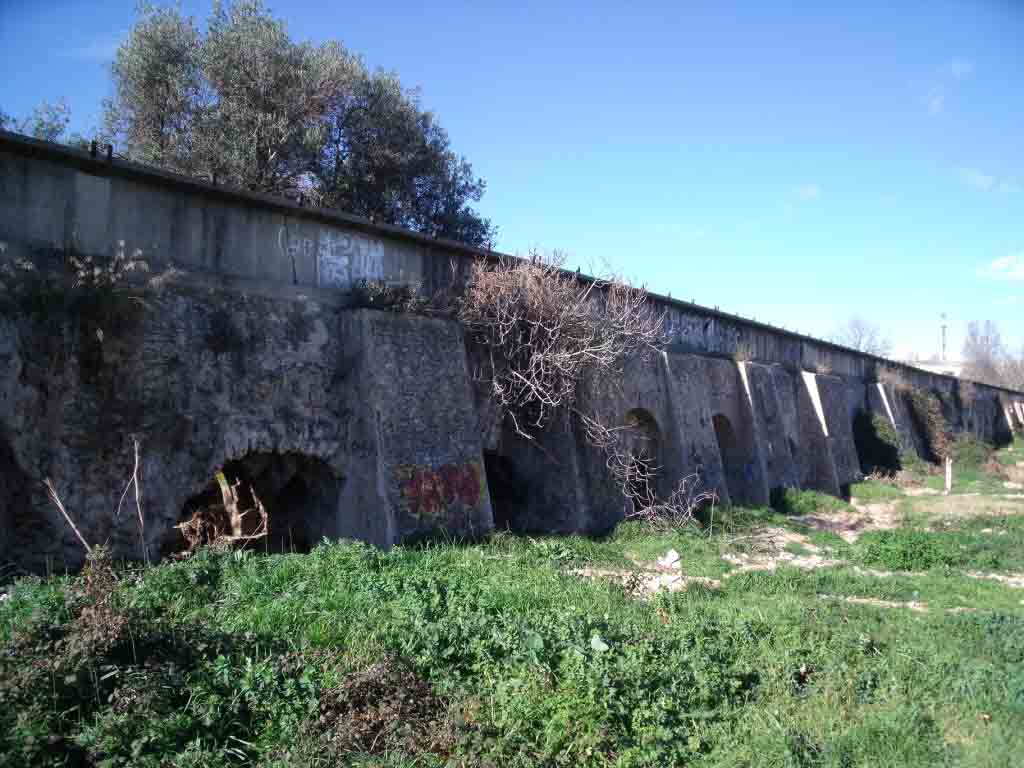
It is located in the rural area of Els Arquets, on the Salt de l’Aigua ravine. It is currently located between the Avinguda de la Generalitat Valenciana in Manises, the Manises hospital and the buildings of the former factory of the Unión Naval de Levante (Levante Naval Union). It is possible to reach this building from the town centre of Manises, Ceramista Mora Gallego street, and taking a detour in the middle of this street towards a path that leads to the arches.
The old part of the aqueduct (the arcades) is in a dangerous state of deterioration and needs to be urgently repaired in its entirety. The irrigation canal that crosses it at the top is a contemporary concrete irrigation canal in use, in good condition.
Islamic era, 10th-11th centuries.
It is a medieval construction, previous to the conquest of València by Jaume I (James I) in the 13th century. According to a document issued by the Royal Chancellery in 1264, the building suffered from many shortcomings due to its antiquity for which the monarch ordered its repair. Hence, it is not surprising that it dates back to the Islamic period and is related to the design and construction of the Séquia de Quart (Quart irrigation canal), probably in the 10th century or even earlier. Some authors consider that it could be a Roman-era construction that was reused, but the construction technique is not the usual for the Roman period.
The “Els Arcs” aqueduct is a unique architectural element in the Horta's hydraulic heritage, not only because of its technical characteristics, but also because of its large dimensions, making it the largest construction among the hydraulic heritage of the Vega de València. Its role is to allow the water from the Quart-Benàger-Faitanar common irrigation canal to flow through a geographical feature of considerable dimensions such as the Salt de l’Aigua ravine. It has an edge length of 230 metres (75419⁄32 ft) and consists of 22 eight arches of irregular size and height. These are arranged on one level, with the central ones reaching a height of 3,5 metres (1131⁄64 ft). However, not all of them are built in the same way and most of those have a masonry structure. The arches are made of medium-size limestone that are vertically arranged, uncut, joined by mortar and using a technique that is very different from the traditional technique of the Roman era. There are also some arches at the ends with a clear layout and low-medieval technique with a semi-circular arch. There is material evidence of repairs with tiles in the 16th, 17th and 18th centuries, so that the architectural complex has now become a collection of reconstructions from different periods. It should be noted that the archways have formed gigantic lime concretions, some of which have become pillars over the centuries. In the 1960s, the bottom and side parts were built from scratch for the irrigation canal at the top of the aqueduct, made entirely of concrete and fitted with a metal railing, which is still in use today by the community of irrigators.
With Monument category (Decret 55/2006 de la Generalitat Valenciana).
- Plan de Acción Territorial de Protección de la Huerta de Valencia. Versión Preliminar. Memoria de Ordenación. Anexo. Fichas de Elementos de Arquitectura Hidráulica. Índice de Fichas, (dir. Arancha Muñoz), Generalitat Valencia, 2008, EPH_11.06, p. 180.
- Pla d’Acció Territorial d’Ordenació i Dinamització de l’Horta de València (PAT de l’Horta). Generalitat Valenciana, 2018. Catàleg annex. Element Patrimonial EPH_11.01, pàgs. 500-503.
- DECRET 55/2006, de 28 d’abril, del Consell, pel qual es declara Bé d’Interés Cultural, amb la categoria de Monument, l’aqüeducte els Arcs de Manises.
GUINOT, E i SELMA, S (2005, inèdit). Les séquies de l’Horta Sud de València: Rovella, Favara, Mislata-Xirivella, Benàger-Faitanar i Quart. València, Conselleria d’Agricultura-Generalitat Valenciana.
GUINOT, E.; SELMA, S., LLORIA, R. El patrimoni hidràulic de les séquies del Tribunal de les Aigües de València. Informe elaborat per a la Direcció General de Patrimoni de la Generalitat Valenciana, Conselleria de Cultura, València, 2003.
SELMA CASTELL, Sergi. Paisatges històrics, patrimoni i didàctica. (Les séquies i les hortes del Tribunal de les Aigües de València). Tesi doctoral publicada en PDF. Castelló, Universitat Jaume I de Castelló, 2014, p. 620.

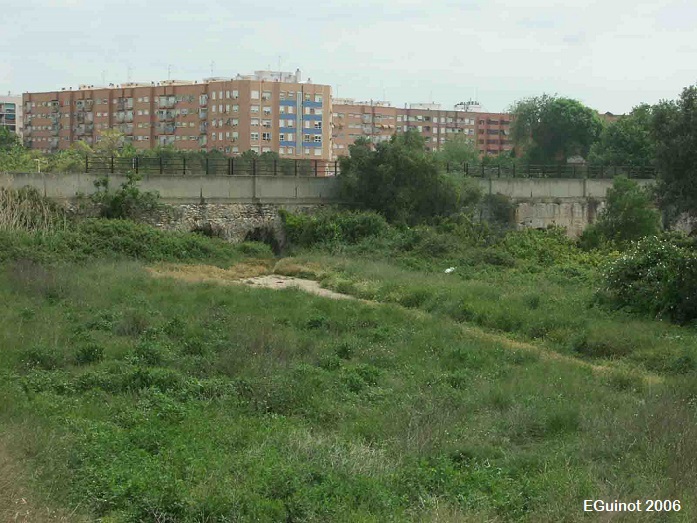
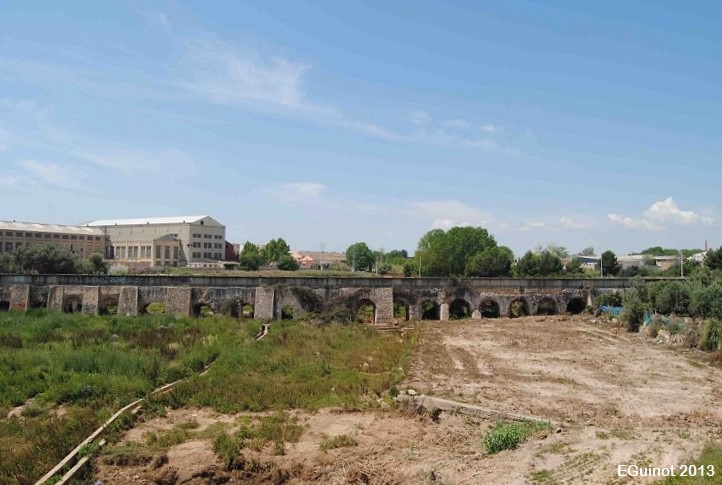
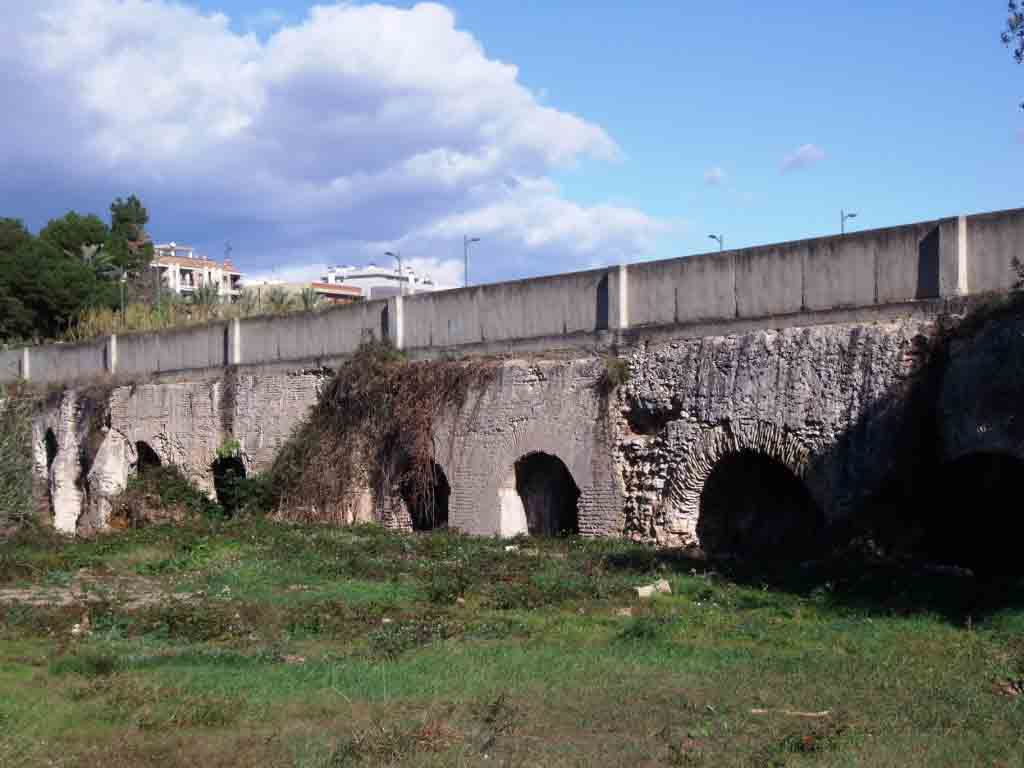


Photos: E.Guinot, Google Earth