- Universitat de València
- Carrasco Sorli, Pedro Miguel
- PDI-Catedratic/a d'Universitat
- Director/a Parc Cientific
- Marco Pico, Francisco
- PDI-Titular d'Universitat
Processed foods usually contain big quantities of sugar to improve their flavour. The growing concern over obesity and diabetes, which are a priority for public health, has led to the search of healthier alternatives than sugar in processed foods, like non-nutritive sweeteners. Within the most commonly used sweeteners in the food industry, we can find artificial produced molecules, such as saccharine, aspartame, sucralose, acesulfame potassium, and neotame. However, its high sweetener power may activate reward mechanisms that perpetuate our threshold of sweetness and appetite. At the same time, sweeteners of natural origin, such as steviol, erythritol, and xylitol, present advantages in comparison with industrial sweeteners, as for example the antibacterial and prevention properties of the caries of xylitol. Nevertheless, the production of some of these natural compounds on an industrial scale requires complex and expensive processes, like the catalytic dehydrogenation of D-xylose, or the use of expensive catalysts. Therefore, it is necessary to identify new production sources of sweeteners of natural origin at high concentrations that are sustainable and more economic.
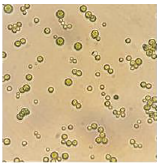
Researchers from the University of Valencia have developed from microalgae a new production system of sweeteners of natural origin, like ribitol, xylitol, and other compounds of polyol type. The microalgae that have been used belong to the Trebouxiales and Watanabeales orders, which are capable of producing ribitol and other polyols in much more elevated levels than other sources of natural origin that have been used so far. By this new procedure, the microalgae production is carried out in bioreactors, which allows to eliminate the dependence of industrial systems with complex and intensive production processes in energy consumption.
The applications of this production method of sweeteners of natural origin, like ribitol and other polyols, appear in such diverse sectors like the food sector, the cosmetics sector, the pharmaceutical industry, and the dental sector. It is applied to be used in products such as chewing gums and sugar-free candies, baked products and desserts, sugar-free drinks, toothpaste and mouthwash, or cosmetic products.
The main advantages of the invention are:
- High production volume of natural sweeteners in comparison with sources of natural origin that are commonly used.
- Lower cost and lower energy consumption of the production process in comparison with the chemical methods of obtaining sweeteners of natural origin.
- Capacity of production of a wide variety of polyols, such as ribitol, xylitol, and arabitol, along with other polyols like sorbitol, mannitol, and inositol.
- Sustainability of the production process, due to the fact that the generated waste of the extracts is compostable and can be used as phytostimulines.
- Patent applied
Blasco Ibáñez Campus
C/ Amadeu de Savoia, 4
46010 València (València)