

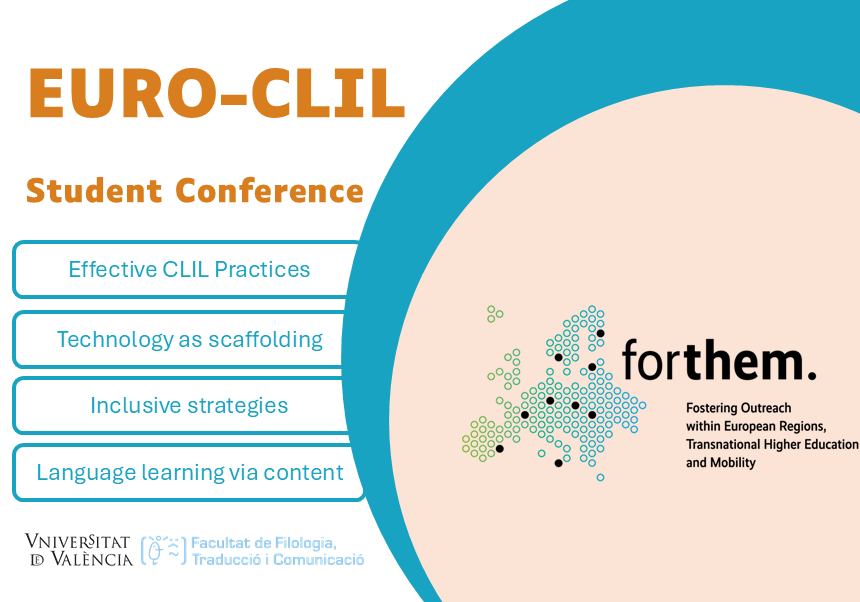
Last November, the Faculty of Philology, Translation and Communication became a meeting point for experts and those interested in language learning, in an initiative entirely created and managed by students from the FORTHEM alliance.
Last November, the Faculty of Philology, Translation and Communication became a meeting point for experts and those interested in language learning, in an initiative entirely created and managed by students from the FORTHEM alliance.
On 20 November, the EURO-CLIL Student Conference began at the University of Valencia, marking a turning point in how academic conferences are conceived. Far from traditional hierarchical formats, this event was driven by a group of UV students who, within the framework of the FORTHEM Multilingualism Lab, successfully built an unprecedented European collaboration network.
From Valencia to Europe: a grassroots project
The initiative took shape during the previous academic year, when a proposal by Valencian students stood out for its ambition. What could have remained a simple academic assignment evolved into a transnational project thanks to collaboration with the universities of Jyväskylä (Finland) and Opole (Poland).
The aim was to create a space where future teachers and researchers (undergraduate, master’s, and PhD students) could exchange ideas with real and direct impact on classrooms. Plenary sessions led by CLIL experts, such as ACañado (University of Jaén, Spain), B (University of Jyväskylä, Finland), and C (University of Opole, Poland), offered diverse perspectives on the state of CLIL across Europe.
A dynamic debate: from theory to classroom reality
The event extended beyond the November conference. In October, an online roundtable brought together more than 85 participants to hear from in-service teachers across Europe. This prior dialogue helped bridge theory and practice, highlighting key challenges:
- Inclusion in bilingual environments: ensuring no student is left behind when learning subjects in a foreign language
- The potential of AI: practical workshops on designing teaching materials beyond textbooks
- New methodologies: from multimodality to content and language integrated learning
With over 100 attendees and 80 speakers from countries such as Latvia, Turkey, and Ireland, the conference combined in-person and online formats to ensure an international reach.
The outstanding success of this edition of EURO-CLIL would not have been possible without the dedication and vision of its organising and scientific committees. From logistics to the rigorous selection of academic proposals, their commitment ensured a high-quality event and an excellent collaborative environment. We would like to express our sincere gratitude to all members of the universities of Valencia, Jyväskylä, and Opole who believed in the potential of this student-led initiative.
Organising Committee:
- María Martínez Zarzo
- Laura Castañe Bassa
- Kamila Styś
- Noemí Barrera Rioja
- Sandra Celda Pérez
- Patricia Guill García
Scientific Committee:
- Lucía Bellés-Calvera
- Enrique Cerezo Herrero
- Abraham Cerveró Carrascosa
- Begoña Clavel-Arroitia
- Irene Guzmán Alcón
- Ana-Isabel Martínez-Hernández



