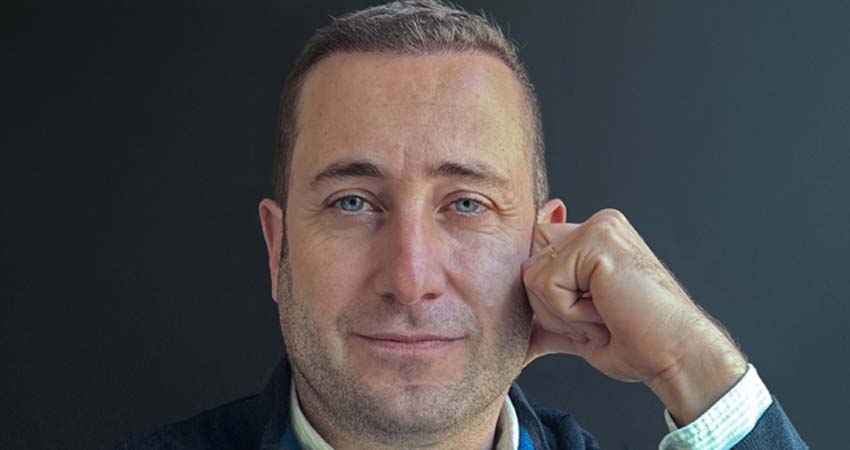
On the occasion of the publication of his book "Todas las promesas". Centre Cultural La Nau
A Conversation with
José Martínez Rubio
On the occasion of the publication of his book
"Todas las promesas" (All the Promises)
PARTICIPANTS
Juan Senís, writer and professor of Language and Literature Education. University of Zaragoza
Cristina García Pascual, head of "Aula de Narrativas" initiatives
José Martínez Rubio (Valencia, 1985) is a professor of Spanish Literature at the University of Valencia. For over twelve years, he has served as a literary critic for various media outlets, including Levante EMV and Valencia Plaza, and as a columnist for Cultur Plaza and the magazine Lletraferit.
His first novel, Mujeres blancas (White Women), was published in 2019. In it, he reconstructed—in the style of a thriller—a true crime story from 1975 Italy known as the "Circeo Massacre," in which three young men from Rome's upper-middle class raped and murdered two girls aged seventeen and eighteen. One of them, Rosaria Lopez, died. The other, Donatella Colasanti, managed to survive and recount the hell they were subjected to. The case sparked the first feminist demonstrations in Italy, and Pier Paolo Pasolini—murdered just a month after the massacre—became obsessed with the story of Rosaria and Donatella. Two of the criminals were arrested, but the third fled to Spain and lived hidden within the Spanish army until his death in 1994. This novel revives the past of Italy’s "Years of Lead" (the Red Brigades, the assassination of Aldo Moro, neo-fascist attacks...) and one of the most obscure aspects of Spain’s Transition: the collusion of international criminals with the last strongholds of a decaying Francoism.
In this first novel and his second, Todas las promesas (All the Promises)—also set in the 1970s but in the France of Spanish migration—many of the themes that have interested the author from an academic research perspective resonate: memory, the Franco dictatorship, the Transition process, the upheavals of history, and private lives shaped by historical events.
Synopsis
Spain. Mid-1970s. Joaquín travels from the "high neighborhood" on the outskirts of Valencia to Saint-Denis, on the outskirts of Paris, seeking a new horizon for his life. He is barely 20 years old, but he already senses that the grey, dull existence he leads in his home neighborhood will be a cross he cannot escape unless he dares to break that destiny. Therefore, he decides to leave behind his past and everything he has (a mother—above all, a mother) and embarks with a folklore troupe that travels every year to Saint-Denis—a melting pot and mirror of all the migrations France has seen—to earn some money and feed the nostalgia of Spanish emigrants with traditional copla songs.
It will be there, far from home, in a new world full of unknown and unexpected challenges, where Joaquín will discover the harshness of life... but also the challenges that freedom places before us when it comes to deciding essential matters.
Steeped in the wisdom and warmth of old Spanish folklore, José Martínez Rubio’s new novel is a brave plea and an investigation into phenomena as contemporary and controversial as immigration and homosexuality.
Reading it, one cannot escape the spell made popular by Jeanette in 1976 with her song: "¿Por qué te vas? ¿Por qué te vas? Todas las promesas de mi amor se irán contigo..." (Why are you leaving? Why are you leaving? All the promises of my love will go with you...). Full of life and reflection, the novel transports us to that critical moment in life where one's destiny is at stake.
Free admission, limited capacity