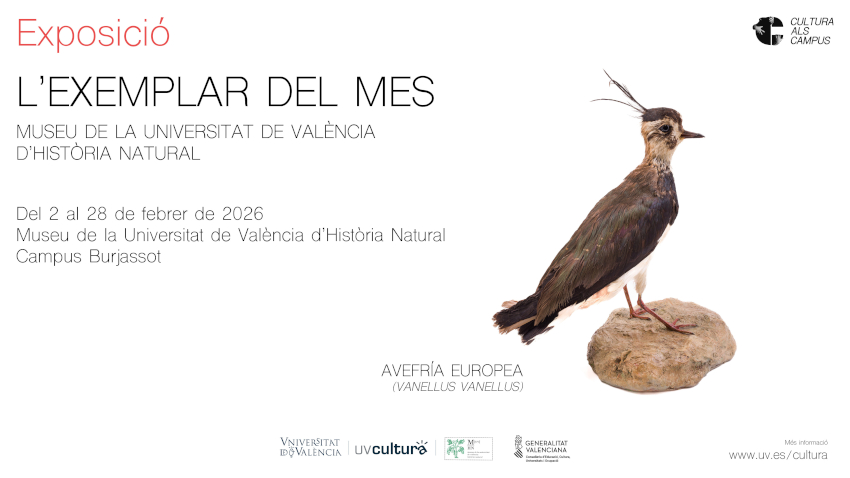
This display, organised by the Natural History Museum of the University of Valencia, aims to turn the spotlight on the institution’s patrimony. Each month, the team at the museum displays at their facilities one of the pieces from their collection in order to popularise relevant works of art, but that a great part of society sadly has not heard of.
In this case, the selected piece is the northern lapwing. The northern lapwing is a European wader, unmistakable for its crest, the black and white contrast of its feathers and its irregular flights. It mainly feeds off invertebrates it catches in the ground, and it is often associated with open spaces with humid and puddled grounds, meadows, cultivation grounds or coastal marshes. In the Valencian Community, this species can be occasionally spotted during the winter, especially in humid zones such as the Marjal dels Moros (Sagunt), which all registered members of this species seem to be interested in.
This piece is part of a historical collection which remained under the Bergamín-Pérez Caballero’s family ownership for decades at Ibi and Nàquera. The father of the family was a hunter and he passed this passion on to his son Francisco, who also took up the art of taxidermy. The preparation on this piece shows classic taxidermy. Judging by the data available, it is likely to have been done by the owner himself with the help from the Martín brothers, renowned Valencian taxidermists who have their workshop at Ercilla street in the city of Valencia. The ornamentation and painting on the mounting stand all point to that workstyle from this workshop and to a mid-21st century aesthetic.
The piece has not been cleaned or restored since its preparation, probably in 1960 or 1970 and it arrived at the museum on a very deficient state. The donation was formalised on 27 July 2022. Given its state and the fact it is a species with very few copies in the MUVHN collections, it was considered appropriate to restore it in order to display it at the waders are of the Zoology room.
It was restored by a professional in the field and it significantly improved the state of the piece. The activity specifically focused on cleaning its feathers, recovering their original colours, as well as the ones on its beak and legs, and remodelling its base or mounting stand to give it a more natural and harmonic look. The result can be clearly observed in the comparative photographs attached.
Beyond its value to be displayed, this piece shows the important role which conservation and restoration jobs play in scientific collections.
Intervention, cleaning and restoration: Tahia Muñoz Jiménez
Photographs: S. Montagud
.