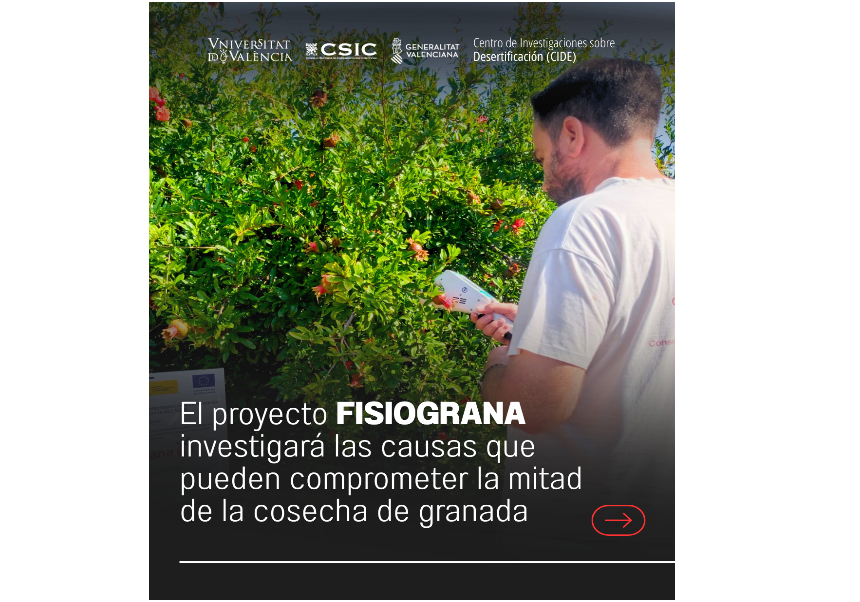
FISIOGRANA: a project to reduce food waste in pomegranate cultivation
The pomegranate is a crop with enormous potential in the context of climate change: it tolerates drought, high temperatures, and difficult soils well, and its fruit has high nutritional value. However, various physiological disorders of the fruit are reducing its profitability and commercial quality. To address this problem, the FISIOGRANA project (AGCOOP/2025/0030) was launched, focusing on analyzing the main physiological disorders of the pomegranate and seeking solutions through irrigation management and other cultivation practices.
A strategic crop with quality problems
The pomegranate (Punica granatum L.) is a fruit tree traditionally cultivated in towns such as Elche, Albatera, and Crevillente, often in soils where other crops do not thrive, thanks to its resistance to salinity and drought. In the Valencian Community, it has become a strategic crop, with growing demand in both the national and international markets. Despite this, its profitability is affected by several physiological disorders that generate significant economic losses.
The project identifies three main problems:
Sunburn: This occurs due to high solar radiation and high temperatures, causing necrosis of the fruit's skin. In warm seasons, it can lead to up to 15% crop loss.
Cracking: This is caused by water or nutrient imbalances in the later stages of fruit development and can exceed 50% losses in unfavorable years, in addition to reducing the fruit's shelf life in export markets.
Aril browning: This is an internal alteration, barely visible from the outside, in which the seed covering changes from bright red to a brownish hue. Its incidence has increased in recent seasons, and its causes are not yet fully understood, although it is associated with heat stress, nutritional deficiencies, and post-harvest storage problems.
What does the project propose?
FISIOGRANA is a project driven by the Desertification Research Center (CIDE, a joint center CSIC-UV-GVA) in collaboration with Anecoop S Coop and the Cajamar Group Foundation. Its overall objective is to reduce the incidence of these physiological disorders or, where possible, eliminate them. To achieve this, the research team is working on two fronts: firstly, identifying the causes of aril cracking, splitting, and browning; and secondly, studying crop management practices that reduce fruit waste—the percentage of product discarded during selection and marketing for failing to meet quality standards—caused by these disorders.
The initial hypothesis is that both proper irrigation management and the use of trellising structures can reduce water and heat stress in the crop during its most critical phases, either by increasing plant transpiration or by providing shade to the fruit to prevent sunscald. Specifically, different irrigation strategies will be evaluated for the Mollar de Elche variety, along with the effect of Y-shaped training systems on heat stress.
To carry out this research, the project proposes five lines of work: a historical agroclimatic analysis of the incidence of physiological disorders over the last 10-20 years; high-resolution phenotyping of different combinations of varieties and rootstocks; the design and evaluation of controlled deficit irrigation and partial root drying strategies; the study of the effect of training systems on heat stress; and, finally, the transfer of the resulting recommendations to the agricultural sector.
Expected results
The team hopes to better understand the causes that cause these alterations and establish the relationship between the water and thermal status of the crop and its appearance, in different varieties and rootstocks. From there, we will seek to improve the quality of the fruit (color, firmness, ripening) through more adequate management of irrigation and the use of vegetation guidance structures, which have already proven effective in other fruit trees such as apple trees, citrus fruits, loquats, persimmons or vines.
Altogether, the FISIOGRANA project hopes to reduce commercial losses from pomegranate cultivation by at least 30%, in addition to improving the quality of the fruit and its added value. All the knowledge generated will be transferred to cooperatives, farmers and the academic field, in order to contribute to more resilient and sustainable pomegranate production in the face of climate change.
This project is financed by the EAFRD, the Ministry of Agriculture, Fisheries and Food and the Generalitat Valenciana, in accordance with what is established in the CAP Strategic Plan 2023-2027. The purpose of this aid is to achieve the transversal objective of modernizing agriculture and rural areas, promoting and sharing knowledge, innovation and digitalization in agricultural and rural areas and promoting its adoption by those dedicated to agriculture, by improving access to research, innovation, knowledge exchange and training.
CIDE Comunication
Contributor to this publication: Pablo Donato Pablos Rivera. This collaboration is supported by the MaX-CSIC Excellence Grant [DEEP-MaX-2024-2 CIDE]