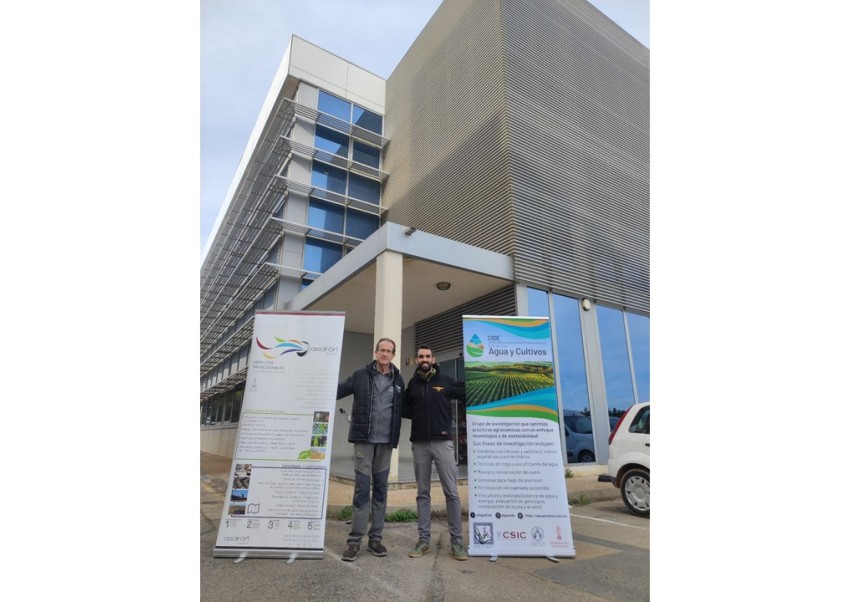
The GAIA Project, titled “Optimizing Water Governance in Agriculture through Artificial Intelligence,” officially started on Monday, 2 March 2026. This two-year project, funded by the Spanish National Research Council (CSIC) through its CoCrea Programme, is aimed at addressing climate change by using artificial intelligence to optimize water use in agriculture through a mobile application designed for irrigation communities and water resource managers.
GAIA addresses one of the most significant challenges in irrigated agriculture: the effective governance of water resources allocated for irrigation. Its objective is to ensure the sustainability of the sector while optimizing crop production under conditions of limited irrigation water allocations at the irrigation-community level. To achieve this goal, GAIA proposes a methodology based on the integration of Artificial Intelligence techniques, proximal and remote sensing, and optimization methods. Specifically, Artificial Intelligence methods will be applied to classify irrigated crops using pattern-recognition approaches based on machine learning and deep learning applied to multispectral and thermal imagery collected by sensors mounted on satellites and unmanned aerial vehicles.
Based on this crop classification, GAIA will estimate theoretical annual crop water requirements and assess water-resource governance practices at the irrigation-community level. In addition, the project will generate optimized alternative scenarios for irrigation water governance in agriculture.
GAIA also considers the generation and transfer of protectable and/or commercially exploitable results to be essential. Accordingly, the project will develop a smartphone application (GAIA-App), based on Artificial Intelligence, designed to support water governance in agriculture for farmer associations, irrigation communities, and water managers. The project will also promote effective strategies for disseminating and exploiting the knowledge generated by GAIA.
Furthermore, GAIA includes activities aimed at knowledge exchange with end users, with the objective of training farmers and technical professionals in the use of the GAIA-App. In this way, GAIA will promote the protection of natural resources through the optimal management of irrigation water, thereby contributing to increased socioeconomic resilience in the primary sector in the face of the major challenges it currently faces.
“GAIA’s results will contribute to promoting the infrastructures, skills, and technologies necessary for the sustainable use of water resources from economic, environmental, and social perspectives, particularly within the agricultural sector,” explains Juan Miguel Ramírez, researcher at the Centre for Desertification Research (CIDE, CSIC-UV-GVA) and GAIA Project Coordinator.
In addition to the Centre for Desertification Research, the company ASDRON is also participating in the GAIA project, contributing its expertise in aerial remote-sensing operations and technical knowledge in the processing of multispectral and thermal imagery. ASDRON supports GAIA by facilitating effective technology transfer between research and agricultural practice.
GAIA is funded under the third edition of the CSIC CoCREA Programme, an initiative that promotes public-private collaboration between the Spanish National Research Council and companies to address strategic industrial challenges.
The CSIC CoCREA Programme, integrated within the CSIC Converge open innovation hub, aims to promote co-creation and co-development projects between CSIC researchers and companies with high potential for industrial application and the generation of industrial property. In this edition, the programme focuses on the development of solutions based on artificial intelligence and quantum technologies, as well as the development of advanced materials with high added value and reduced environmental impact.
CIDE Communication