

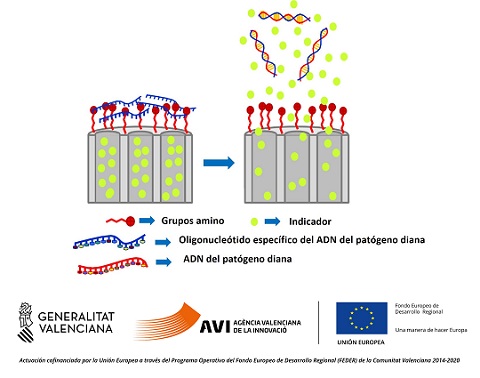
The Scientific Unit for Business Innovation of the IDM (UCI-IDM) is working on the valorization of a novel diagnostic system based on molecular gates with oligonucleotides for the detection of pathogens that cause infections through color change, capable of offering a reading of the result with the naked eye and with a sensitivity similar to systems that use fluorescence.
The Scientific Unit for Business Innovation of the IDM (UCI-IDM) is working on the valorization of a novel diagnostic system based on molecular gates with oligonucleotides for the detection of pathogens that cause infections through color change, capable of offering a reading of the result with the naked eye and with a sensitivity similar to systems that use fluorescence.
The implementation of new fast and sensitive recognition protocols in sensing devices is a great challenge dedicated to the benefit of modern society, which continuously demands better, faster, and more complete information about security, the environment, and especially about Health. In this context, probes based on molecular gated materials have proven to be a powerful tool for rapid and sensitive detection of molecules, biomolecules and microorganisms. However, the detection systems developed so far generally require the use of a fluorescence measurement system to obtain highly sensitive devices. There are some examples in the literature of obtaining sensor systems based on molecular gates and with a colorimetric response, but these systems show a much lower sensitivity and do not offer an amplifying effect capable of generating a highly sensitive response.
In this context, the IDM has managed to demonstrate that molecular gate technology can be equipped with simple enzymatic detection technologies capable of producing a color change in the presence of analytes of interest and offering a reading of the result with the naked eye and with a sensitivity similar to systems that use fluorescence (technology pending patent application).
The sensor materials developed could allow patients to be diagnosed in places with limited infrastructure, without specially qualified personnel, quickly (less than 1h) and without the requirement of transporting the sample to a centralized facility. Its use will allow the rapid implementation of the appropriate treatment, reduction of therapeutic response times, and on-site detection, which will result in a reduction in the socio-sanitary impact derived from any infectious disease.
The results obtained in the project will make it possible to bring the result closer to potential companies in the in vitro diagnostics sector that might be interested in continuing to develop the technology.



