

-
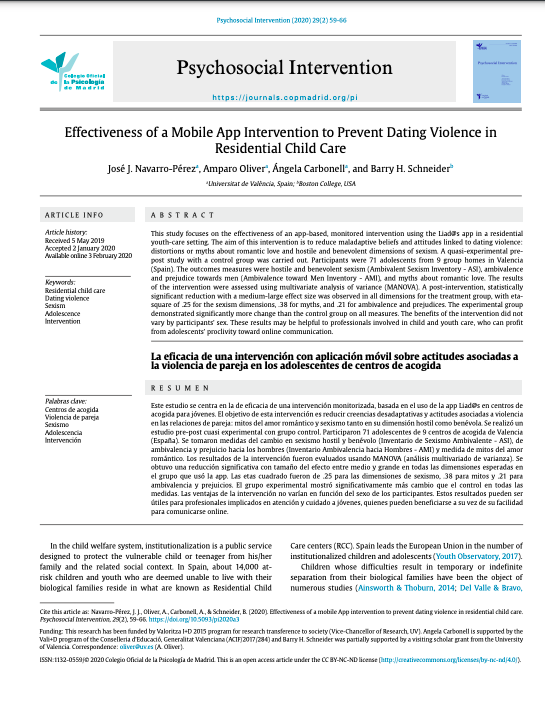
Effectiveness of a mobile app intervention to prevent dating violence in residential child care
Navarro-Pérez, J. J., Oliver, A., Carbonell, A., Schneider, B. H.
(2021). ArticlePsychosocial Intervention. Num.29(2):59-66
Este estudio se centra en la de eficacia de una intervención monitorizada, basada en el uso de la app Liad@s en centros de acogida para jóvenes. El objetivo de esta intervención es reducir creencias desadaptativas y actitudes asociadas a violencia en las relaciones de pareja: mitos del amor romántico y sexismo tanto en su dimensión hostil como benévola. Se realizó un estudio pre-post cuasi experimental con grupo control. Participaron 71 adolescentes de 9 centros de acogida de Valencia (España). Se tomaron medidas del cambio en sexismo hostil y benévolo (Inventario de Sexismo Ambivalente - ASI), de ambivalencia y prejuicio hacia los hombres (Inventario Ambivalencia hacia Hombres - AMI) y...
Este estudio se centra en la de eficacia de una intervención monitorizada, basada en el uso de la app Liad@s en centros de acogida para jóvenes. El objetivo de esta intervención es reducir creencias desadaptativas y actitudes asociadas a violencia en las relaciones de pareja: mitos del amor romántico y sexismo tanto en su dimensión hostil como benévola. Se realizó un estudio pre-post cuasi experimental con grupo control. Participaron 71 adolescentes de 9 centros de acogida de Valencia (España). Se tomaron medidas del cambio en sexismo hostil y benévolo (Inventario de Sexismo Ambivalente - ASI), de ambivalencia y prejuicio hacia los hombres (Inventario Ambivalencia hacia Hombres - AMI) y medida de mitos del amor romántico. Los resultados de la intervención fueron evaluados usando MANOVA (análisis multivariado de varianza). Se obtuvo una reducción significativa con tamaño del efecto entre medio y grande en todas las dimensiones esperadas en el grupo que usó la app. Las etas cuadrado fueron de .25 para las dimensiones de sexismo, .38 para mitos y .21 para ambivalencia y prejuicios. El grupo experimental mostró significativamente más cambio que el control en todas las medidas. Las ventajas de la intervención no varían en función del sexo de los participantes. Estos resultados pueden ser útiles para profesionales implicados en atención y cuidado a jóvenes, quienes pueden beneficiarse a su vez de su facilidad para comunicarse online.
Llegir més Ocultar DOI: 10.5093/pi2020a3 -
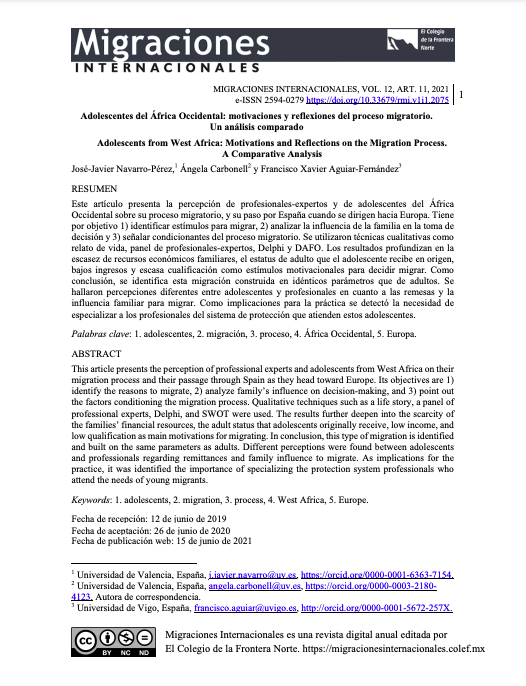
Adolescentes del África Occidental: motivaciones y reflexiones del proceso migratorio. Un análisis comparado
Navarro-Pérez, J. J., Carbonell, A., Aguiar-Fernández, F. X.
(2021). ArticleMigraciones Internacionales. Num.12(1):1-27.
Este artículo presenta la percepción de profesionales-expertos y de adolescentes del África Occidental sobre su proceso migratorio, y su paso por España cuando se dirigen hacia Europa. Tiene por objetivo 1) identificar estímulos para migrar, 2) analizar la influencia de la familia en la toma de decisión y 3) señalar condicionantes del proceso migratorio. Se utilizaron técnicas cualitativas como relato de vida, panel de profesionales-expertos, Delphi y DAFO. Los resultados profundizan en la escasez de recursos económicos familiares, el estatus de adulto que el adolescente recibe en origen, bajos ingresos y escasa cualificación como estímulos motivacionales para decidir migrar. Como...
Este artículo presenta la percepción de profesionales-expertos y de adolescentes del África Occidental sobre su proceso migratorio, y su paso por España cuando se dirigen hacia Europa. Tiene por objetivo 1) identificar estímulos para migrar, 2) analizar la influencia de la familia en la toma de decisión y 3) señalar condicionantes del proceso migratorio. Se utilizaron técnicas cualitativas como relato de vida, panel de profesionales-expertos, Delphi y DAFO. Los resultados profundizan en la escasez de recursos económicos familiares, el estatus de adulto que el adolescente recibe en origen, bajos ingresos y escasa cualificación como estímulos motivacionales para decidir migrar. Como conclusión, se identifica esta migración construida en idénticos parámetros que de adultos. Se hallaron percepciones diferentes entre adolescentes y profesionales en cuanto a las remesas y la influencia familiar para migrar. Como implicaciones para la práctica se detectó la necesidad de especializar a los profesionales del sistema de protección que atienden estos adolescentes.
Llegir més Ocultar DOI: 10.33679/rmi.v1i1.2075 -
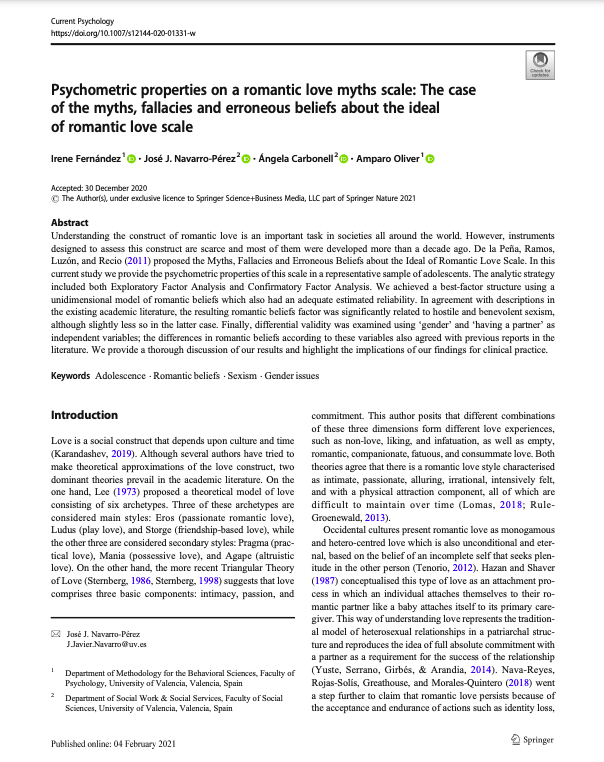
Psychometric properties on a romantic love myths scale: The case of the myths, fallacies and erroneous beliefs about the ideal of romantic love scale
Fernández, I., Navarro-Pérez, J. J., Carbonell, Á., Oliver, A.
(2021). ArticleCurrent Psychology: A Journal for Diverse Perspectives on Diverse Psychological Issues. Num.1-11
Understanding the construct of romantic love is an important task in societies all around the world. However, instruments designed to assess this construct are scarce and most of them were developed more than a decade ago. De la Peña, Ramos, Luzón, and Recio (2011) proposed the Myths, Fallacies and Erroneous Beliefs about the Ideal of Romantic Love Scale. In this current study we provide the psychometric properties of this scale in a representative sample of adolescents. The analytic strategy included both Exploratory Factor Analysis and Confirmatory Factor Analysis. We achieved a best-factor structure using a unidimensional model of romantic beliefs which also had an adequate estimated...
Understanding the construct of romantic love is an important task in societies all around the world. However, instruments designed to assess this construct are scarce and most of them were developed more than a decade ago. De la Peña, Ramos, Luzón, and Recio (2011) proposed the Myths, Fallacies and Erroneous Beliefs about the Ideal of Romantic Love Scale. In this current study we provide the psychometric properties of this scale in a representative sample of adolescents. The analytic strategy included both Exploratory Factor Analysis and Confirmatory Factor Analysis. We achieved a best-factor structure using a unidimensional model of romantic beliefs which also had an adequate estimated reliability. In agreement with descriptions in the existing academic literature, the resulting romantic beliefs factor was significantly related to hostile and benevolent sexism, although slightly less so in the latter case. Finally, differential validity was examined using ‘gender’ and ‘having a partner’ as independent variables; the differences in romantic beliefs according to these variables also agreed with previous reports in the literature. We provide a thorough discussion of our results and highlight the implications of our findings for clinical practice.
Llegir més Ocultar DOI: 10.1007/s12144-020-01331-w -
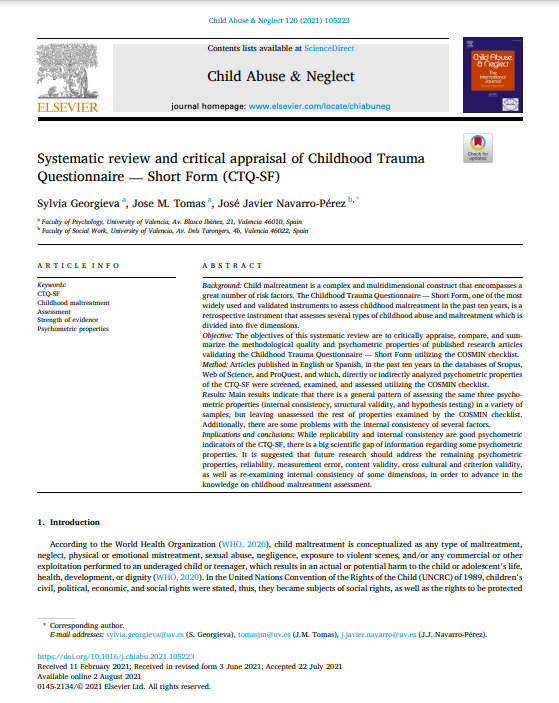
Systematic review and critical appraisal of Childhood Trauma Questionnaire — Short Form (CTQ-SF)
Georgieva, S., Tomás, J. M., Navarro-Pérez, J. J.
(2021). ArticleChild Abuse & Neglect. Num.120:105223.
Background: Child maltreatment is a complex and multidimensional construct that encompasses a great number of risk factors. The Childhood Trauma Questionnaire — Short Form, one of the most widely used and validated instruments to assess childhood maltreatment in the past ten years, is a retrospective instrument that assesses several types of childhood abuse and maltreatment which is divided into five dimensions. Objective: The objectives of this systematic review are to critically appraise, compare, and summarize the methodological quality and psychometric properties of published research articles validating the Childhood Trauma Questionnaire — Short Form utilizing the COSMIN...
Background: Child maltreatment is a complex and multidimensional construct that encompasses a great number of risk factors. The Childhood Trauma Questionnaire — Short Form, one of the most widely used and validated instruments to assess childhood maltreatment in the past ten years, is a retrospective instrument that assesses several types of childhood abuse and maltreatment which is divided into five dimensions. Objective: The objectives of this systematic review are to critically appraise, compare, and summarize the methodological quality and psychometric properties of published research articles validating the Childhood Trauma Questionnaire — Short Form utilizing the COSMIN checklist. Method: Articles published in English or Spanish, in the past ten years in the databases of Scopus, Web of Science, and ProQuest, and which, directly or indirectly analyzed psychometric properties of the CTQ-SF were screened, examined, and assessed utilizing the COSMIN checklist. Results: Main results indicate that there is a general pattern of assessing the same three psychometric properties (internal consistency, structural validity, and hypothesis testing) in a variety of samples, but leaving unassessed the rest of properties examined by the COSMIN checklist. Additionally, there are some problems with the internal consistency of several factors. Implications and conclusions: While replicability and internal consistency are good psychometric indicators of the CTQ-SF, there is a big scientific gap of information regarding some psychometric properties. It is suggested that future research should address the remaining psychometric properties, reliability, measurement error, content validity, cross cultural and criterion validity, as well as re-examining internal consistency of some dimensions, in order to advance in the knowledge on childhood maltreatment assessment.
Llegir més Ocultar DOI: 10.1016/j.chiabu.2021.105223 -

Examining the predictors of prosocial behavior in young offenders and nonoffenders
Samper P, Llorca A, Malonda E, Mestre MV.
(2021). ArticleInternational Journal of Behavioral Development. Num.45(4):299-309
Research on young offenders has primarily focused on identifying predictors of the maladaptive, aggressive behavior; there is a scarcity of evidence on factors that relate to prosocial behavior in these adolescents. The current study examined the link from parenting, emotional instability, and prosocial reasoning to prosocial behavior, while also examining the mediating roles of empathic concern (EC) and perspective taking (PT) in a sample of Spanish adolescent offenders compared to a sample of nonoffenders. Participants were 440 adolescents: 220 young offenders residing in four Youth Detention Centres of Valencia (67.3% men) and 220 enrolled in public and private schools within the...
Research on young offenders has primarily focused on identifying predictors of the maladaptive, aggressive behavior; there is a scarcity of evidence on factors that relate to prosocial behavior in these adolescents. The current study examined the link from parenting, emotional instability, and prosocial reasoning to prosocial behavior, while also examining the mediating roles of empathic concern (EC) and perspective taking (PT) in a sample of Spanish adolescent offenders compared to a sample of nonoffenders. Participants were 440 adolescents: 220 young offenders residing in four Youth Detention Centres of Valencia (67.3% men) and 220 enrolled in public and private schools within the metropolitan area of Valencia (65.9% men). The two subsamples were similar in age (15−18 years), gender, and social class. Analyses show differences in mother’s permissiveness with empathy (PT and EC), in emotional instability and internalized reasoning with PT in predicting prosocial behavior in offenders and nonoffenders adolescents. EC and PT are significative and positively related to prosocial behavior in both groups. These findings have implications for prevention and reeducation interventions oriented to social reinsertion of adolescent offenders and the development of family and social counseling programs that favor adaptive behavior.
Llegir més Ocultar DOI: 10.1177/0165025421995930 -
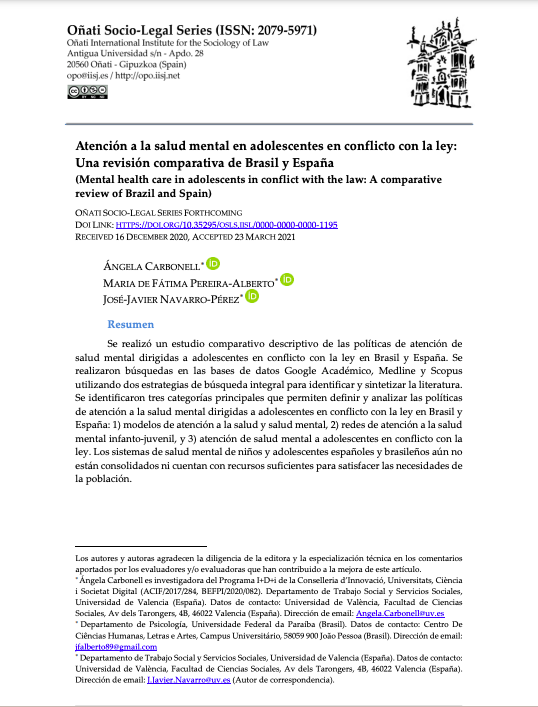
Atención a la salud mental en adolescentes en conflicto con la ley: Una revisión comparativa de Brasil y España
Carbonell, A., Pereira-Alberto, M. F., Navarro-Pérez, J. J.
(2021). ArticleOñati Socio Legal Series. Num.2021:1-24.
Se realizó un estudio comparativo descriptivo de las políticas de atención de salud mental dirigidas a adolescentes en conflicto con la ley en Brasil y España. Se realizaron búsquedas en las bases de datos Google Académico, Medline y Scopus utilizando dos estrategias de búsqueda integral para identificar y sintetizar la literatura. Se identificaron tres categorías principales que permiten definir y analizar las políticas de atención a la salud mental dirigidas a adolescentes en conflicto con la ley en Brasil y España: 1) modelos de atención a la salud y salud mental, 2) redes de atención a la salud mental infanto-juvenil, y 3) atención de salud mental a adolescentes en conflicto con la ley....
Se realizó un estudio comparativo descriptivo de las políticas de atención de salud mental dirigidas a adolescentes en conflicto con la ley en Brasil y España. Se realizaron búsquedas en las bases de datos Google Académico, Medline y Scopus utilizando dos estrategias de búsqueda integral para identificar y sintetizar la literatura. Se identificaron tres categorías principales que permiten definir y analizar las políticas de atención a la salud mental dirigidas a adolescentes en conflicto con la ley en Brasil y España: 1) modelos de atención a la salud y salud mental, 2) redes de atención a la salud mental infanto-juvenil, y 3) atención de salud mental a adolescentes en conflicto con la ley. Los sistemas de salud mental de niños y adolescentes españoles y brasileños aún no están consolidados ni cuentan con recursos suficientes para satisfacer las necesidades de la población.
Llegir més Ocultar DOI: 10.35295/OSLS.IISL/0000-0000-0000-1195 -

Sexismo y mitos del amor romántico en adolescentes que residen en centros de acogida
Carbonell, A., Fernández, I., Navarro-Pérez, J. J.
(2021). ArticleOBETS. Revista de Ciencias Sociales. Num.16(1):75-86
La investigación explora la relación entre sexismo y la distorsión en mitos del amor romántico en adolescentes que residen en Centros de Acogida de Menores en Valencia (España). El diseño de investigación fue descriptivo transversal con una muestra de 147 adolescentes. Los resultados reflejan una relación estadísticamente significativa que indica que, a mayor sexismo en los y las adolescentes, mayores son las distorsiones románticas. Se identificaron mayores niveles de sexismo hacia las mujeres y mitos del amor romántico en chicos, mientras que las mujeres mostraron mayores puntuaciones en las actitudes sexistas hacia los hombres. Se concluye que la vivencia de situaciones de violencia...
La investigación explora la relación entre sexismo y la distorsión en mitos del amor romántico en adolescentes que residen en Centros de Acogida de Menores en Valencia (España). El diseño de investigación fue descriptivo transversal con una muestra de 147 adolescentes. Los resultados reflejan una relación estadísticamente significativa que indica que, a mayor sexismo en los y las adolescentes, mayores son las distorsiones románticas. Se identificaron mayores niveles de sexismo hacia las mujeres y mitos del amor romántico en chicos, mientras que las mujeres mostraron mayores puntuaciones en las actitudes sexistas hacia los hombres. Se concluye que la vivencia de situaciones de violencia familiar no tiene un efecto significativo en la adopción de actitudes y creencias sexistas y románticas idealizadas en adolescentes institucionalizados.
Llegir més Ocultar DOI: 10.14198/OBETS2021.16.1.05 -

Prevención de riesgo psicosocial en adolescentes: el rol de los Centros de Día de Menores en España
Capella-Castillo, S., Navarro-Pérez, J. J.
(2021). ArticleRevista Latinoamericana de Ciencias Sociales, Niñez y Juventud. Num.19(1):1-22.
El artículo analiza la función de los Centros de Día de Menores (CDM) como recursos especializados en la intervención socioeducativa con adolescentes en riesgo. Se trata de una investigación cualitativa, en la que se han integrado diferentes técnicas con el fin de triangular evidencias objetivas. En el plano metodológico participó una muestra de 30 profesionales, implementando diferentes técnicas: entrevistas y grupos de discusión. Los datos obtenidos se codificaron y categorizaron. Los resultados destacan la especificidad de los CDM como recurso de proximidad en el proceso de socialización y de acompañamiento progresivo, individualizado y flexible de adolescentes en riesgo. Las...
El artículo analiza la función de los Centros de Día de Menores (CDM) como recursos especializados en la intervención socioeducativa con adolescentes en riesgo. Se trata de una investigación cualitativa, en la que se han integrado diferentes técnicas con el fin de triangular evidencias objetivas. En el plano metodológico participó una muestra de 30 profesionales, implementando diferentes técnicas: entrevistas y grupos de discusión. Los datos obtenidos se codificaron y categorizaron. Los resultados destacan la especificidad de los CDM como recurso de proximidad en el proceso de socialización y de acompañamiento progresivo, individualizado y flexible de adolescentes en riesgo. Las conclusiones inciden en la especialización del recurso en la atención a adolescentes que atraviesan procesos vitales complejos y en la consolidación del recurso como alternativa socioeducativa a la educación formal, utilizando en el territorio como generador de oportunidades.
Llegir més Ocultar DOI: 10.11600/rlcsnj.19.1.4293 -
Victimization and peer and parents attachment: the mediating effect of regulatory emotional self-efficacy
Samper-García, P., Malonda-Vidal, E., Llorca-Mestre, A., Muñoz-Navarro, R., & Mestre-Escrivá, V.
(2021). ArticleInternational journal of environmental research and public health. Num.18(4), 2062
Studies of the Spanish adolescent population has concluded that victimization is related to lack of emotional regulation and impulse control. Therefore, if a victim is unable to recognize, understand and regulate their emotions, this can result in rejection by their peers. A cross-sectional study was conducted to examine regulatory emotional self-efficacy as a possible mediator in the association between peer and parents attachment and victimization. Adolescents (n = 563) completed Regulatory Emotional Self-Efficacy, Inventory of Parents and Peer Attachment and Kid at School questionnaires. Structural equation models (SEMs) were used to predict a latent variable of victimization with...
Studies of the Spanish adolescent population has concluded that victimization is related to lack of emotional regulation and impulse control. Therefore, if a victim is unable to recognize, understand and regulate their emotions, this can result in rejection by their peers. A cross-sectional study was conducted to examine regulatory emotional self-efficacy as a possible mediator in the association between peer and parents attachment and victimization. Adolescents (n = 563) completed Regulatory Emotional Self-Efficacy, Inventory of Parents and Peer Attachment and Kid at School questionnaires. Structural equation models (SEMs) were used to predict a latent variable of victimization with parents and peer attachment, emphasizing the mediating role of regulatory emotional self-efficacy, as comprised by a positive and a negative aspect. Results showed that peer attachment had an indirect negative effect, through perceived self-efficacy, in managing a positive effect in victimization, while father attachment had an indirect negative affect, through perceived self-efficacy, in managing a negative affect in victimization, and Mother attachment had no statistically significant indirect effect in victimization. This study suggests that the roles of parents and peers, and also between mothers and fathers, are different in relation to the perception of victimization of adolescents. Findings provide relevant information regarding implications for prevention and intervention in victimization.
Llegir més Ocultar DOI: https://doi.org/10.3390/ijerph18042062 -
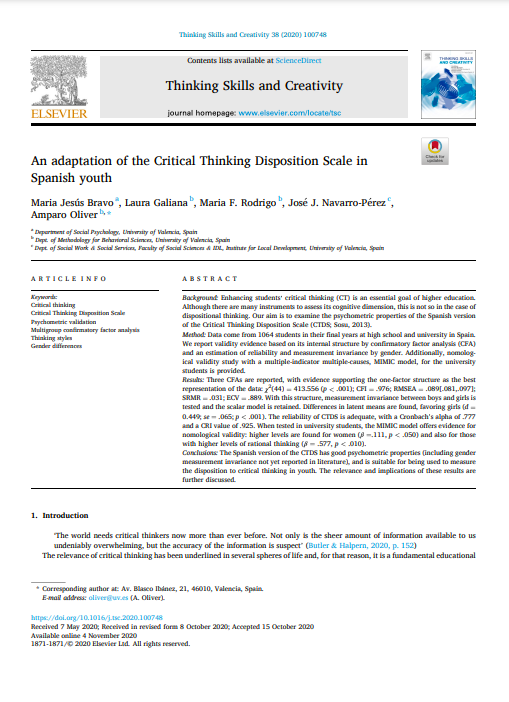
An adaptation of the Critical Thinking Disposition Scale in Spanish youth
Bravo, M. J., Galiana, L., Rodrigo, M. F., Navarro-Pérez, J. J., Oliver, A.
(2020). ArticleThinking Skills and Creativity. Num.38:100748.
Background: Enhancing students’ critical thinking (CT) is an essential goal of higher education. Although there are many instruments to assess its cognitive dimension, this is not so in the case of dispositional thinking. Our aim is to examine the psychometric properties of the Spanish version of the Critical Thinking Disposition Scale (CTDS; Sosu, 2013). Method: Data come from 1064 students in their final years at high school and university in Spain. We report validity evidence based on its internal structure by confirmatory factor analysis (CFA) and an estimation of reliability and measurement invariance by gender. Additionally, nomological validity study with a multiple-indicator...
Background: Enhancing students’ critical thinking (CT) is an essential goal of higher education. Although there are many instruments to assess its cognitive dimension, this is not so in the case of dispositional thinking. Our aim is to examine the psychometric properties of the Spanish version of the Critical Thinking Disposition Scale (CTDS; Sosu, 2013). Method: Data come from 1064 students in their final years at high school and university in Spain. We report validity evidence based on its internal structure by confirmatory factor analysis (CFA) and an estimation of reliability and measurement invariance by gender. Additionally, nomological validity study with a multiple-indicator multiple-causes, MIMIC model, for the university students is provided. Results: Three CFAs are reported, with evidence supporting the one-factor structure as the best representation of the data: χ2 (44) = 413.556 (p < .001); CFI = .976; RMSEA = .089[.081,.097]; SRMR = .031; ECV = .889. With this structure, measurement invariance between boys and girls is tested and the scalar model is retained. Differences in latent means are found, favoring girls (d =0.449; se = .065; p < .001). The reliability of CTDS is adequate, with a Cronbach’s alpha of .777 and a CRI value of .925. When tested in university students, the MIMIC model offers evidence for nomological validity: higher levels are found for women (β =.111, p < .050) and also for those with higher levels of rational thinking (β = .577, p < .010). Conclusions: The Spanish version of the CTDS has good psychometric properties (including gender measurement invariance not yet reported in literature), and is suitable for being used to measure the disposition to critical thinking in youth. The relevance and implications of these results are further discussed.
Llegir més Ocultar DOI: 10.1016/j.tsc.2020.100748




© 2026 UV. - Campus dels Tarongers Av. Tarongers, s/n 46022 València