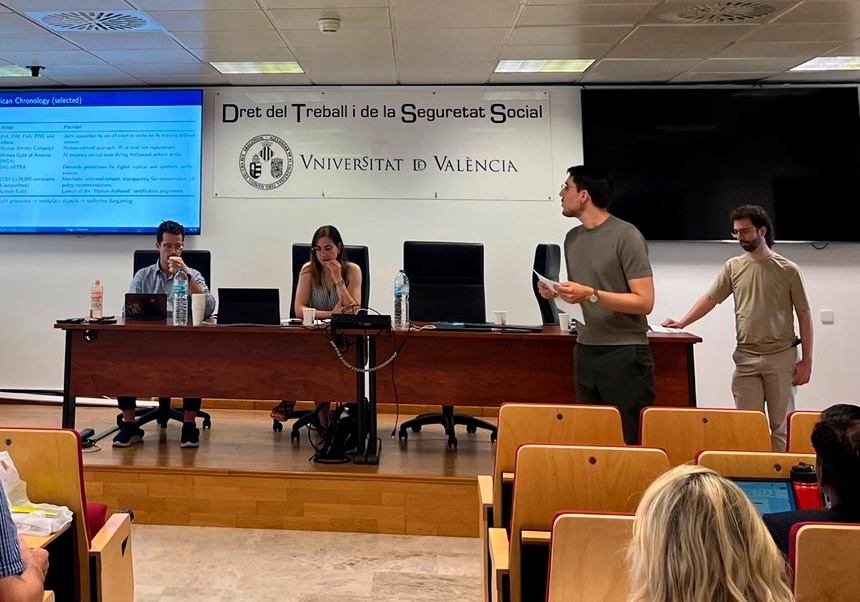
The paper, developed within the European AI-SECRETT project, analyses the mobilisation of creative workers in response to the appropriation of their labour by generative AI and examines the phenomenon of "AI slop" as a form of double dispossession.
Research · Artificial Intelligence · Cultural & Creative Sectors
Econcult researchers present work on "angry creators" at the II International Congress on AI in the World of Work
The paper, developed within the European AI-SECRETT project, analyses the mobilisation of creative workers in response to the appropriation of their labour by generative AI and examines the phenomenon of "AI slop" as a form of double dispossession.
The research team at Econcult (Economics of Culture and Tourism, Universitat de València) presented on 25 June the paper "Angry Creators: The Future of Work After the AI Slop" at the II International Congress on Artificial Intelligence in the World of Work, held at the Universitat de València. The congress brought together lawyers, labour inspectors, academics and early-career researchers from across Europe and Latin America to debate the implications of generative AI for labour relations, with particular focus on the Platform Work Directive, the General Data Protection Regulation, and the EU Artificial Intelligence Act.
The paper, authored by Francesc Felipe-Campillo, Joan Sanchis, Manuel Genovés and Paula Simó-Tomas, represents a significant contribution to the analysis of the labour implications of AI adoption in the cultural and creative sectors — a field in which Econcult holds a distinctive track record of applied research.
A labour conflict, not a technological opposition
The work opens with a precise diagnosis: generative AI targets creative labour directly — writers, musicians, illustrators, voice actors — given that AI models have been trained on copyright-protected works without consent, credit or remuneration. The platform economy had already reshaped the distribution and monetisation of these sectors; AI intensifies the existing asymmetries.
The authors propose the concept of angry creators as an interpretive framework that supersedes the neo-Luddite label. Unlike neo-Luddism or algorithmic Luddism — which still centre the technology — the category of angry creators foregrounds the labour conflict: this is not hostility to AI but a response to dispossession and loss of control over one's own work. The core demands of this movement can be distilled into three words: consent, credit and compensation.
The paper traces a detailed Euro-American chronology of collective mobilisation, from the 2023 Hollywood writers' strike (WGA, SAG-AFTRA) to the 2024 ECSA Manifesto signed by over 30,000 European composers, through to the ongoing Artist Statute negotiations in Spain in 2026. In the Spanish context, the paper highlights the IA Respeta Cultura coalition and the actions of the ALMA screenwriters' union against AI-generated scripts.
AI slop as a second front
The research incorporates the concept of "AI slop" — the saturation of platforms with low-quality AI-generated content — to describe a second vector of harm. This is not a structural rupture: content farms and spam operated on the same logic; AI simply scales it. The result is a double dispossession: creators' works are extracted to train models that then compete directly against them. At the cultural level, algorithmic systems that reward engagement suppress aesthetic risk and individual voice, producing what the authors call cultural flattening.
Key findings
- Creative-sector mobilisation is a labour conflict, not a technological opposition.
- Opposition and negotiation coexist — in both the United States and Spain.
- AI slop adds a second front: double dispossession and cultural flattening.
- The central question is governance: who controls AI, who benefits, and who bears the costs.
- The debate is less about replacement and more about reconfiguration — and the terms of that reconfiguration are politically contested.
Policy proposals
The paper concludes with five lines of policy intervention: copyright reform and collective licensing systems for works used in AI training; stronger sectoral collective bargaining agreements covering consent, remuneration, attribution and digital replicas; mandatory labelling of AI-generated or AI-assisted content; support for quality-oriented human intermediaries as a counterweight to algorithmic flattening; and participatory governance ensuring that creators and civil society have a seat at the regulatory table.
This contribution is part of the AI-SECRETT project (Artificial Intelligence for Smart Creative Economy Transformation and Trust), funded by the EU Digital Europe Programme (GA 101226207), of which Econcult is the coordinating partner. AI-SECRETT's mission is to analyse and support the integration of AI into European cultural and creative sectors, with particular attention to labour, legal and governance dimensions. The presentation at the II International Congress demonstrates Econcult's growing international projection and its capacity to translate scientific findings into spaces of practical and policy debate.
francesc.felipe@uv.es · joan.sanchis@uv.es
Further information on the project: aisecrett.eu
Links:
Images: