

-
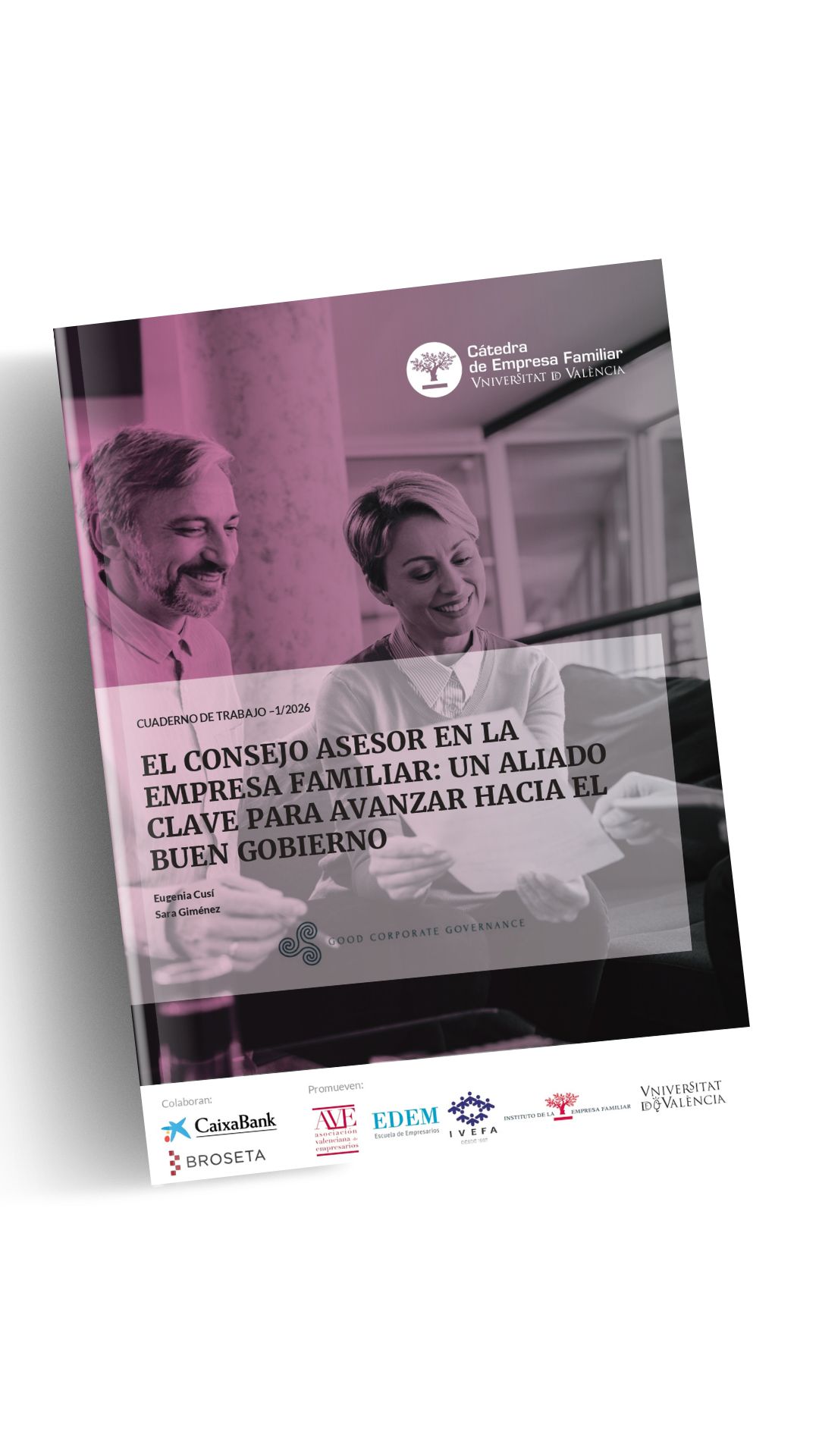
Working Paper 1/2026: “The advisory board in the family business: a key ally for advancing towards good governance”.
Eugenia Cusí (Independent Director/Corporate Governance) and Sara Giménez (Independent Director/Executive Coach) Good Corporate Governance
(2026). Recurs electrònicThe working paper analyses the role of the advisory board as a key tool for professionalising decision-making and advancing towards a model of good governance in family businesses. The publication highlights the importance of evolving from intuitive governance models towards more deliberate systems capable of improving the quality of strategic decisions, anticipating risks and preparing the future of the company. It also addresses aspects such as the differences between an advisory board and a board of directors, the criteria for designing an effective advisory board, and the evolution of governance in family businesses through different practical cases and application examples.
-
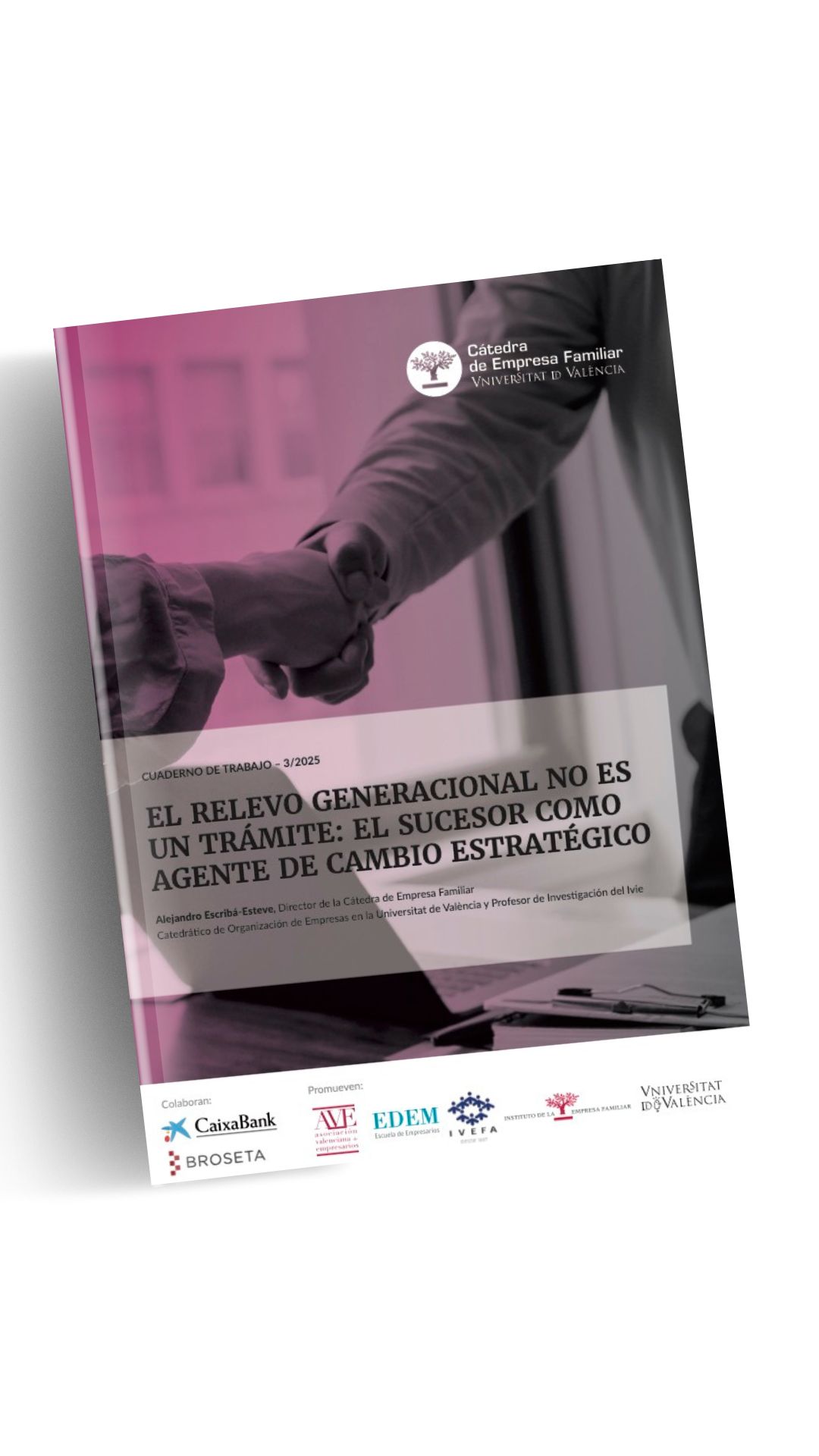
Working Paper 3/2025: ‘Generational succession is not a mere formality: the successor as an agent of strategic change’
Alejandro Escribá Esteve (Director of the Family Business Chair, Professor of Business Organisation at the University of Valencia and Research Professor at the Ivie)
(2025). Recurs electrònicSuccession in a family business is a profound strategic change, not a simple generational formality. The successor must act as an agent of change with their own vision that renews the business project. The process requires an honest diagnosis to determine whether the company needs incremental adjustment, evolution, strategic reorientation or profound transformation. Leadership is built by activating levers such as People, Processes, Structures, Culture, Strategy and Relationships, and is sustained by attitudes such as active humility, determination and trust (based on competence, integrity and benevolence). Resistance is inevitable (from the founder, family, managers or the successor...
Succession in a family business is a profound strategic change, not a simple generational formality. The successor must act as an agent of change with their own vision that renews the business project. The process requires an honest diagnosis to determine whether the company needs incremental adjustment, evolution, strategic reorientation or profound transformation. Leadership is built by activating levers such as People, Processes, Structures, Culture, Strategy and Relationships, and is sustained by attitudes such as active humility, determination and trust (based on competence, integrity and benevolence). Resistance is inevitable (from the founder, family, managers or the successor themselves), but it can be effectively managed using the PROMPT model (Persuasion, Resources and Organisation, Movement, Politics, Timing), allowing the successor to move forward with legitimacy and purpose.
Read more Hide -

DOES CEOS’ PRIOR EXPERIENCE IN GLOBAL JOURNAL OF FAMILY CRISES MATTER FOR FAMILY FIRMS IN THEIR NEXT CRISIS? EMOTIONAL AND RATIONAL ADVANTAGES ACROSS CULTURAL CONTEXTS
María Iborra, University of Valencia José Fernando López-Muñoz, ESIC Business & Marketing School Vicente Safón, University of Valencia & Ivie Members of the STEER research group (Strategy, Top Executi- ves, ESG and Resiliency) and collaborators of the Chair of Family-Owned Business (CEFUV)
(2025). Recurs electrònicThis research note analyses why some family businesses manage to adapt better during global crises. The proposition is clear: having a CEO who has successfully dealt with a previous crisis, such as the one in 2008, can improve the company's performance in new situations of uncertainty, such as COVID-19. Two types of advantages are identified: a rational one, related to a greater ability to drive digital transformation and align strategy with the changing environment, and an emotional one, based on reinforcing the family's identification with the company thanks to that previous experience. Moreover, the impact of the CEO varies according to the cultural context: it is stronger in countries...
This research note analyses why some family businesses manage to adapt better during global crises. The proposition is clear: having a CEO who has successfully dealt with a previous crisis, such as the one in 2008, can improve the company's performance in new situations of uncertainty, such as COVID-19. Two types of advantages are identified: a rational one, related to a greater ability to drive digital transformation and align strategy with the changing environment, and an emotional one, based on reinforcing the family's identification with the company thanks to that previous experience. Moreover, the impact of the CEO varies according to the cultural context: it is stronger in countries with individualistic cultures, where individual leadership has greater weight.
Read more Hide -
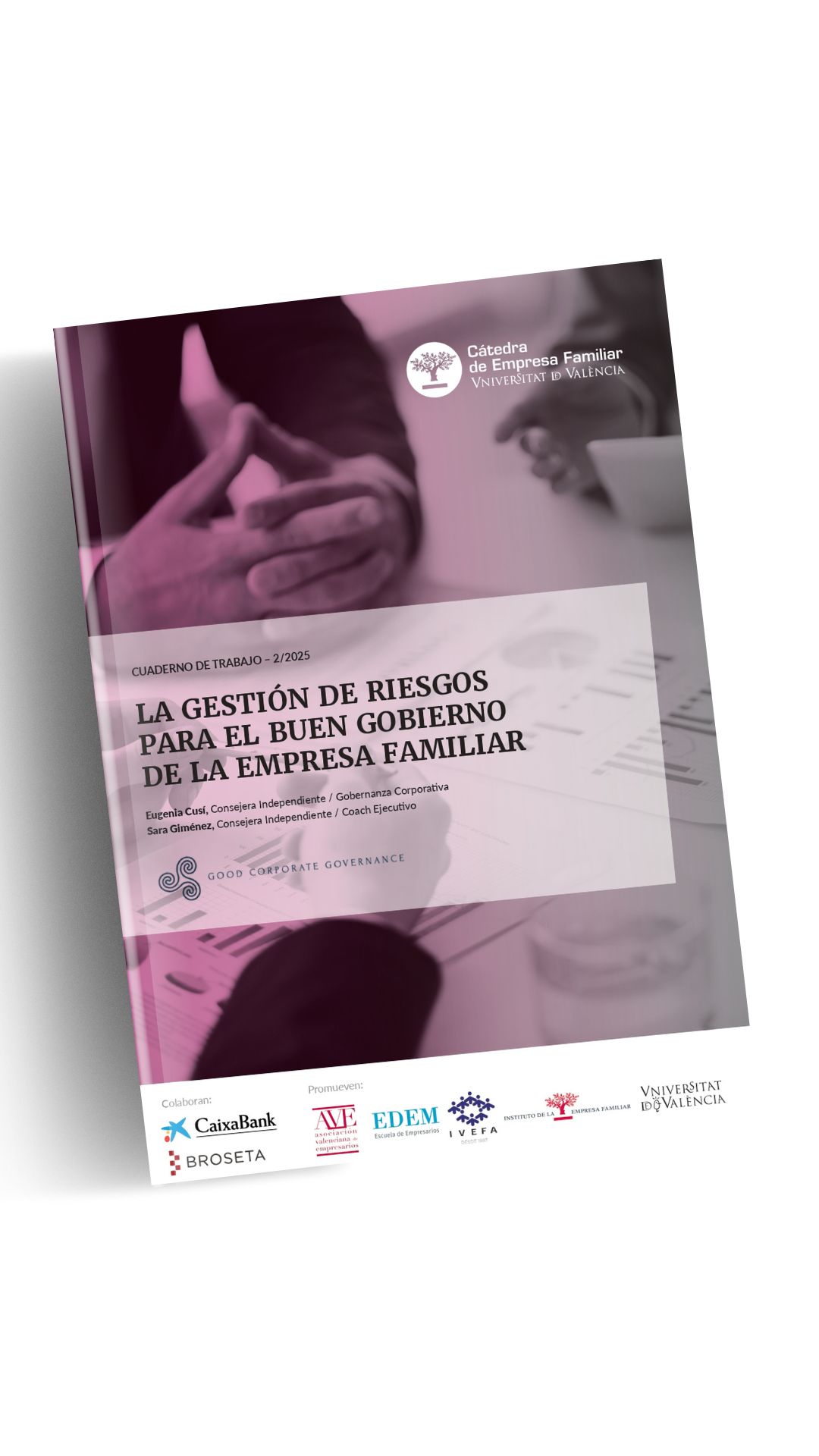
Working Paper 2/2025: ‘Risk management for good governance of family businesses’.
Eugenia Cusí (Independent Director/Corporate Governance) Sara Giménez (Independent Director/Executive Coach) Good Corporate Governance
(2025). Recurs electrònicIt addresses how strategic risk management can strengthen the sustainability, resilience and continuity of family businesses. The booklet provides practical tools for identifying, ranking and prioritising business risks. It details five broad categories of risk (governance, strategic, financial, operational and people-related), the steps to build an effective risk map, and discusses both internal risk management and possible outsourcing. In addition, the specific risks faced by family businesses, such as the lack of succession planning or family conflicts, are examined in depth. All of this from an ethical perspective that reinforces responsible decision-making and commitment to the family...
It addresses how strategic risk management can strengthen the sustainability, resilience and continuity of family businesses. The booklet provides practical tools for identifying, ranking and prioritising business risks. It details five broad categories of risk (governance, strategic, financial, operational and people-related), the steps to build an effective risk map, and discusses both internal risk management and possible outsourcing. In addition, the specific risks faced by family businesses, such as the lack of succession planning or family conflicts, are examined in depth. All of this from an ethical perspective that reinforces responsible decision-making and commitment to the family legacy.
Read more Hide -
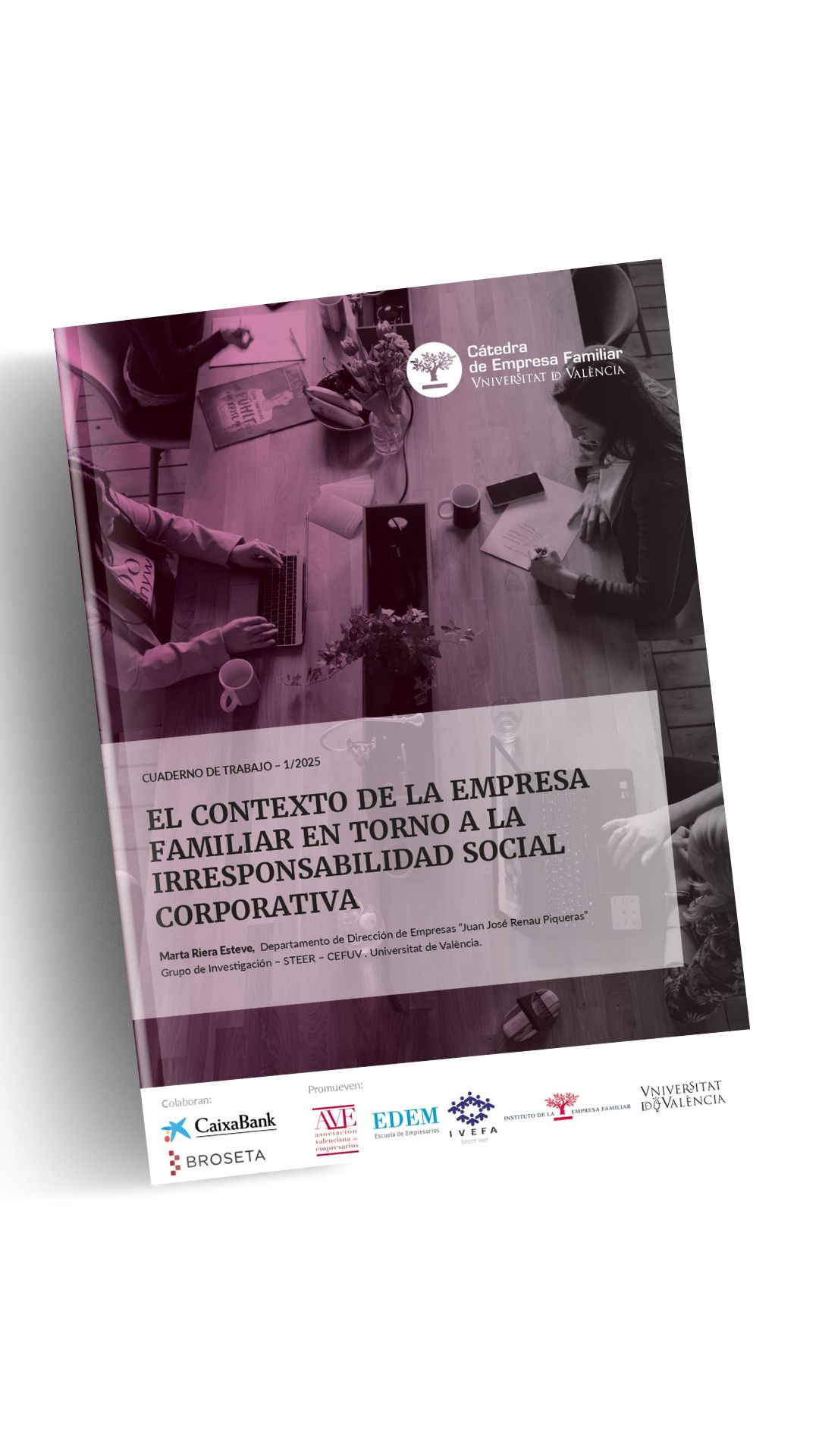
Working Paper 1/2025: “The Context of Family Businesses Regarding Corporate Social Irresponsibility”
Marta Riera Esteve (Department of Business Management: "Juan José Renau Piqueras"; Research Group STEER – CEFUV. Universitat de València).
(2025). Recurs electrònicThis study analyzes the phenomenon of Corporate Social Irresponsibility (CSI) in family businesses, exploring its causes, manifestations, and consequences. Unlike Corporate Social Responsibility (CSR), CSI involves practices that negatively impact the company, its employees, customers, and society as a whole.
-

CEFUV Report 2024
2024
(2024). Recurs electrònicChair of Family Business at the University of Valencia (2024). Report of activities of the Chair of Family Business of the University of Valencia during 2024.
-
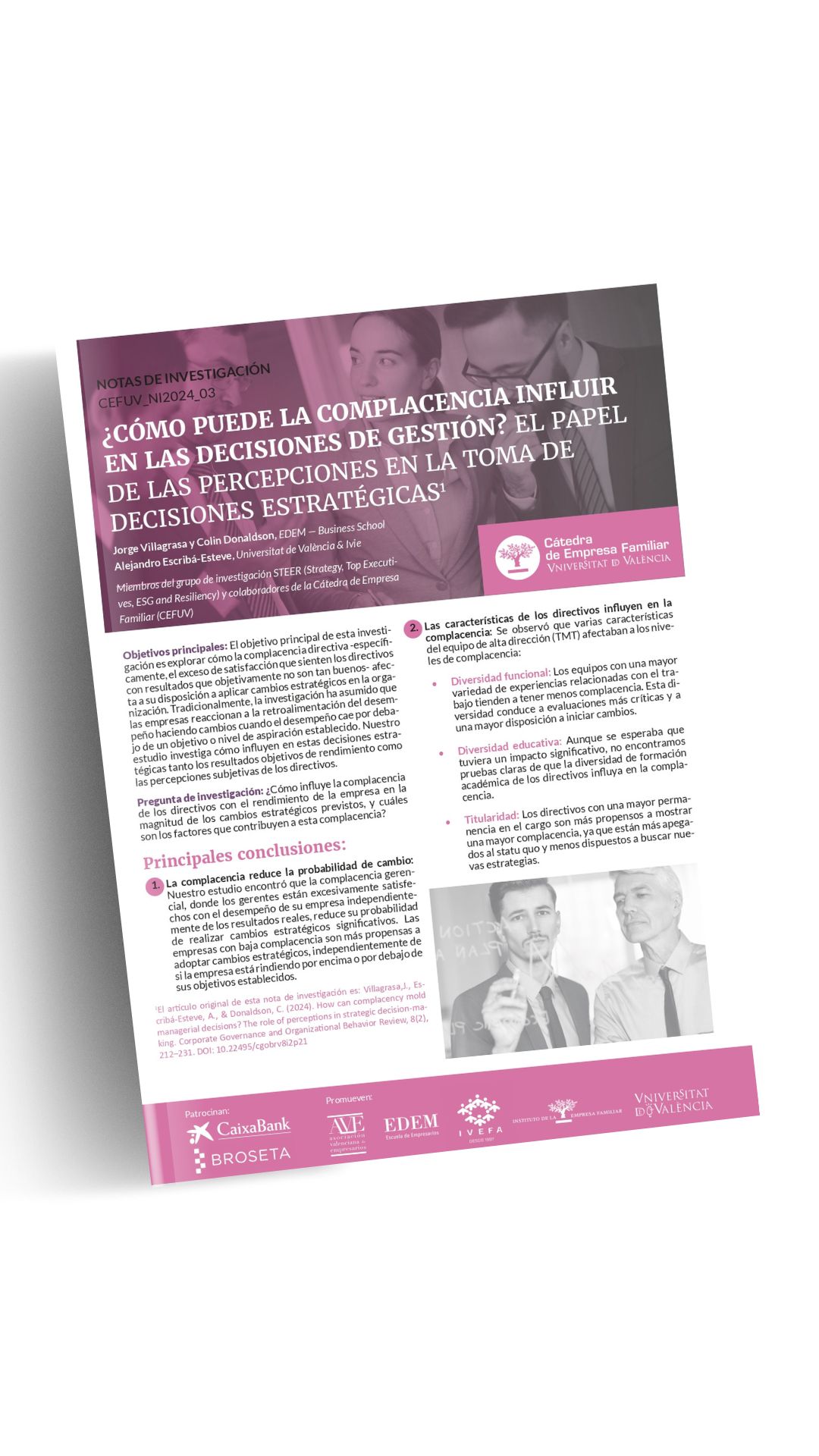
HOW CAN COMPLACENCY INFLUENCE MANAGEMENT DECISIONS? THE ROLE OF PERCEPTIONS IN STRATEGIC DECISION-MAKING
Jorge Villagrasa, EDEM Business School Colin Donaldson, EDEM Business School Alejandro Escribá-Esteve, Universitat de València & Ivie Members of the STEER research group (Strategy, Top Executives, ESG and Resiliency) and collaborators of the Chair of Family Business (CEFUV)
(2024). Recurs electrònicThe concept of complacency (leaders' excessive satisfaction with business performance) and its effects on the willingness to make strategic changes, even when actual results are not favourable. Factors such as functional diversity decrease complacency, while seniority increases it. Encouraging diverse teams, challenging satisfaction with current performance and encouraging leaders to remain open to change are recommended to drive organisational adaptability.
-

THE FINANCIAL SOUNDNESS OF FAMILY FIRMS DURING CRISES: DOES ‘FAMILIARITY’ MATTER?
Jorge Villagrasa; Colin Donaldson, EDEM Business School Alejandro Escribá-Esteve, Universitat de València & Ivie Esther Sánchez-Peinado, Universitat de València Members of the STEER research group (Strategy, Top Executives, ESG and Resiliency) and collaborators of the Chair of Family Business (CEFUV)
(2024). InformesThe study analyses whether family firms have greater financial strength than non-family firms during economic crises, such as the 2008-2009 crisis and the COVID-19 pandemic. Based on an analysis of 137 Spanish SMEs, it concludes that family businesses stand out for their resilience due to their long-term focus, cautious risk-taking and the goal of preserving their legacy. Neither internationalisation nor diversification significantly alter this strength. Moreover, the education and age of management teams in family firms reinforce their financial stability.
-
Workbook 1/2024: "Keys to brand management in family businesses".
Emilio Llopis Sancho (PhD in Branding, Professor at EDEM Escuela de Empresarios and Partner of GLR Partners)
València , 2024. Recurs electrònicIn a highly competitive business environment, branding becomes a crucial strategic asset for family businesses. These companies, with their rich heritage and values passed down through the generations, find in family branding a powerful tool to communicate their unique identity and differentiate themselves from large corporations. This type of branding not only connects with customers looking for authenticity and quality, but also strengthens the emotional bond with the brand, which is vital for attracting and retaining talent, as well as creating a strong corporate culture. In addition, a well-managed brand can increase market value and ensure long-term economic sustainability.
-
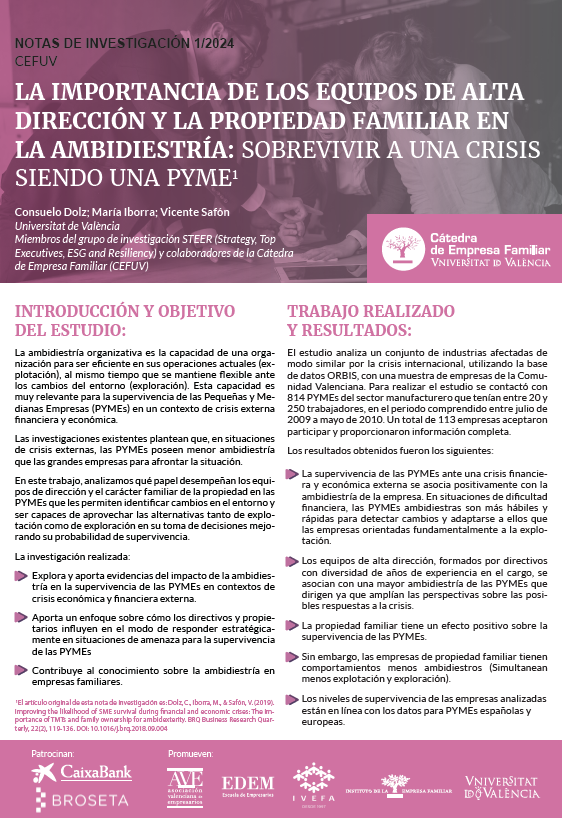
The importance of management teams and family ownership in ambidextrousness: surviving a crisis as an SME
Consuelo Dolz, María Iborra and Vicente Safón (Members of the STEER research group (Strategy, Top Executives, ESG and Resiliency) and collaborators of the Family Business Chair (CEFUV).
València , 2024. Recurs electrònicFind out how Small and Medium Enterprises (SMEs) can successfully face and overcome economic crises. Our research highlights the vital role of organisational ambidestry, diverse top management teams and the influence of family ownership in this process. Explore more about our findings and their impact on business survival here.
 Family Business Chair


© 2026 UV. - Edifici d'Instituts Universitaris d'Investigació C/ Serpis 29, 4ª planta. 46022 València. Espanya. Tel UV: (+34) 961.625.414