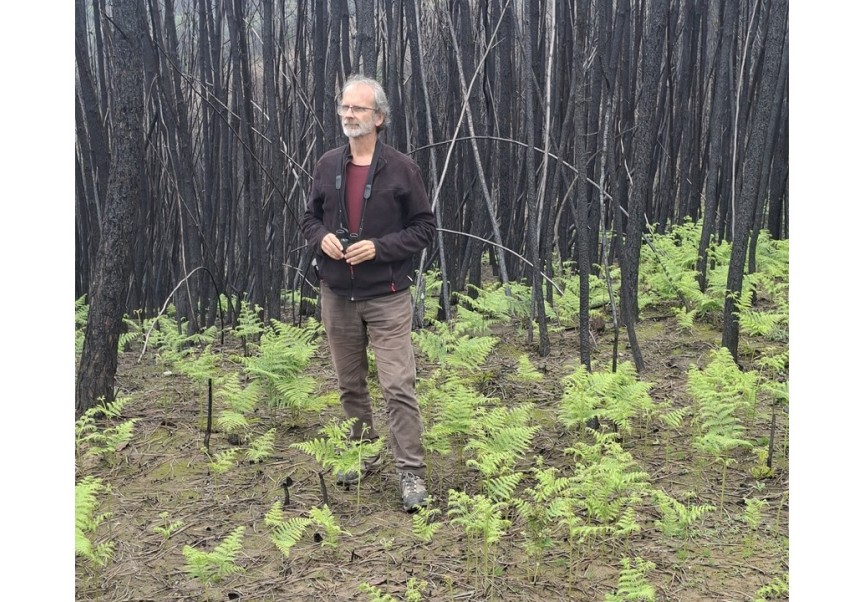
CIDE (CSIC-UV-GVA) scientist Juli G. Pausas has been awarded an ‘Advanced Grant’ from the European Research Council to lead a study aimed at identifying pivotal moments in the history of fire
The ‘FireShifts’ project aims to identify abrupt changes in fire regimes in regions with a Mediterranean climate by examining their impact on plants, which will be useful for fire management
To understand the role of fire in shaping global biodiversity over time, particularly in the Mediterranean region. This is the main objective of the FireShifts project, an initiative led by Juli G. Pausas, a scientist at the Spanish National Research Council (CSIC), which has just been awarded one of the prestigious Advanced Grants from the European Research Council (ERC). The project, which will be carried out at the Desertification Research Centre (CIDE) – a joint centre run by the CSIC, the University of Valencia and the Valencian Regional Government – aims to identify abrupt changes in the frequency and intensity of fires that had evolutionary consequences for Mediterranean plants, specifically their ability to survive and adapt to fire.
The FireShifts project will study the evolution of different plant lineages (clades) and the characteristics that enable them to survive and regenerate under the influence of recurrent fires. To this end, it combines advanced phylogenomic studies—which allow the evolutionary history of plant groups to be reconstructed through the analysis of large amounts of genetic data—with field and laboratory studies, which will provide information on the different responses of plants to fire. The aim is to detect abrupt changes in fire regimes that occurred in the past.
The study will cover Mediterranean plants from all continents (the so-called ‘Mediterranean biome’), with a particular focus on the northern hemisphere: the Mediterranean basin and California. “The project aims to identify changes in fire regimes – their frequency and intensity – which had evolutionary implications by generating or causing the loss of adaptations, particularly in the various regions of the world with a Mediterranean climate. This will enable us to pinpoint key moments in the history of fire on Earth,” summarises Juli G. Pausas. “In other words, the project aims to understand the role of fire in shaping biodiversity on a global scale,” he adds.
Transforming the way we understand wildfires
According to the CSIC researcher, little research has been carried out into the role of fire as an evolutionary force and a driver of biodiversity. “Very little is known about the evolutionary changes that fire has brought about on our planet. By delving deeper into this ecological disturbance, FireShifts will transform our understanding of forest fires,” says Pausas. “This knowledge will help us predict the biological consequences of the changes in fire regimes that we are observing in many regions of the planet. It will also provide a more appropriate conceptual framework for fire management and the ecological restoration of affected areas.”
The team led by Juli G. Pausas at CIDE has long been studying various aspects of the ecology and evolution of ecosystems characterised by frequent fires. His research focuses on the ecology of dry ecosystems where fire plays an ecological and evolutionary role in shaping species, communities and landscapes. The researcher has worked in different parts of the world, particularly in Mediterranean ecosystems in Europe and Australia. He is the author of hundreds of scientific articles and several books, including the popular science title Incendios Forestales. Una introducción a la ecología del fuego, published in the ¿Qué Sabemos de? series by CSIC and Catarata.
“FireShifts will enable us to make a qualitative leap forward in these studies by analysing more diverse groups with wider geographical distributions, whilst also incorporating innovative techniques. Consequently, the results obtained will serve not only to deepen our understanding of the ecology and evolution of these ecosystems, but also to detect changes in fire regimes that were key to the assembly of biodiversity on our planet,” notes the CSIC researcher.
Together with Juli G. Pausas, the following CSIC researchers have secured funding for their projects: Liset M. de la Prida, a researcher at the Cajal Neuroscience Center (CNC), who seeks to understand how the brain uses memories to guide behavior; Ignacio de la Torre, from the Institute of History (IH), who seeks to determine the adaptive differences among human species two million years ago; Julio Escalona, also from the IH, who will examine how local inhabitants and their perception of the environment may have been exploited by elites to establish their domains; and Juan José Ibáñez, from the Milà i Fontanals Institution (IMF), who will reconstruct lost technologies to study how they evolved between 45,000 and 7,000 years ago in Europe and the Near East.
Also awarded an Advanced Grant are Christian Lüscher of the CNC, who will study the factors that predispose certain individuals to substance addiction; Elisa Martí of the Institute of Molecular Biology of Barcelona (IBMB), who will investigate the biological mechanisms underlying spina bifida; Javier Parcet, from the Institute of Mathematical Sciences (ICMAT), who will attempt to classify a type of mathematical structure that describes complex systems in quantum mechanics; and María Ximena Senatore, from the Institute of Heritage Sciences, who will investigate how materialities have historically shaped human presence in Antarctica and what this process reveals about human presence on Earth.
CIDE Communication