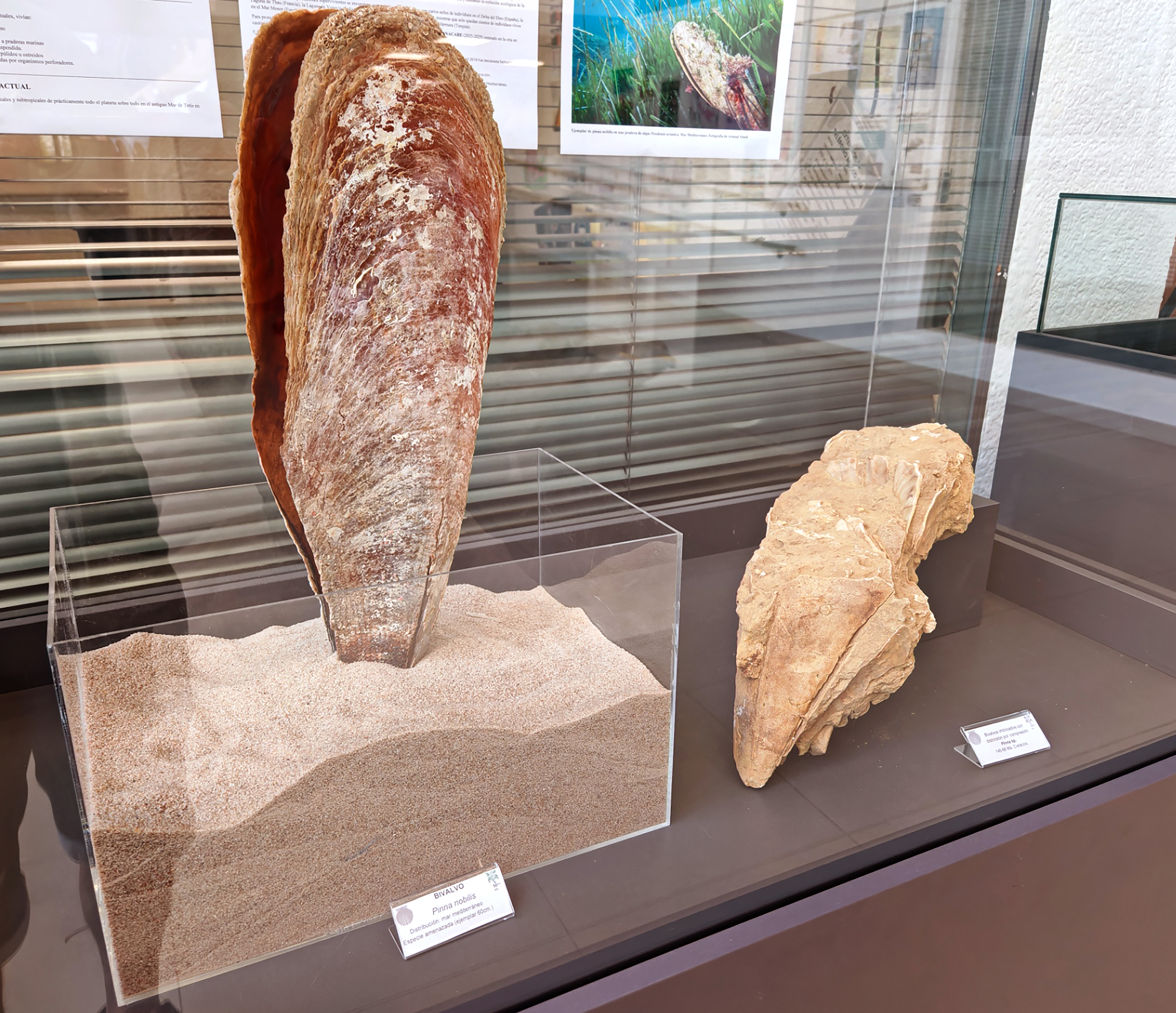
If we could observe a Neogene seafloor millions of years ago, the scene would feel surprisingly familiar: large wedge-shaped shells emerging from the sediment and silently filtering the water. These are Pinna, among the largest known bivalves and an extraordinary example of evolutionary continuity.
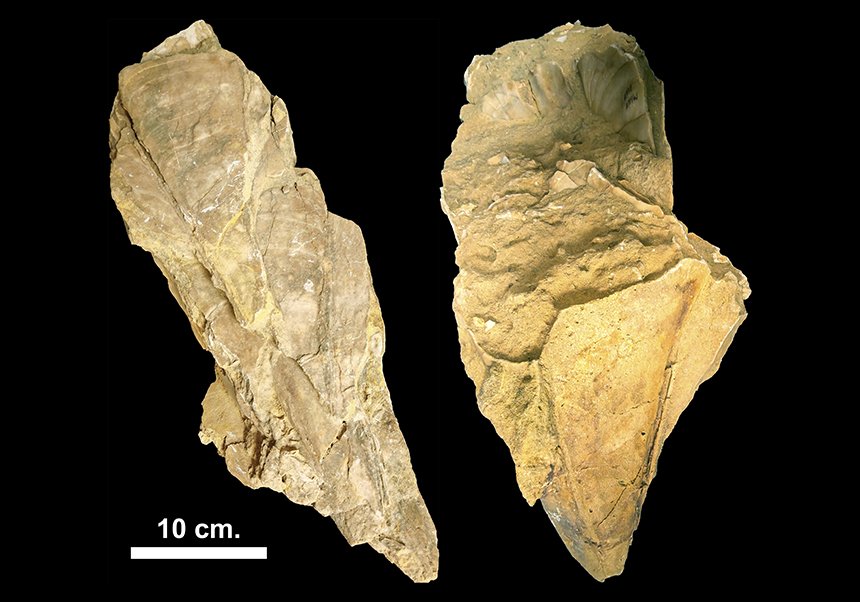
This genus has a fossil record dating back to the Permian, nearly 300 million years ago. The specimen displayed at MUVHN —a 45 cm matrix with multiple individuals— comes from the Neogene (23–3.6 million years ago). Its growth lines and apical end reveal how these organisms lived partially buried and anchored to the seabed using byssus threads.
Like their living relatives, they were filter feeders inhabiting shallow waters (1–50 m), on sandy or muddy bottoms often associated with seagrass meadows. Their shells were not only a “home” but also a substrate for other organisms, enhancing marine biodiversity.
Comparison with the living species Pinna nobilis (noble pen shell) shows a biological design that has remained largely unchanged for millions of years. This large Mediterranean bivalve can exceed one meter in length and plays an important role in water clarity.
However, this “living fossil” is now critically endangered. Since 2016, a mass mortality event caused mainly by the protozoan Haplosporidium pinnae has devastated over 99% of its populations.
Remarkably, its byssus threads gave rise to the famous “sea silk”, one of the most valuable textiles of antiquity.
A lineage that survived millions of years… now depends on our ability to protect it.
Images: