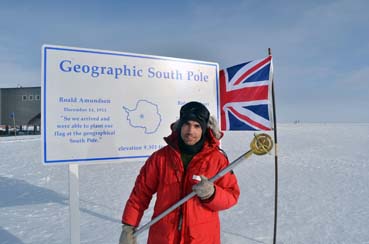
A conferencehe the physicist Carlos Pobes on the past year he spent at the South Pole to take care of the biggest neutrino telescope from Earth, IceCube, ends the First Week of Innovation at the University of Valencia. Pobes will speak this Friday, May 24, at 12:30 am in the Auditorium Marie Curie Science Park.
The First Week of Innovation, organized by the PCB and Càtedra of the Ciència Divulgació has been developed around five debates on innovation, and represents the threshold of the open house Expociencia Science Park this Saturday May 25. Pobes will experience 8 months isolated in Antarctica, in extreme cold and total darkness, Expociencia attendees.The conference is organized by the Institute of Corpuscular Physics (CSIC-UV).
The conference succeeds Carlos Pobes important announcement made last week by international collaboration IceCube experiment, which found the first evidence of very high energy neutrinos whose origin would be beyond our solar system.In the year that was cared Pobes neutrino telescope, consisting of 5,000 detectors in a cubic kilometer of Antarctic ice, IceCube detected several of the 28 neutrinos with energies much higher than the highest created in particle accelerators like the LHC.
According to scientists, these neutrinos originate in the Sun, the largest natural source of neutrinos known, nor are particles from cosmic rays (charged particles into the atmosphere). Its origin would be outside of our solar system, the first detection of neutrinos from astrophysical sources, so far unknown. The finding is important because it validates a new way to study the universe through this elementary particle: since hardly interact with matter and not affected by gravity, neutrinos would be valuable 'messengers' of highly energetic phenomena in the universe where produced in large quantities (supernovas, black holes, etc..).
The conference of Carlos Pobes will explain these results, as well as the configuration of the experiment and its objectives.Also, treat your personal experience after spending the Antarctic winter isolated Amundsen-Scott U.S. base, with temperatures below -70 ° C and in complete darkness for months.Pobes narrated this experience through a blog, 'The longest day of my life', which has received nearly 400,000 hits, and which won a prize in the Contest Disclosure III National Center for Particle Physics, Astroparticle and Nuclear (CPAN).Also participated in the previous edition of Expociencia via video live from Antarctica.
Pobes returned to Spain in January 2013, and currently has returned to research at the Institute of Materials Science of Aragón (CSIC-University of Zaragoza).The conference under the First Week of Innovation at the University of Valencia will be Friday May 24, at 12:30 pm in the Auditorium Marie Curie Science Park.The place and time are the same for Expociencia conference on Saturday May 25.
Last update: 22 de may de 2013 13:34.
News release