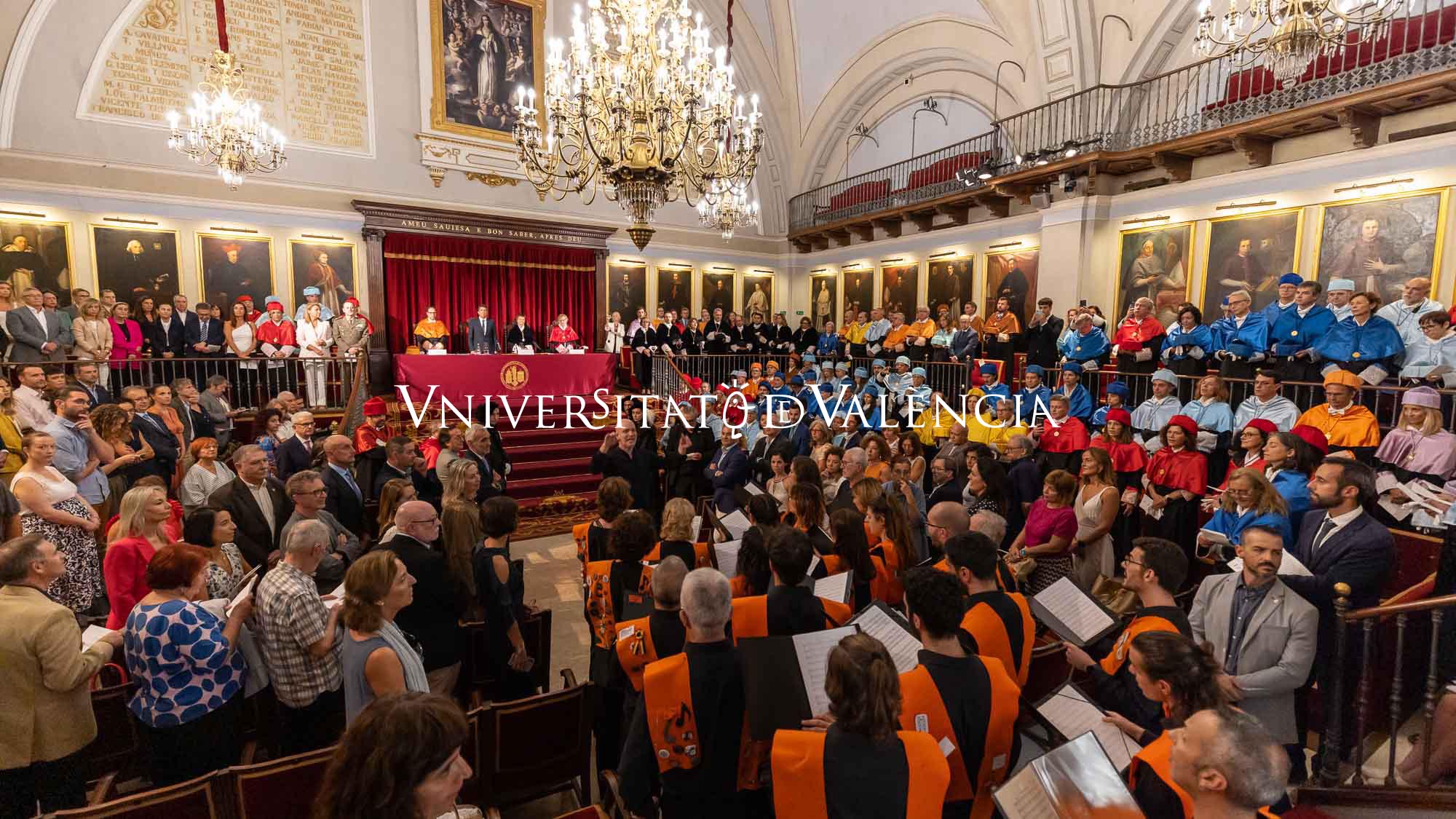
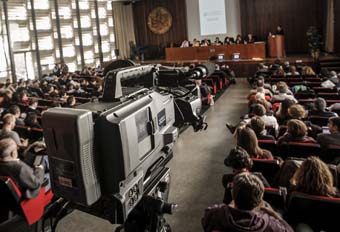
Principal Esteban Morcillo has reaffirmed this Thursday, before the Cloister of the University of València, the institution’s commitment with a “new model of public university” despite a “context of imposed governmental policies”. The principal has presented the management report for the year 2012, which has been approved by 90% of the vote. Esteban Morcillo has underlined that the University of València will make the maximum effort to avoid that a single student be excluded from studies for economical causes. The session has been broadcast live on MediaUni.
At the presentation of the report, Esteban Morcillo has appreciated “the commitment and work from all the people that make possible day after day the teaching and training activities, in search and transfer of knowledge, culture of the University of Valencia”. In the principal’s words, “a clear example of the institution’s commitment with public services and a public university model that we have built together since the recovery of democracy.
The full report on management can be read using the following link:
http://www.uv.es/~sgeneral/Claustre/Doc/Informe_Gestio_2012.pdf
The principal has affirmed that universities are at a crossroads, due to, on one hand, the education reform from the Ministry, and on the other, due to the financial angst that universities are suffering. Esteban Morcillo has remarked that the regional government owes 88 millions to the University (without accounting for the 245.2 millions of old debt). Because of this, the institution, coordinated with other Valencian universities, studies the possibility of claiming this “recent debt” in the courts. Without this part of the debt, the institution will not be able to pay the June extra salary to its staff.
Despite all this, according to the data on the management report 2012, the University of Valencia will continue to defend a Valencian public university system, both undergraduate and postgraduate. It keeps excellent positions in the main international rankings of research, an area where it excels for capturing foreign funds. It is also Europe’s second university in receiving Erasmus students.
Esteban Morcillo has highlighted, among other aspects of the report, the effort of laboral insertion of the students of the University.
In the open turn for speaking, members of the cloister, such as student Dídac Delcan (A Contracorrent) has demanded that cuts do not affect the quality of teaching and that nobody has to give up their studies for economical reasons. Miquel Coll, union representative of the service staff (PAS), has requested more information on the serious economical situation of the institution. José Miguel Gallego, from CGT, has pointed out the lack of autocriticism in the principal’s report, and has detailed the different problems in management. Laura Peris (BEA) has requested information on the process of evaluation on teaching staff, and has requested more classes in Valencian and more resources for scholarships.
The principal has replied each one of the questions and has used his final intervention to underline that the University of València will make its greatest effort to avoid that a single student be excluded from studies for economical causes. He has also reiterated the defense on equality in access to superior education.
Against experts' report
At another point, the Senate of the University of Valencia has approved a highly critical document of the report commissioned from an expert panel by the Minister Juan Ignacio Wert. The University asserts that the experts' report "ignores the financial strangulation of public universities." University's response to the position of experts has been defended by the delegate of the principal for Students, Daniel Gonzalez Serisola.
The University criticizes both the process and the content of the expert report, which has been accused of biased position of reality and context in which the university system in Spain develops . The model proposed by the experts, in the opinion of the Faculty, attacks the constitutional principle of university autonomy.
Jose Adolfo de Azcarraga, a member of the Senate of the University and one of the experts appointed by the Minister Wert for preparing the report, has intervened to defend the text of which he has been co-author. Azcarraga regretted that the University is not invited to explain the contents of the report of experts in different forums. It has been rejected a document with unconstitutional proposals, and has refused to contempt for the students.
Furio Antoni, meanwhile, has criticized the rector election system or the role reserved to the Senate, referred to in the report Wert. But mostly, he said that the University can not simply report the simple disqualification, or can stay either into complacency, not engage in a further discussion of the necessary university reform.
Carles Padilla, Dean of the Faculty of Philology, Translation and Communication, has detailed the genesis of the document now approved by the Senate, which includes contributions from different voices of the University, developed over two months.
Vicent Soler, dean of the Faculty of Economics, has been favorable to changes in the public university system, since it has rejected any "complacency" but has claimed modifications to improve, not to go backwards.
Ernest Cano, dean of the Faculty of Social Sciences, has warned that the document approved by the Senate is not a counter-report. Cano has denied that the proposals of the experts are a good starting point to begin debating the reform of higher education.
Ramon Lopez, meanwhile, defended the position of the Senate, and has made a defense of a university that works for equality and participation of all, although this is not picked up after the rankings.
Students Laia Mas (BEA), Sergi Garrido (SEPC), Jordi Caparros (BEA) and Laura Martin (A Contracorrent) have criticized various aspects of the report Wert, especially the position intended for the student representatives on governing bodies or the scholarship system and attempts to privatize the university system.
The position adopted by the Senate (by a very large majority) is available at:
http://www.uv.es/ ~ sgeneral / Claustre / Doc / Proposta_Claustre.pdf
Operational Plan
The highest body of the University has also approved the 2014 Operating Plan. The document was presented by the Vice Principal of Finance, Maximo Ferrando, who summarized the socio-economic scenario and prospects for the University of Valencia. Ferrando has indicated that the future is financial uncertainty, complicating estimates of the institution. Even so, according to his calculations, if the Government (or the central government by FLA) new debt liquidated (88 million), still putting off old debt (245.2 million) the University of Valencia have enough cash margin to cope with the planned expenditure in 2013.
Maximo Ferrando has announced a restrictive budget for 2014, for the sixth consecutive year.
The full document, which has been approved, is available at:
http://www.uv.es/ ~ sgeneral/Claustre/Doc/Informe_Gestio_2012.pdf
Last update: 24 de may de 2013 08:00.
News release