

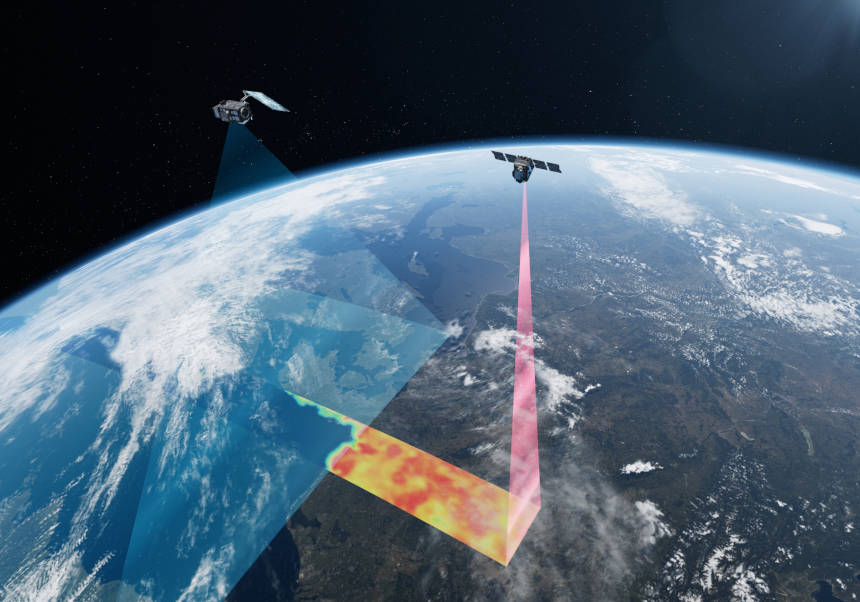
The European Space Agency (ESA) will launch the FLuorescence EXplorer (FLEX) satellite on the night of 14–15 September, bringing to fruition more than two decades of scientific and technological development led by José Moreno, professor of Earth Physics at the University of Valencia (UV). That night, the UV’s ADEIT Foundation will host the event in which the scientific community will be able to follow live the deployment into orbit of a mission that opens a new window onto the study of how vegetation functions and responds to climate change.
The FLEX satellite mission, which will provide unprecedented global observations of vegetation dynamics over the next four years, will be launched from the European spaceport in Kourou, French Guiana, at 22:21 local time (03:21 in Spain) on 15 September. The launch can also be followed live via the University of Valencia website that will link to the ESA’s stream.
As José Moreno, the mission’s principal investigator and chair of its international scientific committee, explains: “Satellite remote-sensing techniques have been used for decades to study the dynamics of our planet on a global scale and, in particular, the dynamics of terrestrial vegetation and its regulatory role in climatic, environmental and even socioeconomic processes. However, until now, the information provided has essentially indicated the spatial structure and changing colour of vegetation. With FLEX, we will be able, for the first time, to go further, because its measurements of fluorescence will provide direct information on the internal processes that regulate vegetation dynamics, quantifying photosynthetic activity, the capacity to assimilate atmospheric carbon, and the ability to adapt to environmental stress and climate variability across the planet. The launch of FLEX represents a qualitative leap forward in Earth observation capabilities for the coming years”.
FLEX in tandem with Sentinel-3
FLEX will operate in tandem with the European Sentinel-3 satellite. While FLEX will provide detailed measurements of vegetation fluorescence on a global scale, Sentinel-3 will supply complementary information on vegetation and the state of the atmosphere and land surface. Combining these observations will enable scientists to study the fluorescence signal within a broader context.
Both satellites will be launched aboard the European Vega-C rocket and will subsequently be placed into their respective orbits.
The operation will be supported by researchers who have contributed to FLEX. A commemorative evening hosted by the ADEIT Foundation will bring together members of the international scientific community, representatives of the ESA and partners from the European space sector. The event will be chaired by the mission’s scientific leader, José Moreno, director of the University of Valencia’s Earth Observation Laboratory (LEO). FLEX is the eighth mission in the ESA’s Earth Explorer programme and will open a new window onto the observation of terrestrial vegetation, which is crucial to research into climate change and the future of agriculture and forests.
Photosynthesis: the source of life on Earth
FLEX will measure from space the faint fluorescence emitted by plants during photosynthesis, on which life on Earth depends, as it underpins plant growth and terrestrial carbon uptake. Its role is therefore fundamental to the carbon cycle and our planet’s climate. Photosynthetic activity is highly dynamic and can be significantly reduced during periods of drought, heatwaves and environmental stress. However, variations in fluorescence can quantify these effects even before observable changes in vegetation greenness or structure become apparent, providing an early-warning mechanism for extreme weather events.
FLEX’s objective will therefore be to observe solar-induced fluorescence (SIF), a very faint light signal naturally emitted by chlorophyll after plants absorb sunlight. This fluorescence contains information about how vegetation processes the solar energy it absorbs, providing a new way of investigating changes in plant functioning, productivity and responses to environmental stress.
With a spatial resolution of approximately 300 × 300 m, FLEX will be the first satellite mission dedicated to providing global measurements across the full emission spectrum of vegetation fluorescence. This spectral information will enable scientists to investigate photosynthetic processes in considerably greater detail than has previously been possible from space.
One of the main scientific objectives is to gain a better understanding of how vegetation responds to extreme environmental events, such as droughts and heatwaves, and whether changes in fluorescence can reveal physiological stress before its effects become clearly visible through conventional satellite observations.
The findings will contribute to research into climate change, as well as to the management of agriculture — with the aim of providing real solutions to hunger around the world — and of forests and woodland.
Scientific leadership from the University of Valencia
Professor José Moreno, a researcher at the Image Processing Laboratory (IPL) of the University of Valencia, has been one of the leading scientific figures behind the mission. Under his leadership, the LEO group has played a fundamental role in the scientific conception and development of FLEX, working closely with the ESA and the international scientific community to turn an ambitious research concept into a satellite mission ready for launch.
Throughout the various stages of FLEX’s preparation, the LEO group has led several ESA-funded projects, including the development of the FLEX-E scientific simulator, coordinated by Antonio Ruiz-Verdú, a researcher at the IPL. The simulator has made it possible to evaluate the technical solutions adopted for FLEX and the algorithms used to generate FLEX’s novel products in the fields of photosynthesis, the carbon cycle and climate change.
These new data-processing algorithms and approaches to interpreting vegetation behaviour based on Earth-observation imagery are being developed within the LEO group as part of two leading research strands funded by prestigious European Research Council (ERC) grants. These are led by IPL researchers Jochem Verrelst (Starting Grant SENTIFLEX and Consolidator Grant FLEXINEL) and Shari Van Wittenberghe (Starting Grant PHOTOFLUX).
The LEO group also takes an active part in field campaigns to calibrate and validate FLEX products, both before and after launch. These campaigns are funded through several national projects, including SPAFLEX, coordinated by researcher Mª Pilar Cendrero.
Links:
